Reflective Gear on a Grey Day
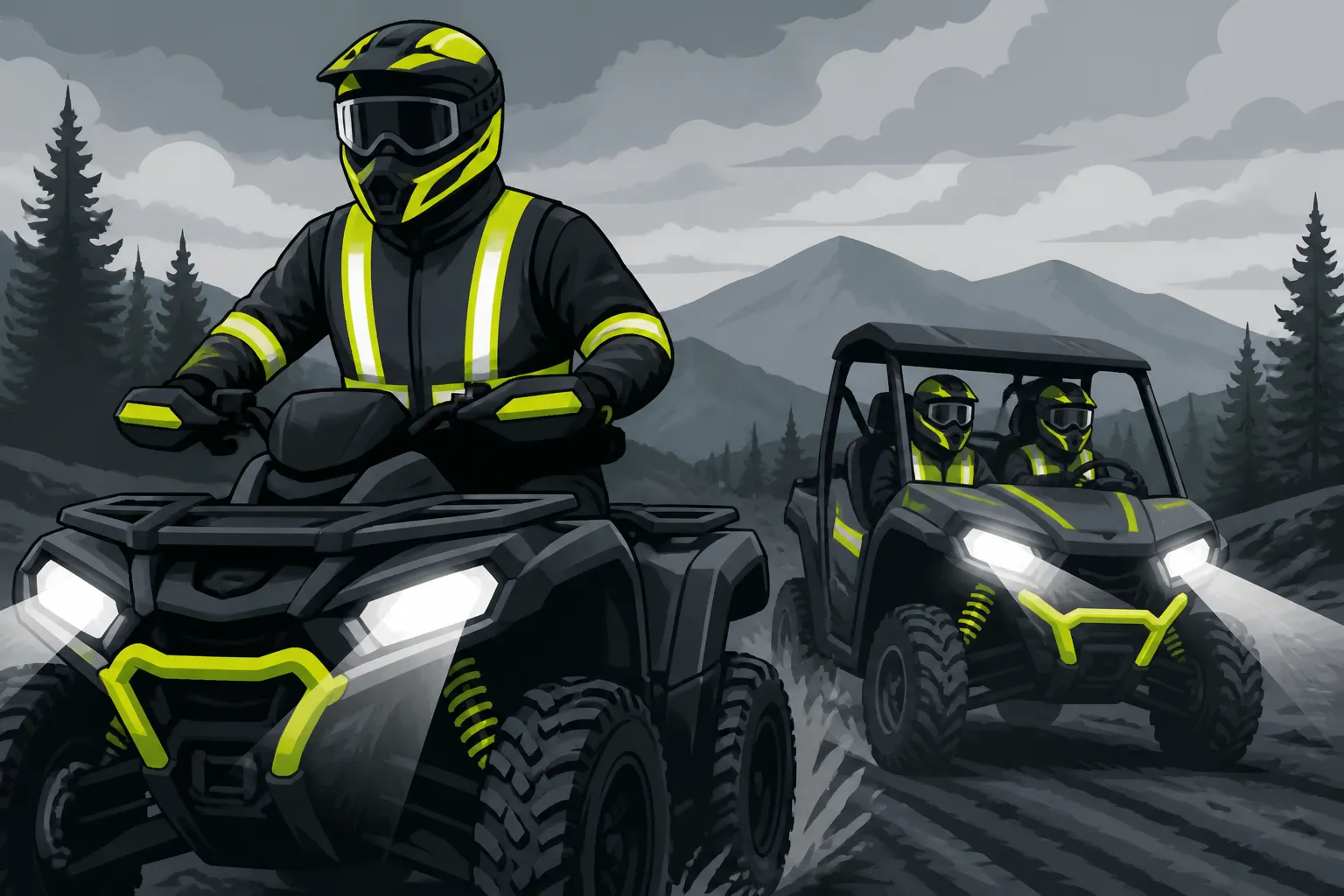
A grey Alberta day can flatten the trail into a blur of wet gravel, low cloud and dark trees, making riders harder to spot even when their machines are running. Reflective gear can help other trail users and drivers notice you sooner, but it works best alongside clean lights, sensible riding choices and a clear understanding of where an ATV or UTV may legally travel.
Why reflective gear matters on a grey Alberta ride
Grey light makes it harder to judge distance
Overcast skies reduce contrast. A dark jacket against wet pavement, spruce trees or a shadowed ditch can blend into the background, and a driver may notice a rider later than expected. Rain, mist and road spray can make the problem worse by softening outlines and obscuring details.
Reflective material helps by bouncing light from a source, such as vehicle headlights, back toward that source. Fluorescent colours, including bright yellow or orange, serve a different purpose: they stand out in daylight and dull weather, but they do not create the same nighttime reflection effect. For a day that may stretch into dusk, having both high-visibility colour and retroreflective details can be more useful than relying on either alone.
Visibility is especially important where trails and roads meet. A rider coming out of a wooded trail near Rocky Mountain House, for example, may be difficult to pick out against a grey road shoulder. Reflective details on the rider’s arms, legs or torso can help show that a moving person is there, rather than presenting only the dark shape of a machine.
Reflective clothing is only one part of being seen
Think of visibility as a set of layers: your clothing, the machine’s required lights, the way you position yourself, and the choices you make about speed and route. A reflective vest can help another person see you, but it cannot make an illegal road route legal or compensate for an unlit machine.
Before heading out, review the rules that apply to your kind of ride. [Alberta Equipment Required on Public Land] and [Alberta Lighting Rules on Public Land] are useful starting points for understanding equipment expectations. If your route includes a road or right-of-way, local permissions and bylaws matter too; [Alberta ATV Road Rules: Bylaws Decide] explains why a road that looks accessible may not be open to OHVs.
A simple rule of thumb: if you cannot clearly see the trail edge, another rider, or a vehicle approaching from a safe distance, slow down and increase space. Visibility gear can improve the chance you are noticed, but it cannot guarantee another person will see you or react in time.
Choosing reflective gear that works
Use visible colour and reflection together
For daytime rides in cloud, rain or fog, start with a jacket, vest or pack cover in a bright colour that contrasts with the surroundings. Reflective strips add a second layer when headlights or work lights hit them. If you often ride into evening, choose gear with reflective details on more than one side rather than a single small strip on the back.
A practical setup might include a high-visibility outer layer, reflective patches on the front and back of the torso, and strips on the arms or lower legs. The moving parts of your body can help signal that you are a person, not a stationary object. Keep visibility features where they can be seen; a strip hidden under a backpack strap or covered by a muddy jacket is not doing much.
| Riding condition | Useful visibility choice | What to check |
|---|---|---|
| Overcast daylight | Bright, contrasting outer layer | Can you be distinguished from trees, gravel and wet ground? |
| Rain or mist | Bright layer plus reflective details | Are the reflective areas clean and uncovered? |
| Dusk or early morning | Reflective material on front, sides and back | Will approaching lights reach the material? |
| Muddy trail | Washable outer layer and machine lights | Is mud covering reflective areas, lamps or lenses? |
| Road crossing or legal roadway use | High-visibility clothing and required equipment | Is the route actually open to OHVs under local rules? |
Bright colour does not replace reflective material, and reflective material does not replace bright colour. If you are buying add-on gear through a powersports retailer such as SuperATV, check the product description carefully rather than assuming an accessory is reflective or designed for clothing visibility. The material, placement and intended use matter more than the retailer name.
Make your gear visible from more than one direction
A rider can be approaching, turning, stopped at a junction or viewed from the side. Reflective details on the front, back and sides help account for those changing angles. On a UTV, reflective elements on the occupants may be more visible than small stickers placed low on a dusty body panel.
Do not cover helmet vents, safety labels, eye protection, lights or other equipment with tape or fabric. If you add reflective tape to a machine, keep it clear of lamps, reflectors, moving parts and surfaces that become hot. Use material intended for the surface and follow the machine or gear manufacturer’s instructions. An improvised attachment that peels off, blocks a light or distracts the operator can create a new problem.
If comparing machine accessories from suppliers such as SuperATV, confirm what the item is made for and whether the manufacturer identifies it as reflective. A decorative graphic may look bright in a shop and still provide little help when headlights strike it in low light. For rider clothing, choose garments designed to be worn comfortably over the layers you actually use on an Alberta ride.
Prepare your ATV or UTV for low visibility
Keep required lights clean and working
Mud, dust and road spray can quickly coat a headlight or taillight. Before leaving the staging area, check that lamps are working and wipe away grime that could reduce their output. Repeat the check after a muddy section or a long stretch behind another machine. For a more detailed look at dusk riding, see [Lights On at Dusk].
A light that is switched on but covered in mud is not useful. Check both the lens and the area around it, and make sure gear or cargo is not blocking the light. If a lamp is damaged or a bulb has failed, address that before continuing where the rules require the equipment to work. Reflective clothing is a backup visibility measure, not a substitute for required head and tail lights.
Consider the difference between being seen and seeing the trail. A headlight may make your machine more noticeable to others, but it does not mean you should maintain daytime speed in fog, heavy rain or fading light. Slow down enough to stop within the distance you can see clearly, especially around bends, trail junctions and parked vehicles.
Keep your route legal and predictable
Grey weather can make a roadside shoulder or ditch look like a convenient place to ride, but appearance is not permission. Alberta’s rules depend on the type of land and the applicable local authorization. [Alberta Ditch Riding Is Not Automatic] and [Alberta Bylaws That Open a Right-of-Way] are useful reminders to check before treating a ditch or road corridor as a route.
If a county road is part of your plan, check the specific local rules rather than assuming one county’s approach applies everywhere. [Alberta Rules for Riding a County Road] covers that distinction. A reflective vest may help other road users see you, but it does not change whether the road is open to OHVs or whether you are allowed to use it.
When a route is legally open, ride in a predictable way. Avoid sudden turns, stop where you can be seen, and leave room between machines so one rider’s spray or dust does not hide the next. If visibility deteriorates, regroup in a safe, permitted location rather than stopping around a blind corner or at the edge of a traffic lane.
A simple visibility routine before you ride
Check clothing and machine before leaving
Make visibility part of the same pre-ride routine as fuel, tires and tie-downs. Put on your outer layer, then check that reflective areas are not hidden by a backpack, chest protector or hydration pack. If you are riding with a group, take a moment to look at each other from the front, side and rear; it is easier to spot a blocked strip or dark outer layer before the ride begins.
On the machine, test the required lights and clean the lenses. Check that racks, cargo and accessories are not obscuring them. If you have added an aftermarket item sourced through a supplier such as SuperATV, make sure it is securely fitted and does not block a lamp or interfere with the machine’s normal controls. Do not assume that adding an accessory changes the legal equipment requirements.
A useful pre-ride checklist:
- Put on a bright outer layer suited to the weather.
- Confirm reflective areas are visible from the front, sides and back.
- Check that your helmet, eye protection and other safety equipment remain unobstructed.
- Turn on and inspect the machine’s required lights.
- Wipe mud, dust or water from lenses and reflective surfaces.
- Confirm your route is open to OHVs and that any road use is permitted.
- Reduce speed if fog, rain, fading light or spray limits what you can see.
Adjust when conditions change
A grey morning can turn into a wet afternoon, and a ride that begins in daylight may continue into dusk. Reassess visibility when the weather changes, when you enter a forested section, or when trail spray starts to collect on your clothing and machine. If a group member becomes difficult to see, that is a practical signal to pause, clean gear or adjust spacing.
For multi-machine rides, agree on simple group habits before starting. Keep enough distance to avoid riding in another machine’s spray, use clear hand signals where appropriate, and choose regrouping spots that are visible and safely away from traffic. Riders should not assume that a person behind them can see through a cloud of mud just because the machines are close together.
Finally, reflective gear is most useful when it remains clean, correctly positioned and appropriate to the conditions. It improves contrast; it does not replace working lights, cautious speed, local rule checks or sound judgment. On a grey Alberta day, combining those measures makes it easier for others to notice you and gives you more time to respond when the trail or road gets busy.
Disclaimer
This article is for general informational purposes only and does not constitute professional advice. Laws, prices and regulations vary by location and change over time. Consult a qualified professional for guidance on your specific situation.