Why the Legal Definition of Highway Includes the Ditch
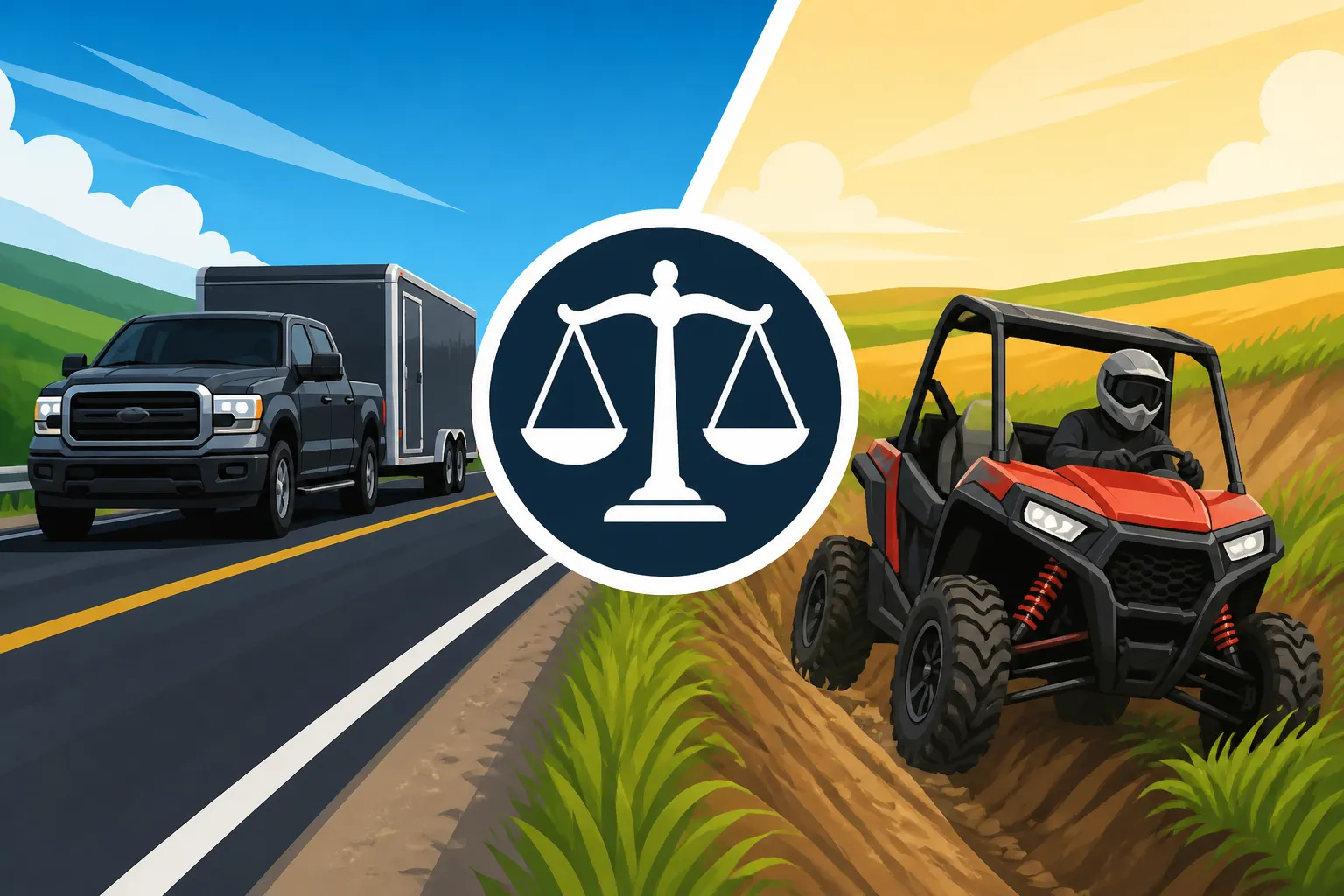
It's a common scenario: you're out riding your quad or side-by-side in Alberta, enjoying the wide-open spaces, and you see a seemingly harmless ditch running alongside a road. You might think, "Perfect, a quick shortcut, or a nice gentle ride away from traffic!" But here's the kicker that catches many riders off guard: in Alberta, that ditch is legally considered part of the highway, and riding it often comes with the same rules and regulations as riding on the paved road itself. This guide is here to unravel the legal complexities of Alberta's "highway" definition, especially as it pertains to OHV riders, so you can avoid tickets and ride with confidence.
The Alberta Traffic Safety Act and "Highway"
When you think of a "highway," your mind probably conjures images of multi-lane asphalt, painted lines, and speed limits. For many, the idea that a muddy, grassy ditch running alongside it could be considered the same thing is baffling, maybe even a little absurd. But the legal definition, particularly within Alberta's Traffic Safety Act, is far more expansive than most people realize.
More Than Just Pavement
The core issue here is that the word "highway" in the eyes of the law isn't just about the paved or graveled surface where vehicles typically travel. It's a much broader term designed to encompass the entire right-of-way, ensuring consistent rules and safety standards across all areas that are publicly accessible and intended for travel. This is why when an officer pulls you over on the shoulder, they're not asking if you were "on the highway" just then, because the shoulder is the highway.
This comprehensive definition serves a crucial purpose: preventing ambiguity. If the legal "highway" only included the paved surface, then areas like shoulders, medians, or ditches could become grey zones where traffic laws might not apply, leading to chaos and dangerous situations. By casting a wide net, the law ensures that safety regulations, right-of-way rules, and equipment requirements apply consistently across the entire public road corridor. It includes everything from the fence line on one side to the fence line on the other, encompassing all the space dedicated to public travel and its associated infrastructure.
The Ditch: An Extension of the Highway
So, how does the ditch fit into all of this? Under the Traffic Safety Act, a "highway" is defined as any road, street, trail, avenue, parkway, or place prepared for or used by the public for the passage of vehicles. Crucially, this also includes any land lying between the boundaries of a highway. The ditch, often seen as a separate, natural feature, falls squarely within this "land lying between the boundaries." It's not just a place for water drainage; it's an integral part of the highway's infrastructure, designed to manage water flow away from the road surface, support the roadbed, and sometimes provide space for utilities.
Think of it this way: the ditch isn't just "beside" the highway; it's an extension of it. It's part of the designated public right-of-way that the municipality or province maintains. This means that if you're riding your OHV in a ditch, you're not riding on some unregulated patch of wilderness; you're riding on what the law considers part of the public road. This distinction is critical because it means all the rules that apply to vehicles on the road surface—like having proper [Alberta Requires Insurance on Public Land], being [Alberta OHV Registration Cost] compliant, and adhering to [Alberta's Minimum Age of 14 on Public Land] for riders—apply equally to you in that ditch. Ignoring this can lead to some pretty uncomfortable conversations with law enforcement.
Why Does This Matter for OHV Riders in Alberta?
For ATV and UTV enthusiasts, understanding this broad definition of "highway" isn't just academic; it directly impacts where, when, and how you can ride. Many riders mistakenly believe that as long as they're not on the paved surface, they're "off-road" and thus exempt from certain regulations. This misunderstanding can quickly lead to fines, vehicle seizure, and even serious accidents.
The Legal Implications of "Highway" Status
The moment your wheels touch a surface legally defined as a "highway" – even a ditch – you are no longer just an "off-road" vehicle in the traditional sense. You become subject to the rules of the road. This means a whole host of regulations kick in:
- Registration: Your OHV needs to be registered with the province. Just like a car, it needs a valid registration certificate and a visible plate. You can find more details on [Alberta Issues a Plate, Not a Sticker] and [Alberta's Class 3 Off-Highway Vehicle Registration].
- Insurance: Operating an OHV on any part of a "highway," including the ditch, requires you to have valid third-party liability insurance. This isn't just a good idea; it's a legal requirement to protect you and others in case of an incident. Not having it can lead to [Alberta Vehicle Seizure for No Insurance].
- Helmet Laws: While helmets are always a smart choice for safety, they become mandatory when operating on public land, which includes those highway ditches. [Alberta Helmet Law on Public Land] has been in effect since May 2017.
- Age Restrictions: Riders must meet minimum age requirements, typically 14 years old for unsupervised riding on public land. [Alberta Rules for a 14-Year-Old Rider] are very specific, and younger riders require [Alberta Adult Supervision at 18].
- Equipment: Your machine must meet certain equipment standards, such as having [Alberta Requires Working Head and Tail Lights] and [Alberta Requires a Spark Arrestor]. Modified exhausts, for example, are generally [Alberta Bans Modified Exhausts] on public land.
- Licensing: While you don't need a specific OHV license, if you're operating on a highway (even the ditch), you typically need to possess a valid driver's license for a conventional vehicle.
The penalties for non-compliance are not minor. Operating an unregistered or uninsured OHV on a highway can result in significant fines and even impoundment of your machine. It's crucial to treat highway ditches with the same respect for the law as you would the paved road.
Common Misconceptions and Dangerous Assumptions
Many riders cling to a few persistent misconceptions when it comes to ditch riding:
- "It's rural, so the rules don't apply": This is a dangerous assumption. The definition of "highway" applies uniformly across Alberta, whether you're in a bustling urban centre or a remote gravel road in a county. A ditch in the County of Wetaskiwin is subject to the same provincial definition as one in the city of Calgary. The only variation comes from local bylaws, which we'll discuss later.
- "The ditch isn't maintained, so it's not a road": While ditches aren't usually graded for vehicle traffic, they are still part of the public right-of-way and are actively managed for drainage and utilities. Their condition doesn't change their legal status.
- "I'm just quickly getting from point A to point B": Even a short hop down a ditch is an infraction if you're not legally permitted to be there. The intent doesn't negate the violation. An officer isn't going to give you a pass because you were "just trying to get across."
- "Everyone else does it": This is perhaps the most common, and riskiest, assumption. Just because you see other riders in ditches doesn't mean it's legal or safe. It often means they're also unaware of the law or taking a calculated risk. Don't base your riding decisions on the actions of others who might be breaking the rules.
These assumptions often stem from a lack of awareness about the intricacies of the Traffic Safety Act. They can lead to avoidable fines, insurance headaches, and even serious accidents. The bottom line is: if you're in a highway ditch, you're on public land that's part of the "highway," and you need to be compliant.
Navigating Ditch Riding Legally and Safely
So, if ditches are generally off-limits, does that mean you can never ride them? Not entirely. There are very specific, narrow circumstances where OHV use in highway ditches is permitted, but these are exceptions to the rule and come with strict conditions.
When Ditch Riding Is Permitted (and under what conditions)
Alberta's Traffic Safety Act and Off-Highway Vehicle Regulation 319/2002 allow for very limited OHV use in highway ditches, primarily for practical purposes related to property access or crossing. These are not invitations for recreational ditch riding.
Generally, you may ride an OHV in a highway ditch only under these conditions:
- Crossing a Highway: You can cross a highway (including its ditches) at right angles to enter or exit private property or a trail, provided you yield to all traffic and ensure the crossing is safe. This means going straight across, not riding down the ditch parallel to the road.
- Entering or Exiting Property: You can use the ditch to directly enter or exit land adjacent to the highway, such as your private property or a designated staging area. Again, this is about access, not travel.
- Specific Bylaws: Some municipal districts or counties have passed bylaws that specifically open certain highway ditches or road allowances for OHV use. This is rare and usually applies to very specific, designated routes. You must verify these bylaws for the exact area you plan to ride in. For example, [Alberta Bylaws That Open a Right-of-Way] would be the specific permission needed.
- Farm Operations: Farmers and ranchers may have specific exemptions for using OHVs on road allowances and ditches adjacent to their land for agricultural purposes, but this is strictly for work, not recreation. [Alberta Farmer-Owned Machines on Private Land] often have different rules.
When these limited permissions apply, you must still adhere to all other OHV regulations, including having your [Alberta OHV Registration Paperwork Checklist] complete, carrying [Alberta Proof of Insurance on Demand], wearing a helmet, and ensuring your lights are on if visibility is poor or it's dusk/night.
Staying Compliant: What You Need to Know
To avoid fines and ensure you're riding legally, here’s a quick rundown of what you absolutely need to have squared away:
- Registration: Your OHV must be registered. This involves a one-time registration and then renewals, typically for [Alberta Registration Terms of One or Two Years]. Make sure you have your [Printing a Certificate Before You Ride] so you can show it to an officer.
- Insurance: Third-party liability insurance is mandatory for public land use, which includes ditches. Even if you only ride private land, if you ever plan to touch a public road allowance, you need it. Check out [Alberta Insurance Requirements on Public Land].
- Helmet: A CSA-approved helmet is required for all riders and passengers on public land. No exceptions for comfort or style. [Alberta CSA Helmet Standards] are what you need to look for.
- Age and Supervision: Understand the rules for young riders. A 12-year-old can ride a youth quad under [Alberta Rules for a 12-Year-Old Rider] but only with close adult supervision.
- Equipment: Ensure your machine is in good working order. That includes [Alberta Requires Working Head and Tail Lights], a functioning [Alberta Requires a Spark Arrestor], and a muffler that hasn't been modified to be excessively loud. [Why a Modified Muffler Can Cost You a Ticket] is something to be aware of.
- Proof of Documents: Always carry proof of your registration and insurance when you ride. An officer can ask to see it at any time. [What an Alberta Officer Can Ask to See] includes these vital documents.
Riding unregistered or without insurance can lead to severe penalties, including steep fines and even the seizure of your machine. It’s simply not worth the risk. Always be prepared to present your papers, and if you're riding a long distance, know that [Carrying Papers on a Long Alberta Ride] is just part of responsible riding.
Understanding Local Bylaws and Designated Routes
While the provincial definition of "highway" broadly includes ditches, individual municipalities (counties, municipal districts, towns, and villages) have the power to create their own bylaws that can either restrict or, in rare cases, permit OHV use on specific roads or road allowances within their jurisdiction. This is where it gets a little nuanced.
The Role of Municipalities in Ditch Access
The provincial government sets the baseline rules, but local councils can adapt them to suit their unique community needs. This means that a ditch that is perfectly legal to ride in one county due to a specific bylaw might be strictly prohibited just across the municipal boundary in another. It's a patchwork, and it's up to you as the rider to know the local rules.
These local bylaws typically fall into two categories:
- Restrictive Bylaws: Many municipalities choose to completely prohibit OHV use on any part of the highway within their boundaries, including ditches, to reduce noise complaints, minimize environmental impact, or enhance public safety. Towns like Canmore or Banff, for example, have very strict rules.
- Permissive Bylaws: Less commonly, some rural counties, often those with large agricultural or recreational populations, might pass bylaws that designate specific road allowances or ditch lines as permissible for OHV use, usually with caveats such as speed limits, time of day restrictions, or specific equipment requirements. These bylaws are usually very clear about which roads or ditches are open and under what circumstances. For example, [County of Wetaskiwin's OHV Bylaws in Alberta] or [Brazeau County's OHV Rules in Alberta] might have specific provisions.
The key takeaway here is that you cannot assume. Just because a ditch looks rideable, or because you've ridden a similar ditch elsewhere, doesn't mean it's legal. You have to do your homework and check the specific bylaws for the area you're in. This information is usually available on the municipal district or county's official website.
Finding Legal Places to Ride
Given the strict provincial definition and the varying local bylaws, the safest and most reliable approach to OHV riding in Alberta is to stick to designated OHV areas and official trails. These areas are specifically managed for off-highway vehicle recreation and come with clear guidelines.
Alberta boasts some fantastic [Alberta OHV Trails: Riding Public Land] that are designed for riders. Places like [McLean Creek: Alberta's Best Known OHV Area] in the Kananaskis, or the Ghost Public Land Use Zone, offer extensive trail networks where you can ride freely (within the established rules, of course).
Here's why focusing on designated areas makes sense:
- Clarity: The rules for these zones are usually well-published and clear, reducing guesswork.
- Legality: You know you're riding legally, as these areas are specifically allocated for OHV use.
- Safety: These areas are often designed with safety in mind, with maintained trails and clear signage.
- Community: You're more likely to encounter other riders and benefit from the community and infrastructure (like staging areas) that support OHV recreation.
Before you head out, always consult official sources for trail maps and current regulations. Resources like Alberta Environment and Parks websites for Public Land Use Zones (PLUZ) are invaluable. Don't rely on word-of-mouth for legal information. Riding responsibly means understanding where you can and cannot go, and knowing that the simple ditch beside the road often comes with rules that are just as strict as the road itself.
Here's a quick comparison to help solidify the difference:
| Feature | Highway Ditch Riding (General Rule) | Designated OHV Trail Riding (e.g., PLUZ) |
|---|---|---|
| Legal Status | Generally Prohibited (part of "highway" definition) | Generally Permitted (specifically allocated for OHV use) |
| Registration | Required | Required |
| Insurance | Required (third-party liability) | Required (third-party liability) |
| Helmet | Mandatory (CSA-approved) | Mandatory (CSA-approved) |
| Age/Supervision | Strict adherence to provincial age/supervision rules | Strict adherence to provincial age/supervision rules |
| Equipment | Must meet provincial standards (lights, spark arrestor, muffler) | Must meet provincial standards |
| Local Bylaws | Crucially important to check; can prohibit or rarely permit | Generally consistent within the zone; check specific PLUZ rules |
| Recreational Purpose | Not intended for recreation; limited exceptions for access/crossing | Specifically intended for recreational OHV use |
| Risk of Fines/Seizure | High, if riding illegally | Low, if following zone-specific rules and provincial regulations |
| Public Lands Pass | Not required for riding itself, but needed for random camping in PLUZ | Not required for riding itself, but needed for [Alberta Public Lands Camping Pass] in designated areas |
Disclaimer
This article is for general informational purposes only and does not constitute professional advice. Laws, prices and regulations vary by location and change over time. Consult a qualified professional for guidance on your specific situation.