Carrying Proof of Residency
Riding your ATV or UTV through Alberta’s incredible landscapes is an experience like no other, but if you're not an Alberta resident, or even if you are, understanding and carrying proper documentation, especially proof of residency, can save you a lot of grief. Many riders, particularly those visiting from out of province, get caught off guard, assuming their home province’s registration is enough. This guide will walk you through why proof of residency matters, what documents you need, and how to keep them accessible to ensure your Alberta riding adventure stays smooth and stress-free.
Why Proof of Residency Matters for OHV Riders in Alberta
When you're out enjoying Alberta's extensive network of trails, public lands, and designated OHV areas, you're operating within a specific legal framework. This framework applies to both residents and visitors, but the rules for visitors often have an expiry date. Knowing where you stand concerning your residency status can be the difference between a pleasant encounter with an enforcement officer and a frustrating delay, or worse.
The "Visitor" Distinction and Your Responsibilities
If you’re visiting Alberta with your off-highway vehicle, you're generally allowed to ride on your home province's or state's registration for a limited time. This is a common courtesy between jurisdictions, allowing you to enjoy a quick trip without the immediate burden of re-registering your machine. However, this courtesy isn't indefinite. Alberta has specific rules about how long an out-of-province machine can operate here without being registered in Alberta. It’s critical for visiting riders to understand their responsibilities. An enforcement officer might ask for proof of your residency outside Alberta to confirm you are indeed a visitor and qualify for this temporary exemption. Without it, you could be viewed as an Alberta resident trying to avoid local registration rules. [Alberta Registration for Visiting Riders] covers some of these specifics in more detail, but the core idea is that you need to be able to demonstrate your status.
Imagine you've driven your truck and trailer all the way from British Columbia, excited for a week of riding in McLean Creek. You hit the trails, having a fantastic time, when you encounter an officer doing routine checks. They see your BC plate on your quad and ask for your ID. If your ID shows an Alberta address, or if you can't provide clear proof of your BC residency, you might find yourself in a sticky situation. The officer might question your visitor status, leading to further investigation and potential delays, even if you’re genuinely just visiting family.
Avoiding Misunderstandings with Enforcement
The goal of any interaction with law enforcement should be clarity and cooperation. By having your proof of residency readily available, you immediately provide the necessary information to confirm your status. This helps the officer do their job efficiently and helps you get back to your ride quickly. Without this proof, an officer might have to make assumptions or conduct additional checks, which can be time-consuming for everyone involved. They are simply trying to ensure that all riders are following the regulations designed to keep public lands safe and managed.
Think of it this way: you’ve invested time, money, and effort into your OHV hobby. The last thing you want is for a technicality like not having a utility bill on hand to derail your day. Officers are trained to verify information, and your ability to produce the requested documents promptly makes their job easier and reflects positively on you as a responsible rider. It demonstrates that you understand the rules and are prepared to comply with them. Clear, official documentation leaves little room for ambiguity, ensuring that you and the officer are on the same page from the outset.
The Implications of Overstaying Your Welcome
Alberta has a "30-day rule" for out-of-province machines. This means that if your OHV has been in Alberta for more than 30 consecutive days, you are generally required to register it in Alberta, regardless of its registration status elsewhere. This rule is particularly relevant for seasonal residents, students, or those on extended work contracts. Your proof of residency, or lack thereof, helps determine if you've crossed this threshold. [Alberta's 30-Day Rule for Out-of-Province Machines] delves into the specifics, but the gist is that if you intend to stay longer than a month, you need to be prepared to register your machine locally.
Let's say you're a college student from Saskatchewan, bringing your quad to Alberta for the school year. You might not realize that after 30 days, your Saskatchewan plate is no longer considered valid in Alberta. If you get stopped, and your only proof of residency is your Saskatchewan driver's license, an officer might start asking questions about how long you've been in the province. If you can't demonstrate that you're within the 30-day window or that you've since established Alberta residency and registered your machine, you could face penalties for operating an unregistered vehicle. This isn't about trapping visitors; it’s about ensuring that those who become longer-term residents contribute to the local system of registration and regulation.
What Documents Qualify as Proof of Residency
So, you understand why you need it, but what exactly counts as proof of residency in Alberta? It’s not just one single document, but rather a collection of official papers that, when viewed together, paint a clear picture of where you genuinely reside. Generally, these documents should show your name and a current physical address.
Government-Issued Identification
The most straightforward forms of proof of residency are typically government-issued documents that include your current address.
- Driver's License or Provincial ID Card: If you're an Alberta resident, your Alberta driver's license or provincial identification card is usually the primary and most accepted form of proof. It clearly states your address and is issued by the provincial government. For visitors, your out-of-province driver's license serves as proof of your home residency, indicating you are indeed a visitor to Alberta.
- Vehicle Registration: Your vehicle registration certificate for your truck or trailer, showing your name and current address, can also be used as supplementary proof. If it matches your driver's license, it strengthens your claim.
- Health Card (with address): While not all provincial health cards display an address, if yours does, it can be considered valid secondary proof. However, a driver's license is generally preferred due to its specific purpose as identification.
It’s important to note that if you’re a new resident to Alberta, you have a grace period to update your driver's license and vehicle registration. During this period, carrying your old out-of-province documents along with a new Alberta utility bill or lease agreement would be crucial to bridge that gap. This transitional period requires careful documentation.
Utility Bills and Financial Statements
Beyond government ID, official correspondence that establishes your presence at a given address is highly valuable. These documents typically need to be recent, usually within the last 90 days, to be considered current.
- Utility Bills: Bills for electricity, gas, water, or internet services are excellent forms of proof. They demonstrate ongoing service at a specific address in your name. A recent ATCO Gas, ENMAX, or Shaw Communications bill, for example, clearly ties you to an Alberta address.
- Bank Statements or Credit Card Statements: While some financial institutions are moving towards paperless statements, a printed statement from a recognized bank or credit card company, mailed to your physical address, serves as strong evidence. The address must be visible and match your other documents.
- Property Tax Assessments: If you own property, a recent property tax assessment from your municipality (e.g., City of Calgary, City of Edmonton) can serve as proof of residency. These are highly official documents that leave no doubt about your property ownership and address.
For those just moving to Alberta, or even for long-term visitors, having a utility bill in your name is often one of the first things you can acquire to establish local ties. When considering what documents to use, think about their official nature and how recently they were issued. Even for visitors, a recent bank statement showing transactions in your home province and mailed to your home address can support your claim of being from elsewhere.
Official Correspondence and Lease Agreements
Other types of official documents can also work, especially if you’re trying to establish new residency or are in a unique living situation.
- Residential Lease Agreement: If you rent, a signed lease agreement showing your name, the property address, and the lease term is excellent proof. This is particularly useful for new residents or long-term visitors who are renting accommodation in Alberta. Resources like LawDepot provide legally sound templates for residential lease agreements, which can be invaluable for ensuring your tenancy documentation is legitimate and recognized, though the document itself still needs to be supported by other forms of ID to prove you are the person named on it.
- Mortgage Documents: For homeowners, mortgage statements or official letters from your mortgage lender confirming your property address can be accepted.
- Employment Records: A recent pay stub or an official letter from your employer (on company letterhead) stating your place of employment and residential address can sometimes be used as supplementary proof, especially for those who have just moved for work.
- Insurance Documents: Your OHV or vehicle insurance policy documents, showing your name and address, can also function as proof. Remember, [Alberta Requires Insurance on Public Land], so you'll be carrying these anyway.
When compiling your proof, aim for a combination of documents. A driver's license paired with a recent utility bill or a lease agreement is a very strong combination. An officer is looking for consistent information across multiple reliable sources.
Practical Tips for Carrying and Presenting Your Proof
Having the right documents is one thing; having them available when you need them, especially in the backcountry, is another. Riders often face the challenge of keeping important papers safe from the elements while still making them accessible.
Physical Copies Versus Digital Access
While digital copies are becoming more prevalent and sometimes accepted, a physical copy of your most critical documents is still the safest bet. Digital devices can run out of battery, get damaged, or lose signal in remote areas.
- Physical Copies: It’s wise to carry laminated copies or copies sealed in a waterproof baggie. Your driver's license, vehicle registration, and insurance cards should always be carried in their original form. For supplementary proof like utility bills or lease agreements, a clear, readable photocopy is usually sufficient. Keep these separate from your wallet in case your wallet gets lost. [Carrying Papers on a Long Alberta Ride] emphasizes the importance of having these documents secure and protected.
- Digital Copies: As a backup, having photos of these documents stored on your phone or in a cloud service that you can access offline is a good idea. However, do not rely solely on digital versions. An officer may ask to see the physical document, and you should be prepared to provide it. If you need to consult legal information related to such documents, for example, understanding the terms of a residential lease, online resources like LawDepot can provide general insights, but they are not a substitute for the actual physical proof of residency.
Imagine you're deep in the Ghost PLUZ, and your phone battery dies just as a conservation officer pulls up. If all your proof of residency is on that phone, you're in a tough spot. A small, waterproof pouch containing paper copies could save you a significant amount of hassle.
Safe and Accessible Storage While Riding
Where you store your documents is almost as important as having them. They need to be protected from moisture, mud, and loss, but also easy to retrieve.
- Waterproof Pouch: This is non-negotiable. A sturdy, sealable waterproof pouch or a small dry bag is ideal for storing all your essential documents.
- Secure Location: Store the pouch in a secure, easily accessible compartment on your OHV – perhaps in a glove box, a small storage box under the seat, or a dedicated backpack pocket. Avoid keeping it in a loose pocket where it could fall out.
- Consider a 'Go-Bag': Some riders create a small 'go-bag' with all their essential documents, a basic first-aid kit, and a small snack. This bag can be quickly grabbed and attached to any machine they ride. This simplifies preparation for each outing and ensures consistency.
You don't want to be fumbling through a muddy backpack or digging under a seat to find your papers while an officer waits. Being organized and prepared shows respect for the officer's time and the regulations. Consider where [Alberta Plate Placement on a Machine] is required; similarly, your documents should be stored in an equally logical and accessible place.
What to Expect When an Officer Asks
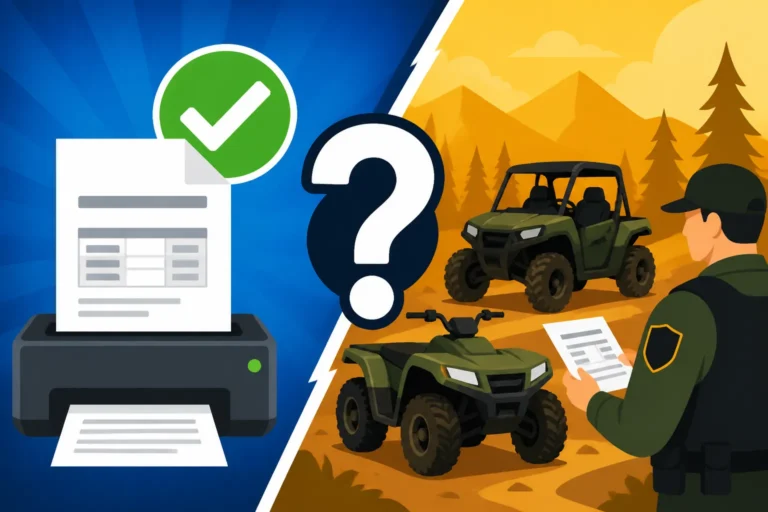
When an enforcement officer, such as an RCMP officer, Fish and Wildlife officer, or Parks Canada warden, stops you, they typically begin by introducing themselves and stating the reason for the stop. They will then usually ask for your driver's license, vehicle registration, and proof of insurance. If your machine is registered out-of-province, this is when questions about your residency might arise.
- Be Polite and Cooperative: Always maintain a respectful and cooperative attitude. Answer questions honestly and provide the requested documents without hesitation.
- Present Clearly: Hand over your documents in an organized manner. If you have a waterproof pouch, present the relevant documents clearly from it.
- Explain Your Situation Briefly: If you are a visitor, state that clearly. For instance, "Hello officer, I'm visiting from Saskatchewan, and here is my Saskatchewan driver's license and my quad's registration." If asked for further proof, be ready to provide a utility bill from your home province or other supporting documents.
An officer's primary concern is compliance and safety. By being prepared and cooperative, you demonstrate that you are a responsible rider. [What an Alberta Officer Can Ask to See] provides further context on the types of information and documents you might be asked to produce during an OHV stop.
Potential Consequences of Inadequate Proof
Failing to carry proper proof of residency, especially as a visitor, can lead to more than just a minor inconvenience. The repercussions can range from immediate fines to more complex legal and administrative hurdles. It’s a preventable situation, and understanding the potential pitfalls underscores the importance of preparation.
Fines and Legal Headaches
The most immediate consequence of not being able to prove your residency, particularly if you're an out-of-province rider suspected of overstaying the 30-day limit, can be a ticket. Operating an unregistered off-highway vehicle in Alberta carries penalties. If an officer cannot confirm your visitor status or determines your machine should be registered in Alberta, they may issue a ticket for operating an unregistered OHV.
Consider a scenario where you've been working in Fort McMurray for two months, and your quad is still registered in Ontario. You haven't updated your driver's license or established formal Alberta residency. An officer might conclude that your machine should be registered in Alberta, even if it's currently plated in Ontario. This could lead to a fine, and potentially even your vehicle being seized in more severe cases. This is not just about the money; it's about the time and stress involved in dealing with the legal process, which could involve court appearances or appeals to dispute the ticket. Knowing what Alberta expects of you can prevent these unwanted legal headaches.
Vehicle Registration Complications
If you cannot provide adequate proof of residency when needed, it can complicate the process if you eventually need to register your vehicle in Alberta. Registry agents need clear proof of your identity and residency to process an [Alberta OHV Registration]. If your documents are inconsistent or incomplete, you could face delays in getting your plate and certificate.
For example, if you move to Alberta and want to register your existing quad, the registry agent will require proof of your Alberta residency. If all you have is an out-of-province driver's license and no utility bills or lease agreements in Alberta, they may not be able to complete the registration. You'd then be in a bind: unable to register your machine and unable to legally ride it on public land. This creates a frustrating bureaucratic loop that could be easily avoided by having your documents in order from the start.
The Hassle of Proving Your Case After the Fact
Let’s say you were issued a ticket because you couldn't produce sufficient proof of residency on the spot. Now, you’re left with the task of proving your case after the fact. This means gathering all your documentation, potentially attending court, and spending valuable time and effort rectifying a situation that could have been avoided with a simple, organized set of papers.
The burden of proof often falls on you. You'd need to compile recent utility bills, bank statements, lease agreements, or other official correspondence to demonstrate your actual residency status at the time of the stop. This involves tracking down paper trails, potentially contacting various service providers for old statements, and putting together a comprehensive package of evidence. This entire process can be incredibly time-consuming and stressful, pulling you away from work, family, and, of course, riding. Proactively carrying your proof of residency means you don't have to face this uphill battle later.
Here's a quick summary of common scenarios and the proof needed:
| Rider Status | Key Document Examples | Potential Consequences (if inadequate proof) |
|---|---|---|
| Alberta Resident | Alberta Driver's License/ID, Alberta Vehicle Registration for OHV, recent Alberta Utility Bill, Lease Agreement, Property Tax Statement. | Delays if documents are not current or accessible, potential fines if the OHV is not registered in Alberta. If vehicle information doesn't match ID, further investigation may occur. |
| Visitor (under 30 days) | Out-of-Province Driver's License/ID (matching OHV registration), recent Utility Bill from home province, Bank Statement mailed to home province, Passport (for international visitors), [Alberta Registration for a Machine From BC], [Alberta Registration for a Machine From Saskatchewan], etc. | Questions about length of stay, need to prove you are within the 30-day limit. If suspicious, an officer might investigate further, leading to delays. If unable to prove visitor status, could be deemed an unregistered Alberta resident OHV. |
| Long-Term Visitor/New Resident (over 30 days) | Should have Alberta OHV Registration, Alberta Driver's License/ID (or in process of obtaining), Alberta Utility Bill, Lease Agreement/Mortgage Documents. | Fines for unregistered OHV (if not yet registered in Alberta), legal complications, potential vehicle seizure. Inability to register OHV if Alberta residency cannot be formally proven to a registry agent. Facing charges for [Thirty Days in the Province] rule violation if still on out-of-province plates. |
Carrying proof of residency is a small step that yields significant peace of mind. Whether you're an Alberta local or just passing through, ensuring you have the right documents, in the right place, can make all the difference in enjoying your ride without interruption.
Disclaimer
This article is for general informational purposes only and does not constitute professional advice. Laws, prices and regulations vary by location and change over time. Consult a qualified professional for guidance on your specific situation.