Alberta Registration for a Machine at a Cabin
You’ve got a quad or side-by-side that lives at your cabin, tucked away for weekend escapes and spontaneous adventures. It makes perfect sense to keep it there, ready for action. But when it comes to registration, many folks wonder if the rules are different for a machine that doesn't live at their primary address. This guide will help you understand Alberta's Off-Highway Vehicle (OHV) registration requirements specifically for machines kept at recreational properties, ensuring your cabin quad is always legal and ready for the trail.
Understanding Alberta's OHV Registration Fundamentals
It's easy to assume that if your ATV or UTV spends most of its life off the main grid, especially at a private cabin, it might somehow fly under the radar for registration purposes. However, the reality in Alberta is a bit more nuanced than that. The law is primarily concerned with where you operate the machine, not just where it's stored.
Why Your Cabin Machine Needs Registration Often
The core reason your cabin quad likely needs to be registered isn't about its permanent address, but about where you plan to ride it. If your cabin is nestled deep in the woods, and you only ever ride on your own private property, then Alberta's general OHV registration requirements often won't apply. But let's be realistic: how many of us only ride in a small circle on our private land? Most cabin owners dream of venturing out onto nearby trails, Crown Land, or even just using a ditch to get to a different section of their property. The moment your tires touch public land—which includes ditches, municipal roads, and designated OHV areas—your machine must be registered. This is the critical distinction that often surprises people. [Alberta Registration Before Riding Crown Land] and [Alberta Registration Before Riding a Ditch] are excellent resources to clarify these specific scenarios.
Imagine you’re out for a peaceful weekend at your remote cabin, far from the hustle and bustle. You decide to take your ATV down the road to visit a neighbour or access a scenic viewpoint. Even if that road is gravel and rarely used, it’s still considered public land. Without current registration, you could face penalties, and your adventure could turn into an expensive headache. The peace of mind that comes with knowing your machine is legally ready for any public land excursion, no matter how brief, is truly invaluable.
The frustration often stems from the perception that "out of sight, out of mind" applies to these recreational machines. But enforcement officers patrol all types of public land, from the most popular Public Land Use Zones (PLUZs) to quiet rural roads. They're looking for registered machines with proper plates and, crucially, proof of insurance. Don't let your weekend getaway be ruined by an unregistered machine; it's a simple step to ensure you're compliant.
What Constitutes an Off-Highway Vehicle in Alberta
In Alberta, an Off-Highway Vehicle, or OHV, is broadly defined to include a range of motorized vehicles designed for off-road use. This typically covers the machines you’d commonly find at a cabin, such as all-terrain vehicles (ATVs or quads), side-by-sides (UTVs), dirt bikes, and snowmobiles. The key characteristic is that they are not designed primarily for highway use, though they might occasionally traverse public roads or ditches to access trails. Knowing the specific classification of your machine helps you understand which regulations apply to you.
The Traffic Safety Act, along with the Off-Highway Vehicle Regulation 319/2002, clearly outlines these definitions. It’s not just about what it looks like; it’s about its intended use and design. Even smaller, youth-sized quads fall under this umbrella. This means whether you have a small utility ATV for hauling firewood around the cabin or a powerful side-by-side for exploring mountain trails, the same core registration principles generally apply when you venture beyond your private property.
It’s easy to get caught up in the idea that your specific machine might be an exception, especially if it's primarily used for chores or very short recreational jaunts. However, the definition is quite encompassing. If it has a motor and it's designed for off-road travel, and you plan to ride it anywhere other than strictly private land, assume it’s an OHV and requires registration. [What the Traffic Safety Act Requires of Alberta OHVs] offers further insight into the legal framework governing these vehicles.
Registering Your OHV: The Practicalities for Cabin Owners
When it comes to the actual process of registering your OHV, having a machine at a cabin doesn't really change the fundamental steps, but it does highlight a few key considerations that might not be obvious to everyone. The goal is to tie the machine's legal identity to its owner, regardless of where the machine physically resides most of the time.
Your Primary Residence vs. Your Cabin's Location
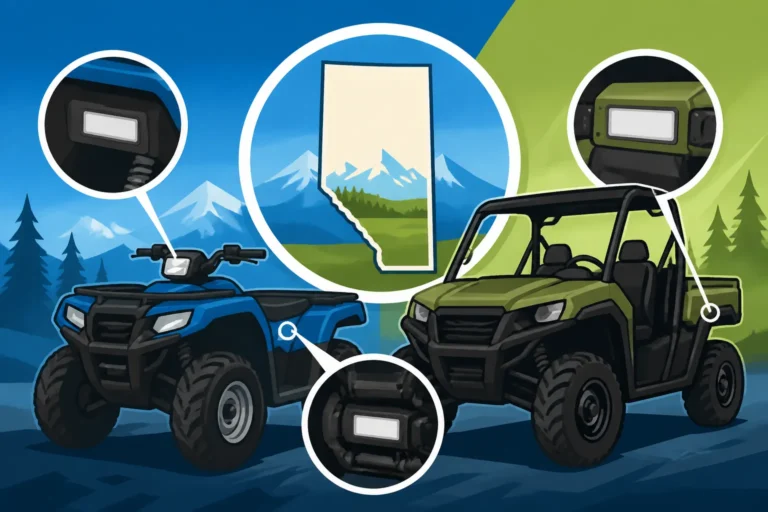
One of the most common questions from cabin owners is whether they should register their OHV to their cabin address. The answer is straightforward: your OHV registration in Alberta is tied to your primary residential address, the same one on your driver's license and other official documents. It doesn’t matter if your machine spends 11 months of the year at your cabin 200 kilometers away; the paperwork needs to reflect where you live. This is because the registration system is linked to the individual owner, not the property where the OHV is stored.
This might feel a bit counterintuitive when the machine never sees your primary home. You might think, "Why do they care where I live if the quad is up north?" However, this standardization ensures consistency and allows for proper identification and communication should there ever be an issue, such as a lost plate or a recall notice. Alberta's registration system is designed around the owner's legal identity and address, simplifying administration and enforcement. [Alberta Registration Address Change] is a good read if you ever move your primary residence.
So, when you head to the registry agent, you'll provide your driver's license, which shows your primary residential address. This is the address that will appear on your OHV registration certificate. The physical location of your cabin, while important for your recreational life, isn't part of the official OHV registration record itself. It’s a small but significant detail to keep straight to avoid confusion at the registry office.
Essential Documents for Registration
Gathering the correct paperwork is crucial for a smooth registration process. For any OHV, whether it’s at your primary home or your cabin, you’ll need proof of ownership. This typically means the original bill of sale. If you bought your machine new, you’ll have a Manufacturer’s Statement of Origin (MSO) or a New Vehicle Information Statement (NVIS). For a used machine, a properly filled out bill of sale from the previous owner is paramount. Make sure this document clearly states the Vehicle Identification Number (VIN), the make, model, year, sale price, and the names and signatures of both buyer and seller. If you’re unsure about crafting a robust bill of sale for a private transaction, resources like LawDepot offer excellent templates that can help ensure all necessary details are covered legally.
Beyond proof of ownership, you'll also need personal identification, usually your valid Alberta driver's license. The registry agent needs to confirm who you are and verify your primary residential address. In some cases, if the machine was inherited, you might need additional documentation like a copy of the will or probate papers to prove legal ownership. Being prepared with all these documents prevents delays and extra trips to the registry. [Alberta Registration Paperwork Checklist] provides a comprehensive list of what you'll need.
It’s worth noting that if you’ve purchased a machine that somehow lacks proper documentation, registering it can be significantly more challenging. It's always best to ensure you receive a complete and accurate bill of sale at the time of purchase, whether from a dealer or a private seller. A clear paper trail is your best friend when it comes to legal ownership and registration. If the VIN is missing or illegible, that's another hurdle altogether, as highlighted in [Alberta Registration When the VIN Is Gone].
Finding a Registry Agent and Completing the Process
The process of registering your OHV is handled by authorized registry agents across Alberta. You can’t typically do the full initial registration completely online, as physical documents often need to be presented for verification. When you arrive at the registry office, you'll present your proof of ownership, personal ID, and fill out the necessary forms. The agent will process your information, verify your documents, and issue your registration certificate and an OHV license plate. Don’t forget to ask about the current registration fees; while the base fee is set, individual registry agents may add a service charge. [Alberta Registry Agents and OHV Paperwork] is a great resource to locate an agent near you.
Even if you reside in Calgary and your cabin is near Edson, you can register your OHV at any Alberta registry agent. The system is provincially connected, so you don't need to visit a registry in the town closest to your cabin. This flexibility is a huge convenience for cabin owners. Just ensure you have all your documents in order before you go.
Once registered, you'll receive a physical license plate that must be affixed to your OHV. You'll also get a registration certificate. While you’ll eventually receive a digital copy, it's always wise to print a physical copy to carry with you when riding. It's your proof of legal registration on the trail, and an officer may ask to see it. [Printing a Certificate Before You Ride] explains why a physical copy is so important.
Common Cabin Scenarios and Registration Implications
Life at the cabin isn't always cut and dry, and neither are the ways we use our OHVs. Understanding how Alberta's registration laws apply to different situations can save you a lot of hassle and ensure your adventures stay within legal bounds.
Riding Exclusively on Private Cabin Land
If your cabin property is expansive, or if you have an arrangement with neighboring landowners to ride only on private land, you might be exempt from OHV registration. Alberta's rules generally state that an OHV does not need to be registered if it is operated exclusively on land owned by the owner or on land for which the owner has permission from the landowner. This sounds ideal for a cabin owner, but there’s a critical catch: the moment your machine leaves that private parcel and enters any public land, including crossing a public road or even just riding in the ditch alongside it, registration becomes mandatory.
This exemption is often misunderstood. It's not about the location of your cabin; it's about the extent of your riding. Many a rider has received a ticket because they assumed their "private property only" rule extended to the small strip of public access land they had to cross to get from one part of their property to another, or to access a specific area of their private land that required a brief stint on a public right-of-way. It's very rarely a true "never leaves private land" situation for most cabin owners.
So, while the letter of the law offers an exemption for purely private land use, the practical reality for most cabin owners means registration is almost always a good idea. The ease of mind and flexibility it provides far outweighs the effort of registration. Plus, even if you mainly ride on private land, being able to occasionally take a registered machine out for a spin on a nearby designated trail without worry is a definite bonus. [Alberta Farmer-Owned Machines on Private Land] delves into a similar exemption for agricultural use, which might offer parallel insights for large private landholdings.
Venturing Onto Public Land From Your Cabin
This is where the rubber meets the trail, quite literally. If your cabin is nestled near a Public Land Use Zone (PLUZ), Crown Land, or any area with designated OHV trails, you're likely going to want to explore beyond your private boundaries. The instant your OHV moves from your cabin property onto a public road, a public ditch, a cutline, or any government-managed recreational area, it must be legally registered. This is not optional. An unregistered OHV on public land can lead to significant fines, and in some cases, even vehicle seizure.
Think of those inviting trails that start just down the road from your cabin. To get to them legally, your machine needs to be registered. This also applies to the simple act of crossing a public road to reach another section of your property or a friend's private land. While the crossing itself might be brief, it still constitutes operating on public land. It's a common trap many riders fall into, thinking that a quick hop across a road doesn't count. It absolutely does.
The enforcement of these rules is consistent across the province. Whether you're in a well-known riding area like McLean Creek or a more remote corner of the Eastern Slopes, officers can and will check for valid registration. Ensuring your cabin machine is registered opens up a world of legal exploration and removes the anxiety of an unexpected encounter with enforcement. [Alberta Penalties for Riding Unregistered] outlines the consequences of not being compliant.
Ensuring Ongoing Compliance and Renewals
Registration isn't a one-and-done deal. Like any vehicle registration, your OHV's registration needs to be renewed periodically to remain valid. In Alberta, you can choose to register your OHV for one year or two years. It's essential to keep track of your expiry date, as riding with an expired registration is the same as riding unregistered on public land. Many people opt for the two-year registration to minimize annual paperwork, especially if their cabin is far from a registry agent.
You should receive a renewal reminder, but it's ultimately your responsibility to ensure your registration is current. Renewals can often be done online or at any registry agent. Just make sure your primary residential address on file is up-to-date, so any correspondence reaches you. For those who own multiple machines or travel frequently, setting a reminder on your phone or calendar can be incredibly helpful. [Alberta ATV Registration Renewal Online] can guide you through the digital renewal process.
Keeping your registration current means you can spontaneously decide to go for a ride from your cabin without having to worry about legalities. It also helps in situations like selling your machine, as a current registration makes the transfer of ownership smoother. An expired registration can create hurdles, requiring you to renew before you can properly transfer it to a new owner.
Other Important Considerations for Cabin OHV Use
Beyond the basic registration, there are a few other critical aspects that cabin owners should be fully aware of. These elements are just as vital for legal and safe OHV operation in Alberta and complement your registration efforts.
Insurance: A Non-Negotiable Requirement
Just like registration, insurance for your OHV is mandatory if you plan to operate it on any public land in Alberta. This isn't just a suggestion; it's a legal requirement. Having adequate liability insurance protects you financially in case of an accident where you are at fault, covering damages or injuries to others. While you might keep your machine at a cabin, the requirement for insurance is based on its potential use on public land, not just its storage location. [Alberta Requires Insurance on Public Land] is a must-read for all OHV owners.
Many riders, especially those who only use their machines for short periods at the cabin, sometimes overlook this critical step. They might assume their home insurance covers it, or that basic vehicle insurance is enough. This is usually not the case. You need specific OHV insurance, and it needs to be current. An officer can ask for proof of insurance on demand, and not having it can lead to hefty fines and even vehicle seizure.
Shopping around for OHV insurance is a good idea, as rates can vary. Ensure your policy covers the specific type of machine you own and the kind of riding you intend to do. It’s an investment in your peace of mind, knowing that if an unforeseen event occurs, you’re covered. Don't let your cabin adventures be overshadowed by financial risk.
Plate Placement and Visibility
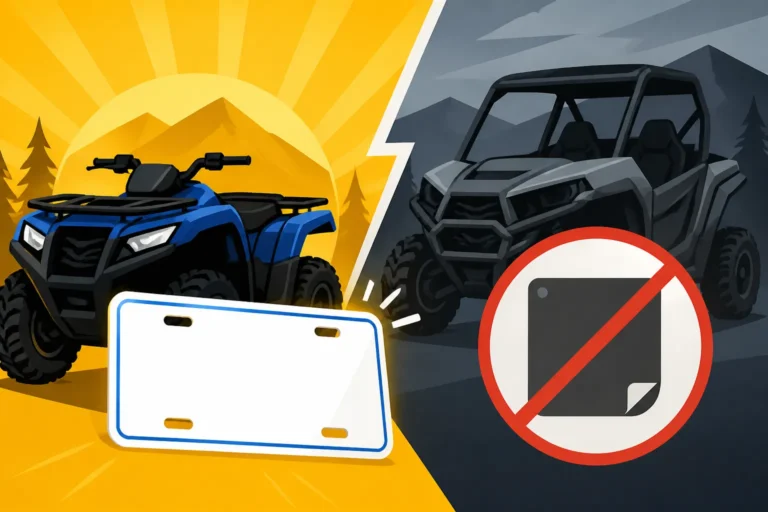
Once your OHV is registered, you’ll receive a license plate. Proper placement of this plate is crucial. The plate must be securely fastened to your OHV and clearly visible from the rear. It cannot be obscured by mud, snow, accessories, or anything else that would prevent it from being read easily. This is often where cabin machines run into trouble – after a muddy ride, the plate can get caked in grime, making it unreadable. It's your responsibility to ensure it's clean and legible at all times when operating on public land.
The placement requirements are specific to ensure enforceability. An officer needs to be able to identify your machine quickly and accurately. If your plate is dangling, tucked away, or covered, you could still receive a ticket, even if your registration is perfectly valid. It's a small detail that can have consequences. [Alberta Plate Placement on a Machine] goes into specific detail on where your plate should sit.
Before you head out from the cabin, especially after a particularly dirty trail ride, take a moment to ensure your plate is clean and properly affixed. A quick wipe-down can prevent an unnecessary interaction with enforcement and keep your adventure on track.
Understanding Out-of-Province Rules for Visitors
If your cabin attracts friends or family from other provinces who bring their own OHVs, it's important for everyone to understand Alberta's rules for visiting riders. Generally, out-of-province OHVs can be ridden in Alberta for a maximum of 30 consecutive days, provided they are properly registered and insured in their home jurisdiction and the rider carries proof of residency and registration from that jurisdiction. This means your BC or Saskatchewan friends don't need to register their machines in Alberta if they're just visiting for a short stay.
However, the "30 consecutive days" part is key. If a friend leaves their machine at your cabin for an extended period, or if they stay longer than 30 days, their machine would then require Alberta registration. This often comes up for snowbirds or those with seasonal properties who might leave their OHV at a cabin for many months. The clock starts ticking when the machine enters Alberta, and for residents moving to Alberta, they have a limited time to register their machines here. [Alberta Registration for Visiting Riders] and [Alberta's 30-Day Rule for Out-of-Province Machines] are excellent resources for these scenarios.
It’s always a good idea to inform your out-of-province guests about these rules before they arrive, so there are no surprises. This ensures that everyone in your group can enjoy the trails around your cabin legally and safely, contributing to a hassle-free and memorable experience for all.
Table: OHV Requirements for Cabin Owners
Here's a quick overview of the key requirements based on where you ride your OHV from your cabin:
| Requirement | Exclusively on Private Cabin Land | Venturing Onto Public Land (e.g., trails, ditches) |
|---|---|---|
| OHV Registration | Not usually required (if truly never leaves private land) | Mandatory |
| OHV License Plate | Not usually required | Mandatory (must be visible from rear) |
| OHV Insurance | Recommended (for liability) | Mandatory (minimum liability) |
| Proof of Ownership | Always recommended to carry | Always recommended to carry |
| Valid ID | Recommended | Mandatory (to identify rider) |
| Spark Arrestor | Recommended | Mandatory |
| Working Lights | Recommended | Mandatory (if riding at night/low light) |
| CSA-Approved Helmet | Recommended (for safety) | Mandatory (for riders and passengers) |
Disclaimer
This article is for general informational purposes only and does not constitute professional advice. Laws, prices and regulations vary by location and change over time. Consult a qualified professional for guidance on your specific situation.