Where Your OHV Plate Must Sit to Be Seen
Riding your ATV or side-by-side across Alberta's stunning landscapes, from the foothills to the northern bush, is one of life's great joys. But nothing can put a damper on a fantastic day quicker than a roadside stop from an enforcement officer, especially if it's for something as seemingly simple as an obscured or improperly mounted license plate. It's a common frustration: you have your plate, you think it's visible, but suddenly you're facing a ticket. This guide is here to clear up the confusion, helping you understand exactly where your OHV plate needs to sit to be seen, what the law expects, and how to avoid those avoidable fines.
The Core Requirement: Visibility is Key
When you're out enjoying Alberta's incredible trails, the last thing on your mind is often the small piece of metal fastened to your machine. However, that license plate is your machine's official identifier, and provincial regulations are pretty clear that it needs to be seen. It's not just about having it on your machine; it's about making sure it's always visible to anyone who needs to see it, from fellow riders to enforcement officers. Ignoring this seemingly minor detail can quickly turn a fun outing into a costly one, and nobody wants that.
Understanding the "Readily Visible" Standard
So, what exactly does "readily visible" mean in the eyes of the law here in Alberta? It's more than just being there; it implies that an enforcement officer, or anyone for that matter, should be able to clearly read your plate from a reasonable distance without needing to get up close and personal, or clean off an excessive amount of grime. Think of it this way: if a conservation officer or a member of the RCMP is observing machines from a short distance away, your plate numbers and letters should jump out at them.
This standard takes into account various conditions. In broad daylight, a plate might be perfectly legible, but what about at dusk, or when you're kicking up a little dust? What if there's mud flying, or fresh snow coating everything? A plate that's mounted too low, at an awkward angle, or in a spot that's prone to getting splashed constantly, simply won't meet this "readily visible" standard. You might think you've done your due diligence by simply bolting it on, but the spirit of the law is about visibility in real-world riding conditions, not just a static display.
The Legal Basis: Alberta's Traffic Safety Act and Regulations
The requirement for a visible OHV plate in Alberta stems directly from the provincial Traffic Safety Act and its associated Off-Highway Vehicle Regulation. While I won't dive into specific section numbers here, the general principle is straightforward: any vehicle operating on public land, which includes trails, ditches, and even some Crown land, must be clearly identifiable. This is why [Alberta Issues a Plate, Not a Sticker] for your OHV, marking it as a registered machine. It's not just a suggestion; it's a legal mandate designed to ensure accountability and safety for everyone sharing these spaces.
This legal framework for OHVs mirrors some of the requirements for on-road vehicles, but with some key differences that acknowledge the rugged environment off-highway vehicles operate in. Unlike a car that generally stays clean on paved roads, your OHV is designed to get dirty, to splash through puddles, and to kick up dust. The challenge, then, is to meet that "readily visible" standard despite these inherent aspects of off-road riding. Understanding [What the Traffic Safety Act Requires of Alberta OHVs] in a broader sense helps put the plate visibility rule into perspective – it's all part of ensuring a responsible and trackable riding community.
Common Mounting Locations and Their Challenges
When you first get your new (or new-to-you) OHV, you might scratch your head wondering where exactly to put that shiny new license plate. Manufacturers often include a small bracket or a designated spot, but these aren't always ideal for ensuring long-term visibility or durability in the harsh off-road environment we love to ride in Alberta. Each type of OHV, and even different models within types, presents its own set of considerations, and what works perfectly for one machine might be completely unsuitable for another.
Front and Rear: The Ideal, and the Reality
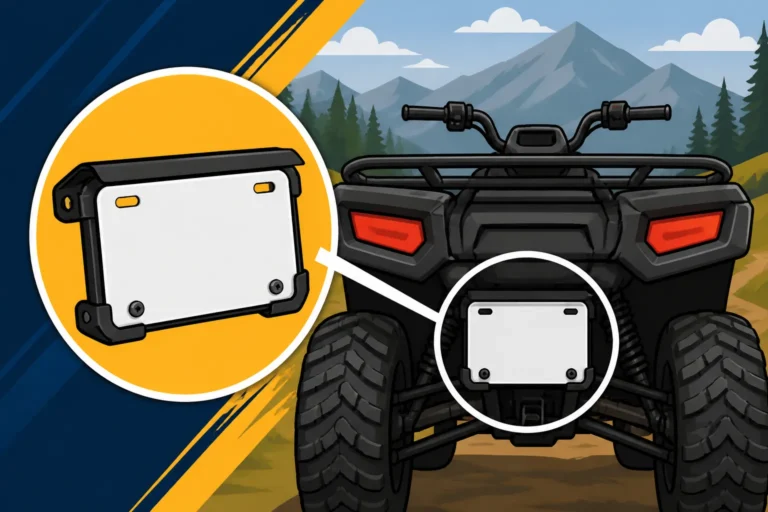
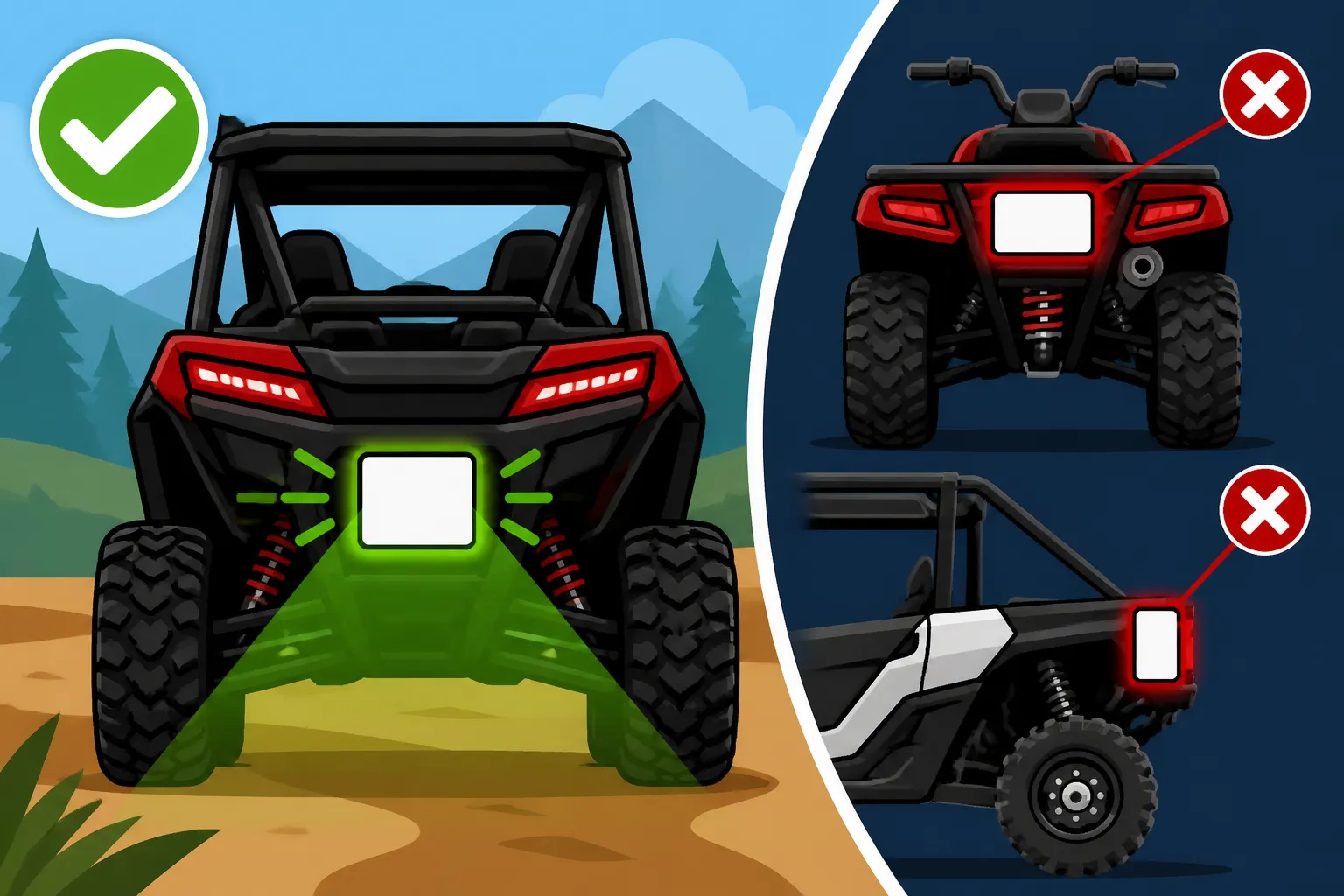
Most riders instinctively look to the front or rear of their machine for plate placement, and these are indeed the most common spots. The rear of an ATV or side-by-side is often seen as the primary location, particularly because it's usually less exposed to direct impacts from trees or rocks when pushing through brush. However, the rear is also highly susceptible to mud, dirt, and snow spray kicked up by your own tires. A plate mounted too low on the rear fender or bumper can quickly become an unreadable brown or white rectangle, especially after crossing a few creek beds or ripping through a muddy section.
The front of the machine, while sometimes offering a "cleaner" view initially, comes with its own set of challenges. On an ATV, a plate mounted to the front rack can get hit by branches or easily bent if you bump into something. On a side-by-side with a winch or brush guard, finding a flat, unobstructed spot that doesn't interfere with your lights or accessories can be tricky. Plus, a plate mounted too far forward is vulnerable to impacts that can bend or dislodge it entirely. The "ideal" spot often becomes a compromise between clear visibility, protection from damage, and avoiding constant re-cleaning.
Side-by-Sides vs. ATVs vs. Dirt Bikes
The type of off-highway vehicle you ride significantly impacts your plate mounting options and challenges.
Side-by-sides, with their larger frames and often more robust bodywork, tend to offer more flat surfaces for mounting. The rear bumper or a dedicated frame section often works well. However, side-by-sides also carry more cargo, often have spare tires mounted, or feature elaborate roll cages, all of which can potentially obstruct a plate. You might have to get creative with an auxiliary bracket to ensure the plate is mounted squarely and away from potential obstructions or mud spray from the rear wheels.
ATVs typically have front and rear racks, which are natural places to consider. Many riders opt for the rear rack, either attached directly to the rack tubing or to the plastic fender below it. If mounted to the fender, ensuring it's high enough to avoid immediate mud splash is crucial. For the front, if mounted, it needs to be secure enough to withstand vibrations and minor impacts without bending or falling off. Suspension travel is another factor; on an ATV, a low-mounted plate can easily bottom out or scrape if you hit a dip or obstacle, bending it out of shape.
Dirt bikes present perhaps the greatest challenge due to their minimalistic design. They have very limited flat surfaces and are built for aggressive, high-travel suspension. The rear fender is usually the only practical spot, but this area is highly prone to mud and dirt spray, and the flexible plastic fenders can make secure, rigid mounting difficult. Some riders use small, reinforced brackets that extend slightly off the fender, but the key is to ensure it remains visible and doesn't get ripped off during a ride. Given the limited space, dirt bike riders often have to pay extra attention to ensuring their plate is clean and visible at all times.
Practical Tips for Ensuring Your Plate Stays Visible
Ensuring your OHV plate remains visible isn't just about picking a spot; it's about making smart choices with hardware, considering the elements, and developing good pre-ride habits. The rugged nature of off-highway riding means your plate is going to take a beating, so setting it up for success from the get-go will save you headaches and potential fines down the trail. A little preventative maintenance and thoughtful installation can go a long way in keeping your plate legal and intact.
Materials and Mounting Hardware for Durability
The cheap hardware that sometimes comes with accessory mounts might seem fine, but it rarely stands up to the constant vibration, mud, water, and impacts of Alberta's trails. Invest in good quality, rust-resistant bolts, lock nuts, and washers. Stainless steel is often a good choice. Consider using a thin, rigid backing plate (like a piece of aluminum or sturdy plastic) behind your actual license plate if you're mounting it to a flexible surface like a plastic fender. This will prevent the plate from bending and fatiguing, which can lead to it cracking or even falling off entirely.
The goal is to create a mounting point that is as stable and robust as possible. Loose plates rattle, bend, and are prone to falling off. Vibration can slowly loosen even seemingly secure bolts, so checking them periodically is a must. If you're custom-fabricating a bracket, ensure it's made from strong material and securely attached to the machine's frame, not just to a flimsy piece of plastic. [Mounting an OHV Plate So It Stays Readable] involves not just placement, but also the physical integrity of the mount itself against the elements.
Protecting Your Plate from Mud, Snow, and Debris
This is where the rubber meets the road (or the tire meets the mud!). Even a perfectly mounted plate will quickly become invisible if it's coated in mud or snow. For rear-mounted plates, consider extending or adding a mud flap above the rear tire. This simple addition can drastically reduce the amount of spray hitting your plate. On snowmobiles, snow accumulation can be a constant battle; make sure your plate is clear of exhaust heat, which can melt and refreeze snow, encasing the plate in ice.
During your ride, make it a habit to glance at your plate when you stop for a break, or while waiting for your group. A quick wipe with a glove or a handful of snow can prevent it from becoming completely obscured. While certain clear plate covers exist, be cautious: some jurisdictions consider even clear covers to be an obstruction if they create glare or distort the plate, so always verify local regulations. The best protection is a smart mounting location combined with active vigilance.
Optimal Angle and Lighting for Visibility
The angle at which your plate is mounted is critically important. A plate that's angled sharply upwards or downwards can be nearly impossible to read, especially from an enforcement vehicle on a parallel trail or road. Aim for a mounting position that keeps the plate as close to perpendicular to the ground as possible, allowing for a clear, flat view of the numbers and letters. If it's on a fender that naturally slopes, use a bracket to correct the angle.
For those adventurous night rides, visibility extends to lighting. While your OHV plate itself typically doesn't require direct illumination from a separate light (unlike some on-road vehicles), ensuring your tail lights are in good working order is essential for overall safety and visibility. [Alberta Requires Working Head and Tail Lights] not only for seeing where you're going but also for being seen by others, and this indirectly contributes to your machine's overall legal compliance during nighttime operation. A well-lit machine helps officers identify it more easily, even if they're looking for an obscured plate.
What Happens When Your Plate Isn't Visible?
It's easy to dismiss a dirty or bent license plate as a minor inconvenience, but in Alberta, an obscured or missing OHV plate is a legitimate regulatory infraction. The consequences can range from a simple warning to a significant fine, and in some situations, can lead to further scrutiny of your vehicle's registration and your overall compliance with off-highway vehicle laws. Nobody wants their riding day to end with a lecture and a piece of paper that costs money, so understanding the potential repercussions is key to avoiding them.
Consequences of an Obscured or Missing Plate
The most immediate consequence of a non-visible or missing plate is usually a ticket. The specific fine amount can vary, but it's never a trivial sum. Beyond the financial hit, there's the inconvenience and frustration of having your ride interrupted. An officer might stop you, requiring you to clean or re-secure your plate on the spot, potentially delaying your trip. If your plate is missing entirely, it can raise questions about whether your OHV is even registered, leading to further investigation. Imagine being pulled over and having to prove your machine is legally registered when its primary identifier is gone. This is why it's so important to protect the plate you paid for when you registered your machine. [Alberta OHV Registration Cost] includes that physical plate, and losing it means you'll face the cost and hassle of replacement.
It's also worth remembering that enforcement officers view an intentionally obscured plate (bent out of sight, covered with tape, or even a strategically placed mud flap) much more seriously than one that's simply caked in mud. While both are issues, the former suggests a deliberate attempt to evade identification, which can escalate the situation and lead to more severe penalties. The goal of the plate is identification, and anything preventing that is seen as non-compliance.
Dealing with Roadside Checks and Officer Discretion
If an officer pulls you over regarding your plate, the best approach is always cooperation and respect. They have a job to do, which includes ensuring all OHVs on public land are properly registered and identifiable. If your plate is genuinely just caked with mud or snow, offer to clean it immediately. Often, an officer will appreciate your cooperation and might issue a warning instead of a ticket, especially if it's clearly an accidental obstruction.
However, if your plate is bent, missing, or appears intentionally obscured, the officer's discretion might lean towards a fine. They're looking for responsible riders. During these checks, an officer can also ask for your registration papers and proof of insurance. Being prepared with [Producing Insurance on Demand] and your [Alberta Registration Paperwork Checklist] readily available (perhaps in a waterproof bag) can help demonstrate that you're a responsible rider, even if there's a minor issue with your plate. A good attitude and being able to quickly resolve a simple issue can make a big difference in the outcome of a roadside stop.
Replacing a Lost or Damaged Plate
Despite your best efforts, sometimes plates get lost or damaged on the trail. A bad bump, a snagged branch, or just metal fatigue can send your plate flying or render it unreadable. If this happens, you need to address it promptly. Riding around without a plate or with a severely damaged one is essentially the same as riding unregistered, and carries significant penalties, including the potential for [Alberta Penalties for Riding Unregistered].
Fortunately, replacing a plate in Alberta is a straightforward process. You'll need to visit an [Alberta Registry Agents and OHV Paperwork] office. They can guide you through the steps to obtain a replacement. Usually, you'll need your registration documents and some identification. While you await your new plate, avoid riding on public land if at all possible, as you're technically not compliant. Check with the registry for any temporary solutions, though generally, you need the physical plate to ride legally.
Common Mistakes and How to Avoid Them
Even experienced riders can sometimes make basic mistakes when it comes to OHV plate visibility. These oversights, while seemingly minor, can lead to unnecessary hassle and expense. By being aware of these common pitfalls and adopting a few good habits, you can ensure your plate is always compliant and ready for inspection, keeping your focus on the trail ahead. A little foresight goes a long way in avoiding roadside complications and enjoying your ride without worry.
Avoiding Intentional Obscurity (Bending, Covering, Etc.)
This is arguably the biggest mistake any OHV rider can make, and it's also the most problematic in the eyes of the law. Intentionally bending your plate upwards to hide it, applying dark covers, or using strategically placed accessories to block its view is a clear act of defiance against identification requirements. While you might think you're clever, enforcement officers are well-aware of these tactics and view them as attempts to avoid accountability.
The consequences for intentional obscurity can be far more severe than for a plate simply caked in mud. It implies a deliberate disregard for the law and can lead to higher fines, more detailed inspections, and a much less forgiving attitude from the officer. Save yourself the trouble and the potential for a really bad day: mount your plate clearly and keep it visible. Trying to hide your plate sends the wrong message about your intentions on Alberta's public lands.
Overlooking the Basics During Pre-Ride Checks
Before every ride, especially if you're hitting the kind of terrain that kicks up a lot of mud or dust, make a quick visual check of your OHV plate a part of your routine. It's easy to get excited and just jump on and go, but a minute spent walking around your machine can save you a ticket. Is the plate clean? Is it securely attached? Is it bent in a way that makes it hard to read? These simple questions are worth asking yourself.
It's particularly important if your machine has been sitting for a while, or if you've recently performed maintenance. Vibrations from transport or rough trails can loosen bolts. Snow and ice can accumulate when parked outdoors. Don't wait until you're already deep on the trail to discover an issue. Check it at home, check it again at the staging area before you leave the truck, and make periodic checks throughout your ride, especially after particularly muddy or dusty sections. This simple habit of [What an Alberta Officer Can Ask to See] includes your plate, so always be ready.
Relying Solely on Manufacturer Mounting Points
While many OHVs come with a small bracket or a designated spot for a license plate, these are often designed for aesthetic purposes or minimal use, not the rigorous demands of Alberta's diverse landscapes. Relying solely on these flimsy plastic tabs or poorly angled brackets is a common mistake that can lead to a lost or damaged plate. Factory mounts are rarely robust enough to withstand constant vibration, impacts, or heavy mud spray without bending, breaking, or obscuring the plate over time.
Instead of just bolting it where the manufacturer suggests, take a moment to assess the location for long-term viability. Is it protected from tire spray? Will it clear your suspension travel? Can it withstand a minor bump without bending? If the answer to any of these is no, consider investing in an aftermarket plate bracket or fabricating a more durable solution. Often, a small, reinforced aluminum bracket that elevates the plate slightly or moves it to a more protected, yet still visible, location is a worthwhile upgrade. This often leads to a more durable and compliant setup, preventing issues like those related to [Why a Modified Muffler Can Cost You a Ticket], where a simple modification can lead to fines, so too can an inadequate plate mount.
| OHV Type | Ideal Placement (Primary) | Common Challenges | Tips for Visibility |
|---|---|---|---|
| ATV | Rear rack or dedicated fender mount | Mud/snow spray from rear tire, low mounting, awkward angle | Use elevated bracket, add mud flap, check and clean frequently. Ensure clear of exhaust. |
| Side-by-Side | Rear bumper/frame, brush guard on front (if visible) | Obstruction by cargo/spare tire, limited flat surfaces | Secure, flat mounting. Avoid areas that collect mud or get blocked by gear. Consider auxiliary plate lighting. |
| Dirt Bike | Rear fender | Very limited space, prone to mud, fragile plastic fenders | Reinforce fender, use flexible but secure mount, keep it clean. Avoid mounting too low near the wheel. |
| Snowmobile | Rear tunnel/fender | Snow/ice accumulation, exhaust heat distortion, breakage | Elevated, secure mount, clear of exhaust. Brush off snow and ice regularly during stops. |
Disclaimer
This article is for general informational purposes only and does not constitute professional advice. Laws, prices and regulations vary by location and change over time. Consult a qualified professional for guidance on your specific situation.