Registering a Side-by-Side in Alberta
It's incredibly frustrating when you're all geared up to hit Alberta's incredible trails or simply get some work done on your acreage with your side-by-side, only to realize the registration process feels like navigating a muddy creek without a map. Getting your UTV or SxS legally registered in Alberta doesn't have to be a confusing maze. This comprehensive guide will break down every step, document, and detail you need to know to ensure your machine is road-ready (for ditches, at least!) and trail-legal, saving you headaches and potential fines.
Why Your Side-by-Side Needs to Be Registered in Alberta
You might think your side-by-side is just for fun on the weekends or for getting around your property, but the moment those tires touch certain types of land in Alberta, the rules kick in. It’s not just about a bureaucratic hurdle; it’s about public safety, land management, and accountability. Understanding why registration is mandatory helps underscore its importance.
The Law and Public Land Access
The core reason your side-by-side needs registration in Alberta boils down to provincial law, specifically the Traffic Safety Act and the Off-Highway Vehicle Regulation 319/2002. These pieces of legislation dictate how off-highway vehicles (OHVs), including your side-by-side, are to be operated and maintained when they leave private land. If you plan to ride on anything considered "public land," you absolutely must have your machine registered and plated.
What exactly counts as "public land"? This is where many riders get tripped up. It's not just designated OHV parks or Crown land. The legal definition of a "highway" in Alberta is surprisingly broad and includes ditches alongside roads, alleys, and even many unmaintained trails. So, if you're taking your side-by-side to cross a grid road, ride along a shoulder, or access Crown land for hunting or recreation, you're on public land. An unregistered side-by-side in these scenarios can lead to significant fines and could even result in your machine being seized. The law is designed to ensure that all vehicles operating in these shared spaces are identifiable and that their owners are accountable. It’s about more than just keeping track of machines; it’s a critical component of managing recreational and industrial use of our vast Alberta landscape.
Beyond the Law: Practical Reasons
While avoiding fines is certainly a powerful motivator, there are several practical benefits to registering your side-by-side that go beyond simply complying with the law. Think of registration as your machine's official identity. This identity is crucial for a number of reasons that impact you as an owner and the broader community of riders.
Firstly, registration provides indisputable proof of ownership. If your side-by-side is ever stolen, having it registered with a unique plate and certificate of registration makes it significantly easier for law enforcement to track it down and return it to you. Without this official record, it can become a nightmare to prove the machine is yours, especially if it ends up in another province or is resold illegally. Furthermore, for resale purposes, a registered machine is far more attractive to potential buyers, as it shows clear ownership history and helps streamline the transfer process. Buyers are often wary of machines without proper paperwork, and a smooth registration history builds trust. Finally, nearly every insurance provider in Alberta will require your side-by-side to be legally registered before they'll offer you a policy for riding on public land. Without registration, getting the necessary coverage to protect your investment and yourself from liability becomes virtually impossible. Check out [Alberta Requires Insurance on Public Land] for more details on this often-overlooked necessity.
Exceptions to Registration
Now, while the general rule is that if you're on public land, your side-by-side needs to be registered, there are a few specific exceptions where you might not need to go through the process. It's important to understand these nuances to avoid unnecessary registration or, more critically, to avoid being caught without it when it is required. Always err on the side of caution if you're unsure.
The most common exception is for machines that never leave private property. If your side-by-side is exclusively used on your own land, whether that's a sprawling ranch, a small acreage, or a closed-course track, then Alberta's registration requirements generally don't apply. This includes situations where you might trailer your machine to another private property and only ride there with permission. However, remember that even a quick jaunt down the access road or through a public ditch to get to another part of your land or a neighbour's property usually triggers the requirement. There's also a specific farm exemption for agricultural use. If your side-by-side is primarily used for farm work, there are provisions that might exempt it from registration, but these typically involve strict conditions about where and how the machine is operated. You can learn more about this specific scenario in [Alberta's Farm Exemption From Registration]. Lastly, if you're a visiting rider from another province or territory, you might be exempt from Alberta registration for a limited time, provided your machine is properly registered in your home jurisdiction. Be sure to understand the "30-day rule" and other conditions outlined in [Alberta Registration for Visiting Riders] to ensure you're compliant.
Where to Register Your Side-by-Side in Alberta
Once you've determined that your side-by-side definitely needs to be registered, the next step is figuring out where to go to make it happen. Unlike some other services, OHV registration in Alberta is handled through a network of authorized private businesses rather than a single government office. Knowing your options can save you time and frustration.
The Registry Agent Process
In Alberta, most motor vehicle and off-highway vehicle services, including registration, are provided through a network of independent businesses known as registry agents. These are not government offices, but rather private entities licensed by the province to provide services on its behalf. This system is designed to offer convenience and accessibility across the province, from small towns to large cities. You'll find registry agents in strip malls, standalone buildings, and often integrated into other businesses.
To register your side-by-side, you'll typically need to visit a registry agent in person. While some renewals can be done online, initial registrations or transfers of ownership almost always require a face-to-face interaction to verify documents and identification. It's a good idea to call ahead to your chosen registry agent to inquire about their specific hours, whether they accept walk-ins or require appointments, and if they have any specific requirements beyond the provincial standards. This pre-call can prevent a wasted trip, especially if you're coming from a rural area. When you arrive, be prepared with all your necessary documents (we’ll get into those next!) and be ready to answer questions about your machine and its intended use. The staff at registry agents are usually very knowledgeable and can guide you through the process, but having everything organized on your end will make it much smoother.
Online vs. In-Person Registration
The modern world offers convenience, and many services have shifted online. While online options exist for some aspects of OHV registration in Alberta, it's crucial to understand their limitations, especially for initial registration. Don't assume you can do everything from your couch, as that's a common mistake that leads to frustration.
For a brand-new side-by-side registration or a transfer of ownership for a used machine, an in-person visit to an Alberta registry agent is almost always required. This is because the agent needs to physically verify your identity, scrutinize original ownership documents like a Manufacturer's Statement of Origin (MSO) or a bill of sale, and ensure all the paperwork is legitimate before a plate and registration certificate can be issued. There's a level of verification that simply cannot be replicated online for these first-time scenarios. However, once your side-by-side is initially registered, you can often renew your registration online. This is a huge convenience for subsequent years, allowing you to pay your fees and receive an updated certificate without leaving home. Keep in mind that [Alberta Online Renewal Hours] might be limited, so check them before you plan to renew. While the online system for renewals is generally user-friendly, it’s not set up for the complex initial verification needed for new machines or ownership changes.
What Documents You'll Need for Registration
This is arguably the most critical section because missing even one piece of paperwork can send you home empty-handed from the registry. Getting all your ducks in a row before you head to the registry agent is key to a smooth and successful registration process.
Proving Ownership
The most fundamental requirement for registering any vehicle, including your side-by-side, is proving you are the rightful owner. Without this, no registry agent will process your application. The specific documents needed will depend on whether you're registering a brand-new machine or a used one.
For a new side-by-side purchased from a dealership, you'll need the Manufacturer's Statement of Origin (MSO) or sometimes called a New Vehicle Information Statement (NVIS). This document is essentially the "birth certificate" for your machine, indicating that it's new and has never been registered before. The dealership should provide this to you at the time of purchase. Ensure it's original and complete, as copies are usually not accepted. If you're buying a used side-by-side, the most crucial document is a valid bill of sale. This is a legally binding document that details the transfer of ownership from the previous owner to you. It should include the full names and addresses of both buyer and seller, the date of sale, the purchase price, and a complete description of the side-by-side, including its Vehicle Identification Number (VIN). For added security and clarity, especially in private sales, consider using a professionally drafted bill of sale template, which can be easily found and customized on platforms like LawDepot, to ensure all necessary legal details are covered. If you find yourself in the tricky situation of trying to register an ATV in Alberta without a bill of sale, it's a much more complicated process, and you should read [Alberta ATV Registration Without a Bill of Sale] for guidance. It's not impossible, but it definitely adds layers of complexity and may require statutory declarations.
Personal Identification and Residency
Beyond proving ownership of the machine, you also need to prove who you are and that you are eligible to register a vehicle in Alberta. This means bringing the right personal identification and, in some cases, proof of residency.
To verify your identity, you'll need to present valid, government-issued photo identification. This typically means an Alberta Driver's Licence or an Alberta Identification Card. The registry agent uses this to confirm your legal name, date of birth, and current address. If you're a new resident to Alberta and haven't yet obtained an Alberta driver's licence or ID card, you'll also need to provide proof of your Alberta residency. This could include utility bills, a rental agreement, or other official documents showing your current Alberta address. For more specific details on what constitutes acceptable proof, refer to [Alberta Registration for a New Resident]. It's crucial that the name and address on your identification match the information you're providing for the registration. If you're a visitor to Alberta, remember the "30-day rule." If you plan to be in the province for more than 30 consecutive days and are operating your side-by-side on public land, you generally need to register it here, even if it's registered in your home province. This is detailed further in [Alberta's 30-Day Rule for Out-of-Province Machines], and understanding this can save you from an unexpected ticket.
Insurance and Other Requirements
While not strictly a "registration document" in the same way as a bill of sale, valid insurance is an absolute prerequisite for registering your side-by-side for public land use in Alberta. No insurance, no registration, no riding on public land – it's that simple.
You will need to show proof of valid liability insurance for your side-by-side. This usually means an insurance "pink card" or a letter from your insurance provider confirming coverage. The policy must meet Alberta's minimum liability requirements. It's a common misconception that because it's an off-highway vehicle, insurance isn't as critical, but the province sees it differently when you're in public spaces. Your registry agent will verify this coverage before processing your registration. For a deeper dive into why this is so important, check out [Alberta Requires Insurance on Public Land]. It's worth noting that, unlike cars and trucks, side-by-sides in Alberta do not require a safety inspection before registration. This is a relief for many new owners, but it places the onus on you to ensure your machine is in safe operating condition. Lastly, if you're importing a machine from outside of Canada, there might be additional requirements such as customs clearance documents and potentially a VIN verification to ensure its authenticity and compliance with Canadian standards before it can be registered in Alberta.
The Registration Process: Step-by-Step
Navigating the registration process, whether it's for a brand-new machine or a used one, can feel a bit daunting if you've never done it before. Breaking it down into clear, manageable steps makes it much easier to tackle. Let’s walk through the different scenarios you might encounter.
First-Time Registration for a New Machine
Congratulations on your new side-by-side! Getting it registered is the final step before you can legally enjoy it on Alberta's trails and public lands. This initial registration is relatively straightforward, provided you have all the necessary paperwork from your dealership.
First, gather all your documents: your valid Alberta ID (driver's license or ID card), proof of Alberta residency if your ID doesn't reflect your current address, your proof of insurance (the "pink card"), and most importantly, the Manufacturer's Statement of Origin (MSO) or New Vehicle Information Statement (NVIS) provided by the dealer. Make sure these are original documents, not copies. Next, head to your nearest Alberta registry agent. As discussed, this cannot typically be done online for a first-time registration because the agent needs to verify the original MSO/NVIS. Once at the registry, you’ll present your documents, fill out any required forms, and pay the registration fees. After successful processing, you'll be issued a registration certificate and an OHV license plate. Keep in mind that [Alberta Issues a Plate, Not a Sticker] – the days of windshield stickers are gone. Your registration certificate is now a digital document, but you must print it out and carry it with you when you ride. [Alberta Digital Certificates Must Be Printed] is a critical detail many new riders miss, leading to potential fines on the trail.
Registering a Used Side-by-Side (Transfer of Ownership)
Buying a used side-by-side can be a great way to save money, but the transfer of ownership process requires careful attention to detail. Skipping steps here can lead to big headaches down the line, so it's vital to ensure everything is done correctly.
Before you even step foot in a registry, ensure you have a legitimate, signed bill of sale from the previous owner. This document is your primary proof of ownership. As mentioned earlier, using a robust template (like those from LawDepot) can protect both buyer and seller. It's also highly advisable to check for any liens on the machine before you finalize the purchase. You can do this by requesting a Personal Property Registry (PPR) search at any Alberta registry agent with the VIN of the side-by-side. This simple step can save you from unwittingly buying a machine that still has outstanding debt against it, which would technically belong to the lender. More on this can be found in [Alberta Registration and Lien Records]. With your valid bill of sale, your personal ID, and proof of insurance in hand, head to the registry agent. The process then mirrors a new registration: present your documents, complete the forms, pay the fees, and you’ll receive your new registration certificate and plate. Make sure the previous owner's registration is cancelled and the transfer is properly recorded.
Renewing Your Side-by-Side Registration
Once your side-by-side is initially registered, you'll need to renew it periodically to keep it legal for public land use. This is generally a much simpler process than the initial registration or transfer.
Alberta OHV registrations can typically be renewed for either one or two years. The choice is yours, with a two-year option sometimes offering a slight convenience discount, but always double-check the current rates. You’ll receive a renewal reminder in the mail or electronically before your current registration expires. It’s important to note [When an Alberta OHV Registration Expires] so you don’t accidentally let it lapse, as riding with an expired registration is the same as riding unregistered. Many registry agents offer online renewal services for OHVs. This is usually the quickest and easiest way to renew, allowing you to pay your fees from home and print your new registration certificate immediately. You can find more specific information on this in [Alberta ATV Registration Renewal Online]. If you prefer, or if there's an issue with your online renewal, you can always visit a registry agent in person to complete the process. Be aware that [Why Your Renewal Costs More Than the Base Fee] is often due to additional registry agent service charges, which are separate from the provincial registration fees.
Costs and Fees Associated with Side-by-Side Registration
Understanding the financial aspects of registering your side-by-side is crucial for budgeting and avoiding any surprises. While I can't provide exact figures (as these can change), I can explain the types of costs you'll encounter and why they exist.
Understanding the Basic Registration Fee
The primary cost you'll incur is the provincial registration fee itself. This fee is set by the Alberta government and goes towards the administration of the vehicle registration system. It's the core charge for being legally permitted to operate your side-by-side on public land.
This basic fee covers the provincial portion of the registration. However, when you go to a registry agent, you'll notice that the total amount you pay is usually a little higher than just this provincial fee. This is because registry agents are private businesses that charge a service fee for the convenience of processing your transaction. This additional charge, often called a "counter fee," covers their operational costs and allows them to provide efficient service. You can learn more about these specific charges in [Alberta Registry Counter Fees]. When you're registering, you'll typically have the option to register your side-by-side for one year or two years. Opting for a two-year registration can sometimes be more cost-effective in the long run, as you pay the registry agent fee only once every two years instead of annually. This choice is detailed in [Alberta Registration Terms of One or Two Years]. It's always a good practice to ask your registry agent for a full breakdown of the costs before you proceed so there are no surprises.
Taxes and Additional Costs
Beyond the direct registration fees, there are other financial considerations when acquiring and maintaining your side-by-side that factor into its overall cost of ownership and compliance. Being aware of these helps you budget effectively.
When you purchase a new side-by-side from a dealer in Alberta, you will be subject to the federal Goods and Services Tax (GST). Unlike some other Canadian provinces, Alberta does not have a provincial sales tax (PST) or Harmonized Sales Tax (HST) on top of the federal GST. This is a significant advantage for Alberta consumers, as explained in [Alberta Has No Provincial Sales Tax]. However, if you buy a used machine from a private seller, you typically do not pay GST on that transaction. Another significant "cost" that isn't directly part of registration but is absolutely mandatory for public land use is insurance. Your insurance premiums will vary widely based on the machine's value, your riding history, where you live, and the type of coverage you choose. It's a non-negotiable expense if you plan to ride anywhere but private land, and you can get an idea of typical costs by reading [Alberta Insurance Cost for an ATV]. Lastly, while not a direct fee, if you opted for a custom bill of sale, perhaps from a service like LawDepot, there might have been a small cost associated with drafting that legal document to ensure all details were robustly covered.
Penalties for Non-Compliance
Ignoring Alberta's OHV registration rules can lead to more than just a stern talking-to; it can result in significant financial penalties and even the loss of your machine. Understanding the potential consequences should reinforce the importance of proper registration.
The most immediate consequence of riding an unregistered side-by-side on public land is a fine. Alberta has specific penalties for operating an off-highway vehicle without proper registration, and these tickets can quickly add up. For example, you can face substantial fines for riding unregistered, as outlined in [Alberta Penalties for Riding Unregistered]. Furthermore, if you are caught operating your side-by-side on public land without valid insurance, the consequences are even more severe. Not only will you face fines, but law enforcement officers have the authority to seize your vehicle on the spot. This means your side-by-side could be impounded, leaving you stranded and facing towing and storage fees on top of the fines. This harsh penalty for lacking insurance is detailed further in [Alberta Vehicle Seizure for No Insurance]. If you choose to dispute a ticket in court, be prepared for additional costs beyond the initial fine, including court fees and potentially legal representation. [Alberta Court Costs for an OHV Citation] can give you an idea of what to expect if you find yourself in that situation. It's always far less expensive and less stressful to simply register and insure your machine properly from the outset.
What Happens After Registration
Once you've successfully registered your side-by-side and have your plate and certificate in hand, you're almost ready to ride. But there are still a few crucial steps and ongoing responsibilities to ensure you remain compliant with Alberta law and can enjoy your machine without issues.
Plate Placement and Requirements
Your shiny new OHV license plate isn't just a souvenir; it's a legal identifier that needs to be properly displayed on your side-by-side. Improper plate placement is a common reason riders receive tickets, so pay close attention to the rules.
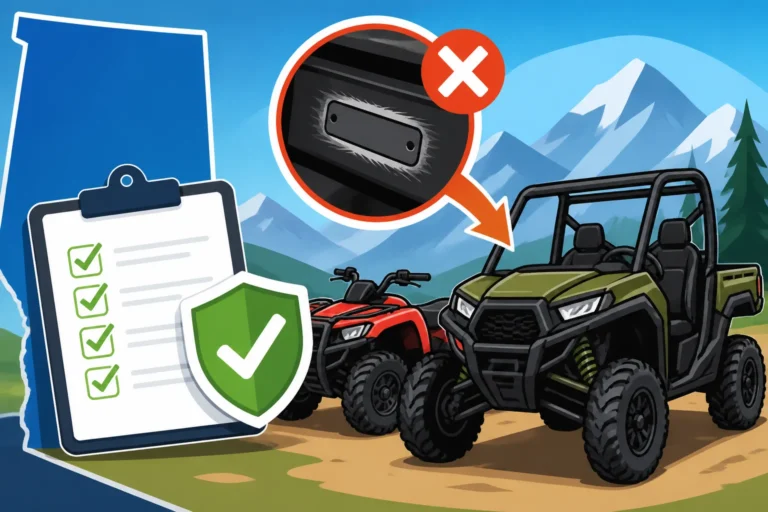
Alberta law requires that your OHV license plate be securely affixed to the rear of your side-by-side. It must be clearly visible, unobstructed, and kept clean so that all characters and numbers are readable at all times. This means no mud caking over it, no gear strapped directly in front of it, and no creative mounting that obscures any part of the plate. Many riders choose to mount their plate to the rear cargo rack or bumper, ensuring it’s well-lit if riding at night. The goal is easy identification for law enforcement and others. For specific guidance on where the plate must sit, check out [Alberta Plate Placement on a Machine]. Fines can be issued for plates that are not properly mounted, illegible due to dirt, or missing entirely, even if you have your registration certificate with you. It's a quick and easy check to avoid a penalty.
Carrying Your Registration and Insurance Proof
Having your side-by-side registered and insured is one thing; being able to prove it on demand is another. Alberta law requires you to carry proof of both your current registration and valid insurance whenever you are operating your OHV on public land.
While your registration certificate is now a digital document, you are legally required to have a printed copy with you. A digital image on your phone is generally not considered sufficient in all circumstances, as per [Printing a Certificate Before You Ride]. So, print out that certificate, fold it neatly, and keep it in a waterproof bag in your glove box, under your seat, or in your riding gear. Similarly, you must carry your insurance pink card or an equivalent proof of insurance. Law enforcement officers have the right to ask you to produce these documents on demand, and failing to do so can result in a ticket, even if your machine is, in fact, registered and insured. [Alberta Proof of Insurance on Demand] emphasizes this point. Make sure they are easily accessible, but also protected from the elements so they remain readable.
Maintaining Your Registration Details
Registration isn't a one-and-done deal. There are specific circumstances where you'll need to update your registration details to ensure they remain accurate and legally compliant. Ignoring these updates can lead to administrative headaches down the road.
If you move to a new address within Alberta, you are legally obligated to update your registration information with a registry agent. This ensures that any official correspondence regarding your side-by-side reaches you. Failing to update your address could mean missing important notices, including renewal reminders or even legal notifications. You can find more information on this process in [Alberta Registration Address Change]. Furthermore, if you decide to sell your registered side-by-side, you are responsible for formally transferring the registration to the new owner. This protects you from any liability associated with the machine once it's no longer yours. The process typically involves both you and the buyer visiting a registry agent to complete the transfer. Detailed steps for this are in [Alberta Registration Transfer After a Sale]. Finally, if you no longer own the machine, or if it's been totalled or will permanently only be on private property, you can also cancel its registration. This is usually done to avoid future renewal reminders or in cases where the machine will never again be operated on public land, and you can learn how to do so in [Cancelling an Alberta ATV Registration].
Common Scenarios and Questions
The registration process for side-by-sides, while generally straightforward, can throw a few curveballs depending on the machine's history or how it was acquired. Here are some common situations that often lead to questions and specific considerations.
Registering a Machine Without a VIN
Imagine finding a great deal on a used side-by-side, only to realize the Vehicle Identification Number (VIN) is missing, defaced, or unreadable. This situation, while challenging, isn't necessarily a dead end, but it will require extra steps and patience.
Attempting to register a machine without a clear, verifiable VIN is significantly more difficult than a standard registration. The VIN is the unique identifier for your side-by-side, much like a fingerprint. Without it, verifying ownership and ensuring the machine isn't stolen becomes problematic. If the VIN is missing or unreadable, your first step should be to thoroughly inspect the machine for any indication of the VIN, including on the frame, engine block, and various data plates. If you can't find it, or if it appears tampered with, you'll need to approach a registry agent to discuss your specific situation. They may advise you to contact law enforcement to have the machine inspected for potential theft or to see if a replacement VIN can be assigned after a thorough investigation. This process can be lengthy and may involve statutory declarations and police checks, as detailed in [Alberta Registration When the VIN Is Gone]. Be prepared for potential hurdles and delays, as the registry agents' primary concern is preventing the registration of stolen or unidentifiable vehicles.
Machines from Out of Province or Country
Alberta is a popular destination, and many riders bring their machines with them, or even purchase them from other jurisdictions. Understanding the specific requirements for machines originating outside of Alberta is crucial for a smooth registration.
If you've recently moved to Alberta and brought your side-by-side from another Canadian province, you're generally allowed to operate it on its out-of-province registration for up to 30 consecutive days. After this period, you are required to register it in Alberta. This process will typically involve providing your previous registration certificate, a bill of sale, and proof of your new Alberta residency. For specific guidance on this, refer to [Alberta Registration for a Machine From BC] or [Alberta Registration for a Machine From Saskatchewan], as the principles are similar for any Canadian province. If you've imported your side-by-side from outside Canada, for example, from the United States, the process becomes more complex. You'll need to ensure all customs clearance paperwork is in order, including proof that all applicable duties and taxes have been paid. The machine may also need to meet Canadian import requirements and potentially undergo a VIN verification before it can be registered in Alberta. [Alberta Registration for an Imported Machine] provides a more in-depth look at this particular scenario, highlighting the critical customs paperwork on the way home.
Business or Fleet Registration
For businesses, organizations, or even individuals who own multiple side-by-sides for commercial purposes or a rental fleet, there are additional considerations for registration to ensure all machines are compliant.
If you're registering side-by-sides for a business, such as for a guided tour company, a logging operation, or an oilfield services company, the registration process is similar to that of a personal machine, but with some key differences. You'll need to provide documentation for the business, such as a corporate registration or trade name registration, and the individual processing the registration will need to show authorization to act on behalf of the company. Each side-by-side in your fleet will require its own unique registration and license plate. For businesses operating a rental fleet, there are often specific liability and insurance requirements to consider, beyond just the basic registration. You can find more detailed information on these requirements in [Alberta Registration for a Business Machine] and [Alberta Registration for a Rental Fleet]. It’s vital to ensure every machine used in a commercial capacity is fully compliant, as penalties for unregistered or uninsured fleet vehicles can be severe and impact the business's operations and reputation.
Here's a handy table summarizing the typical requirements for new versus used side-by-side registration:
| Requirement | New Side-by-Side (from Dealer) | Used Side-by-Side (Private Sale) |
|---|---|---|
| Proof of Ownership | Manufacturer's Statement of Origin (MSO)/NVIS | Bill of Sale (LawDepot recommended) |
| Machine ID | VIN on MSO/NVIS (Verified by agent) | VIN on Bill of Sale (Verified by agent) |
| Personal ID | Valid Alberta Driver's Licence/ID Card | Valid Alberta Driver's Licence/ID Card |
| Residency Proof | Required if ID address is not current | Required if ID address is not current |
| Insurance | Proof of Liability Insurance (Pink Card) | Proof of Liability Insurance (Pink Card) |
| Lien Check | Not applicable (new machine) | Highly Recommended (PPR search at registry) |
| Inspection | Not required | Not required |
| Payment of Fees | Provincial fee + Registry agent fee | Provincial fee + Registry agent fee |
| GST | Applicable at purchase | Generally not applicable (private sale) |
Disclaimer
This article is for general informational purposes only and does not constitute professional advice. Laws, prices and regulations vary by location and change over time. Consult a qualified professional for guidance on your specific situation.