Moving a Random Camp After Fourteen Days
A two-week Alberta riding trip can turn stressful when you realize your camp is nearing its limit and you are not sure what “moving” actually means. On applicable public land, relocating a random camp means more than shifting your tent down the road. This guide explains the 14-day limit, the one-kilometre move, the 72-hour return restriction, and how to plan your ATV or UTV riding around them.
Understand Alberta’s random camping time limits
The 14-day limit applies to your camp location
When random camping is allowed, Alberta’s public-land rules generally limit how long you can stay at one location. The limit is 14 consecutive days. It is a limit on your stay at the location—not a reason to assume that moving your tent a short distance, changing campsites within the same small area, or packing up for a day of riding resets the clock.
The practical approach is to note the date you set up camp and plan your departure before the 14th day. If you arrive on a Friday, for example, mark the date in your phone or on a paper calendar. That small habit can prevent a last-minute scramble to find another suitable spot, especially if the weather turns or your group needs more time to pack.
The rule is part of the wider picture covered in Alberta Random Camping Rules Explained and Alberta’s 14-Day Camping Limit. The exact land designation matters: random camping is not allowed everywhere, and local restrictions, closures, or site-specific rules may affect where you can stay. A spot that appears empty on arrival is not automatically an authorized camping area.
Moving camp involves distance and time away
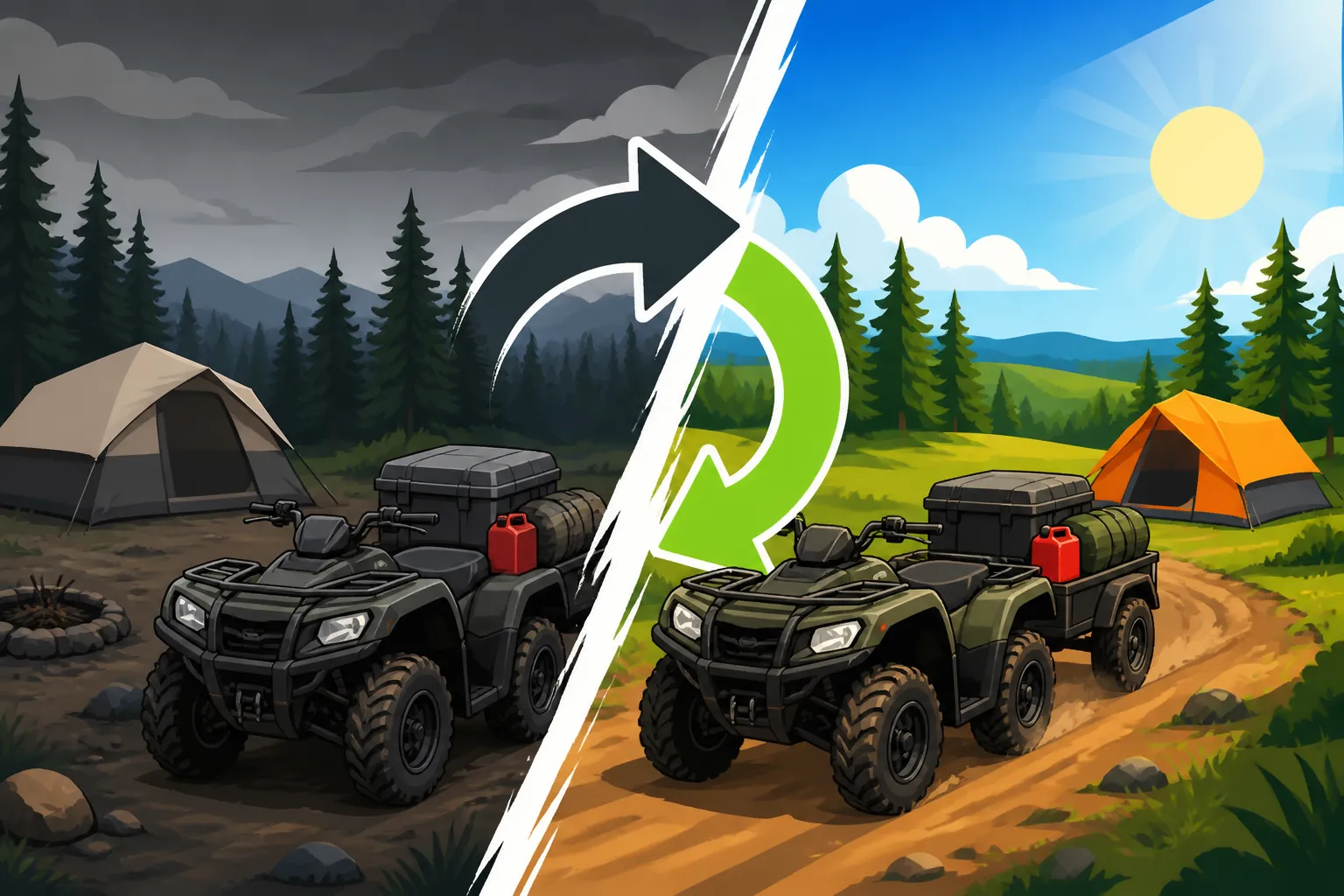
After reaching the applicable stay limit, moving only a few hundred metres is not a reliable reset. The relocation rule calls for moving at least one kilometre from the previous camp location, and you must stay away from that location for 72 hours before returning. In other words, packing up and setting up just beyond the nearest bend may not meet the requirement.
Think of the one-kilometre move and the 72-hour absence as two parts of the same plan. If your group leaves the original camp on Tuesday morning, do not plan to return to that location on Wednesday night. Keep track of both where you moved and when you left. The practical details are covered in Alberta’s 1-Kilometre Relocation Rule and Moving a Kilometre Away and Staying Gone Seventy-Two Hours.
| Planning question | Practical answer |
|---|---|
| How long can you stay at one random camp location? | Generally, up to 14 consecutive days where random camping is permitted |
| How far should you relocate after the stay limit? | At least one kilometre from the previous camp location |
| Can you return to the original location the next day? | No. Stay away for 72 hours before returning |
| Does a short move within the same small camping area reset the limit? | Do not assume it does; plan a clearly separate location at least one kilometre away |
| Does moving camp automatically make OHV use legal? | No. Riding access and camping permission are separate questions |
These are planning basics, not a substitute for checking the rules that apply to the specific public land area. Before setting up, confirm the current land-use information and any closures or special restrictions.
Choose a genuinely separate place to camp
Measure from the original camp, not just the road
A common point of confusion is where to measure the kilometre from. For planning, treat the original camp area as your reference point, rather than assuming a kilometre driven along a winding road necessarily puts you a kilometre away in a straight line. Roads can loop, double back, or run close to the previous site, so distance travelled and distance between locations are not always the same.
Use a reliable map to identify a potential new area and check that it is both far enough away and suitable for camping. onX Offroad can help you inspect terrain and plan a route, but a navigation app should be a planning aid—not the final word on whether camping or riding is allowed. Confirm land status, access, and restrictions using the appropriate Alberta land and trail information before you commit to a new camp.
That matters in places such as the Ghost Public Land Use Zone or the Livingstone and Porcupine Hills area, where access rules, designated routes, seasonal closures, and camping opportunities can differ by location. A point on a digital map may look open while a gate, closure, private parcel, lease condition, or local restriction makes the route or destination unsuitable.
Pick a spot that is legal and practical for the whole group
A legal distance is only one part of a good relocation. Look for a site where camping is permitted, where vehicles can reach the area without creating new tracks, and where you can set up without damaging vegetation or sensitive ground. Avoid choosing a spot simply because it is the first empty clearing beyond the one-kilometre mark.
Consider the group’s needs before you move. A family travelling with a trailer may need a firm, level approach and room to turn around. A group with several machines may need enough space to park without blocking a road or access point. If the new site is close to water, wetlands, a recreation area, or an industrial facility, check the applicable setbacks and land-use guidance rather than guessing.
Also think about the next morning. Is there a lawful route from the camp to the trails you plan to ride? Will your machines need to cross a closed area, private land, or a restricted road to get there? A campsite that meets the relocation distance but creates an access problem is not a useful solution.
Plan the move around your ATV or UTV ride
Keep camping rules separate from riding rules
A camping move does not grant permission to ride wherever you like. Alberta OHV access depends on the land designation, route status, closures, and applicable rules. Some public land areas require riders to remain on designated trails; elsewhere, access may be subject to different restrictions. A camp can be permitted while a nearby cutline or trail is closed to your machine.
Before riding from either the old or new camp, check the land area and route information. If you are heading to a Public Land Use Zone, review the specific zone rather than relying on a general map view. Checking a Zone Before You Go and Alberta OHV Trail Map Downloads are useful starting points for building that habit. For riding in the Ghost, for example, designated routes and seasonal conditions can shape which loops are practical from your campsite.
Use onX Offroad to help organize a proposed route, identify nearby roads or trails, and keep your group oriented when mobile service is poor. Then compare that plan with official land-use information and posted signs on the ground. If a gate or closure conflicts with the route on your screen, follow the restriction and choose another route.
Pack and move camp without leaving a mess
A relocation day can feel like a chore, particularly when the machines are muddy, the trailer is loaded, and everyone would rather be riding. A simple packing order helps keep the move calm. Secure loose gear first, check that fuel and food are stored safely, and make sure nothing can slide off a rack or trailer on rough access roads. Give yourself enough time to reach the new area before dark.
Before leaving, walk through the old site. Collect food scraps, packaging, broken straps, and small items that are easy to miss in grass or gravel. Put out any fire completely where fires are allowed, and follow fire restrictions in effect for the area. Leave the site in a condition that does not advertise that a group has been camping there.
At the new camp, keep vehicles and trailers on durable surfaces where possible. Do not widen a track to make turning easier, drive across wet ground to find a flatter spot, or treat an open-looking area as permission to create a new route. These choices protect the area and make it less likely that a temporary camp creates lasting damage.
Build a simple 14-day relocation plan
Record the dates, locations, and return window
Do not rely on everyone in the group remembering when camp began. Put the arrival date in a shared trip note and mark the day you need to leave. Record the original location and the proposed relocation point as well. A paper map, saved offline map, or shared GPS pin can help the group understand where the one-kilometre move begins and ends.
A practical plan might look like this:
- On arrival, confirm the camping area is permitted. Check the land designation, notices, and any local restrictions.
- Write down the setup date. Set a reminder a few days before the 14-day limit.
- Choose a second camp location early. Confirm it is at least one kilometre from the original location and that camping and vehicle access are permitted there.
- Plan the 72-hour absence. Note the earliest time you could return to the original location, and do not build the itinerary around returning sooner.
- Check your riding routes separately. Confirm that trails and access roads are open and appropriate for your machine.
- Recheck conditions before moving. Closures, fire restrictions, weather, and access conditions can change your practical options.
onX Offroad may help with route organization and saved map views, especially when you are planning the relocation before leaving signal range. Keep another way to navigate as well, and do not let an app’s displayed route override signs, closures, or land-use rules.
Have a backup if the preferred site is unavailable
A planned relocation can fall apart for ordinary reasons: a road is closed, the ground is too wet, a site is already occupied, or the group discovers the access route is not suitable for a trailer. Keep a backup option rather than assuming your first choice will work. If neither location is clearly allowed, move to an established campground or another authorized area instead of improvising on land where camping may be restricted.
It can also help to make the move an itinerary change rather than a lost riding day. Choose a route that gets the group to the new camp safely, then plan a shorter ride from there. If the group is exhausted or the weather is poor, getting the camp established before dark is more important than squeezing in another trail loop.
Before you leave, review the area’s current rules and carry the information you may need offline. You can use onX Offroad as one part of that preparation, but check official sources for camping permission, restrictions, and trail status. For broader context on how land designations affect access, see Alberta’s Public Land Use Zones Explained.
Disclaimer
This article is for general informational purposes only and does not constitute professional advice. Laws, prices and regulations vary by location and change over time. Consult a qualified professional for guidance on your specific situation.