Alberta Cabins Near a Riding Area
A cabin that looks close to an Alberta trail on a map may still be a long drive from a legal staging area, and some places do not allow you to ride directly from the property. This guide explains how to choose a cabin near an OHV riding area, compare practical locations, check access and rules, and plan for the details that can make or break a riding weekend.
What “near a riding area” means in Alberta
Close to a trail is not always close to a legal starting point
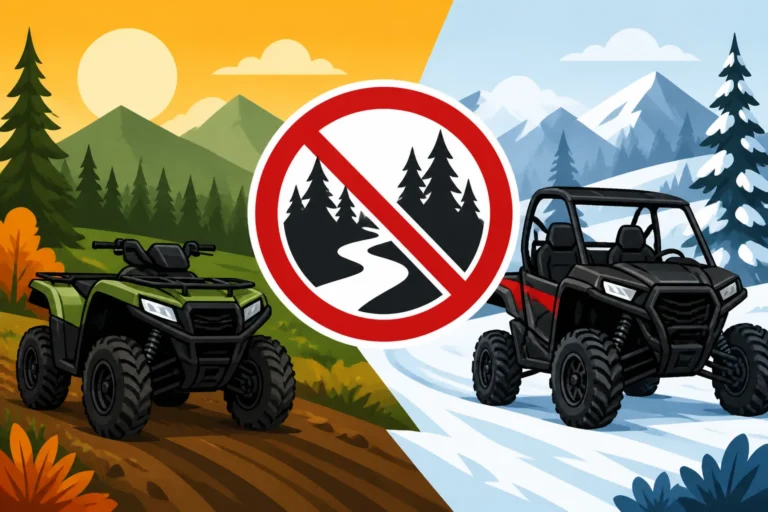
A cabin can be near forest, foothills, or a web of unpaved roads without having a legal OHV route from its driveway. The property may sit beside private land, a road where OHVs are not allowed, or an area with seasonal restrictions. You may still need to load your ATV or side-by-side onto a trailer and drive to an approved staging area before unloading.
That distinction matters when you are comparing listings. A description such as “minutes from trails” may refer to a scenic walk, a mountain-bike route, or a road that is not open to your machine. Ask the host exactly where riders are permitted to unload and whether guests commonly haul machines to a staging area.
In Alberta, a nearby road or ditch is not automatically an OHV route. Local bylaws and land-use rules can determine where riding is allowed, so check the route rather than assuming you can ride from the cabin. [Alberta ATV Road Rules: Bylaws Decide] is useful background when a proposed route includes a town street, county road, or highway ditch.
Decide whether you want trail access or a comfortable base
For some groups, the priority is minimizing the drive to the riding area. They are happy with a simple cabin, basic cooking facilities, and a short trailer haul each morning. Other groups want a quiet, comfortable place to return to after a muddy day, even if reaching the staging area takes longer.
Think about the shape of your weekend. A group doing long days on the trails may value nearby fuel, food, trailer parking, and a place to rinse mud off gear more than a cabin with a scenic view. Families or mixed groups may prefer a location with room to relax while some riders head out for the day.
It also helps to separate “near the riding region” from “near the exact trailhead.” Alberta riding areas can cover a wide stretch of public land, while the closest accommodation may be in a nearby community. Browse [Alberta OHV Camping and Staging Areas] and [Alberta Trails With Camping] to get a better sense of where riding-day logistics happen.
Check the riding area, not just the accommodation listing
Start by identifying the riding area you intend to visit, then locate its staging areas, access roads, and current rules. Do this before choosing a cabin whenever possible. If you book first, you may discover that the closest suitable riding area is farther away than expected or that a route you had in mind is closed to your machine.
A mapping tool such as onX Offroad can help you visualize roads and riding routes while you compare accommodation locations. Treat the map as a planning aid, not as confirmation that a route is currently open or legal. Cross-check route access with official land-use information and local updates before you unload.
For public land, the exact zone can affect which trails are designated and which machines are permitted. [Alberta's Public Land Use Zones Explained] and [Checking a Zone Before You Go] can help you build that check into your planning instead of leaving it until you arrive.
Alberta areas to consider for a cabin-based riding trip
The foothills west of Calgary
The foothills west of Calgary can suit riders looking for a mix of forest roads, rugged terrain, and access to established riding areas. McLean Creek is a familiar destination for many Calgary-area riders, but a cabin anywhere in the broader region is not necessarily close to its staging points. Check the actual driving route, trailer access, and where you are allowed to unload.
For a cabin trip, consider whether your group wants to stay near the riding area or in a community that offers more services. A more remote stay may reduce the morning drive but can make fuel, groceries, and last-minute supplies less convenient. A town-based stay can make those errands easier while adding time on the road to the staging area.
Be especially careful about assuming you can ride along a nearby road to connect the cabin to public land. Road access depends on local rules, and a route that appears continuous on a map may include a closed or restricted segment. Use [Alberta Trails Near Calgary] to explore the broader region, then confirm the rules for the specific route and zone you plan to use.
Rocky Mountain House, Nordegg, and the central foothills
The Rocky Mountain House and Nordegg area can work well as a base for riders exploring central Alberta’s foothills and public-land riding options. These are not interchangeable starting points: the best choice depends on the riding zone, the condition of your access roads, and how much time your group is willing to spend driving with a trailer.
Cabin listings in this region may be spread between town, rural properties, and more remote settings. A remote cabin can feel like a true getaway, but ask about the final approach road, parking surface, turning room, and whether a long trailer can be left safely. A narrow or steep access road can be tiring after a full day on the trails, especially if you are towing.
Make a practical arrival plan. Confirm where you can park the truck and trailer, whether there is space to turn around, and what happens if you arrive after dark or in wet weather. Riders coming from central Alberta can compare options through [Alberta Trails Near Red Deer] and use [Alberta Trail Maps Worth Downloading] to prepare maps before reaching areas with unreliable cell service.
Hinton, Grande Prairie, and northern riding trips
Hinton can be a useful accommodation base for riders planning trips into the surrounding foothills and forest regions. Grande Prairie and nearby northern communities may make sense for trips farther north. In both cases, “near the trails” can cover a large area, so choose the riding zone before narrowing down cabin locations.
Northern trips often call for more attention to fuel range, food, weather, and communications. A cabin that is convenient for one riding area may be poorly placed for another, and a route that looks short on a screen can take longer with a trailer or on rough roads. If the group is splitting days between different zones, compare the driving time to each staging point rather than focusing on the closest one.
For a northern or multi-day itinerary, make sure everyone agrees on the plan before booking. Confirm who is bringing the trailer, where machines will be stored overnight, and whether the accommodation has room for the full group and its gear. [Alberta Trails Near Edmonton] and [Alberta Trails Near Grande Prairie] can help you explore possible destinations before you settle on a cabin base.
How to choose a cabin that works for riders
Compare access, parking, and machine storage
A rider-friendly cabin is not just a place to sleep. You need enough space for the people, machines, and equipment in your group. Ask whether the property has secure parking for the truck and trailer, room to unload if that is permitted, and a safe place to store machines overnight.
If the cabin is on a narrow rural road or shared property, clarify where a trailer can be parked without blocking neighbours or emergency access. Do not assume the listing photos show the full parking area. Ask for a description of the approach road and whether it is suitable for the size of your towing setup.
Use this checklist when comparing options:
| What to confirm | Why it matters |
|---|---|
| Trailer parking and turning space | A tight driveway can make arrival and departure stressful |
| Machine storage | Machines and riding gear need a secure, practical overnight spot |
| Legal route to staging | Nearby roads may not be open to OHVs |
| Distance to fuel and supplies | Remote locations can require more advance planning |
| Road conditions | Gravel, mud, steep grades, or snow can affect towing |
| Cleaning expectations | Hosts may restrict washing machines or muddy gear on the property |
| Group capacity | Beds, bathrooms, and common space should match the group |
| Cell coverage | Useful for coordination, navigation, and emergencies |
Ask the host specific questions rather than relying on a general “ATV-friendly” label. For example: “Can we park a truck and trailer on the property?” and “Where do guests legally unload their machines?” These questions are easier to resolve before booking than after a long drive.
Match the accommodation to your group
A large group may need more than enough beds. Consider bathrooms, drying space, shared meal preparation, and a place to spread out wet riding gear. If everyone returns at the same time, a small entryway can quickly become a pile of muddy boots, helmets, gloves, and rain layers.
For families, check whether the cabin layout and property are suitable for children when machines are being unloaded or stored. Keep children away from active loading areas, and do not treat a private driveway as a riding area unless the property owner clearly permits it and the arrangement is safe.
A couple or small group may prefer a simpler cabin close to the chosen staging area, while a mixed group may be happier in a larger place with room for non-riders to relax. Be clear about the daily schedule, too. Some riders want an early start and a full day on the trail; others would rather have a slower morning and a shorter ride.
Budget for more than the nightly stay
The cabin rate is only one part of a riding weekend. Add the cost and time of towing, fuel, groceries, any required passes, and possible cleaning or damage deposits. A lower-cost cabin farther from the staging area may not be the better value if the group spends much more time and fuel getting to and from the trails.
Ask about the host’s policies for muddy equipment, outdoor washing, trailer parking, and late arrival. Some properties may not allow machines to be washed on-site because of drainage, septic, or neighbour concerns. Bring a plan for cleaning gear at an appropriate location instead of assuming a garden hose will be available.
Also consider the non-riding parts of the trip. If the weather turns, a fire restriction closes an area, or a machine needs attention, the group will still need somewhere comfortable to spend time. A cabin with a usable kitchen, indoor gathering space, and nearby services can make a disrupted riding day much easier.
Plan the ride before you arrive
Confirm access and conditions close to departure
Once the cabin is booked, identify your intended staging point and check whether it is appropriate for your machine and trailer. Review the current land-use information, seasonal restrictions, and access conditions. Trail networks can change, and storms, maintenance, fire activity, or land-management decisions may affect where you can ride.
Build a backup plan instead of relying on one route. Identify another legal riding option within a reasonable drive, and agree on what the group will do if the primary area is unavailable. A backup could mean shifting to another permitted zone, changing the riding day, or making the trip more about the cabin and less about the trail.
onX Offroad can help with route orientation and offline planning, especially when cell service is limited. Download or prepare the information you need before leaving town, but do not use a mapped line alone as proof that a trail is open. [Alberta Trail Maps Worth Downloading] can help you think through map preparation, and [Alberta Random Camping Rules] is relevant if your plans also include camping on public land.
Pack for towing and backcountry riding
A cabin stay does not remove the need to prepare for a remote ride. Pack basic machine tools, tire repair supplies, water, food, warm layers, rain protection, a first-aid kit, and a way to communicate if your group separates or runs into trouble. The foothills can feel chilly and wet even when conditions in town seem mild.
Check each machine before leaving the cabin: tires, brakes, lights, fuel, belts or chains as applicable, and any required safety equipment. Make sure your load is secured for the drive to the staging area. Loose gear can shift during towing, and a forgotten helmet or essential tool is much harder to replace once you are away from town.
Set expectations for the group. Agree on a meeting point, a turnaround time, and what happens if a machine has a problem. Riders should know the day’s general route and carry the essentials themselves rather than relying on one person to carry everything.
Respect the cabin, land, and local community
Riding responsibly includes how you behave before and after the trail. Keep noise down when arriving early or returning late, follow the host’s instructions for parking and gear, and avoid revving or testing machines near neighbours. A quiet cabin community can be a long way from the trailhead, but residents still share the roads and the area around your accommodation.
On public land, stay on designated routes and respect closures, posted signs, and other users. Do not cut across private property just because it looks like the shortest connection between a cabin and a trail. If you are uncertain whether a road is open, stop and verify rather than making the route up as you go.
A well-planned cabin trip gives you a comfortable base without blurring the line between lodging access and legal riding access. Pick the riding area first, confirm where you can stage, and then choose accommodation that makes the drive, storage, and group logistics manageable. That small amount of planning can save a weekend from turning into a frustrating search for somewhere to unload.
Disclaimer
This article is for general informational purposes only and does not constitute professional advice. Laws, prices and regulations vary by location and change over time. Consult a qualified professional for guidance on your specific situation.