When a Town Bylaw Limits How Many Ride
Navigating Alberta's off-highway vehicle (OHV) rules can feel like trying to hit a moving target, especially when you think you've got the provincial regulations down, only to find a local town or county has a completely different set of expectations. Many riders assume that if their quad or side-by-side has enough seats, they can take as many passengers as those seats allow. But the reality is far more complex, and local bylaws often impose strict limits on how many people can actually ride an OHV within their specific boundaries, leading to confusion and, unfortunately, unexpected fines. This guide will help you understand why these local rules exist, how they differ from provincial norms, and what you need to do to avoid inadvertently breaking a bylaw when riding in Alberta's communities.
The Provincial Baseline for Passengers on OHVs
Before we dive into the nuanced world of local bylaws, it's essential to understand the general rules set out by the province regarding passengers on off-highway vehicles. The provincial regulations generally focus on safety, ensuring that machines are operated responsibly and that passengers are carried in a manner that doesn't compromise the safety of anyone on board or nearby. This is often the starting point, but it's rarely the complete picture, especially once you enter a specific town or county.
At a foundational level, Alberta's Traffic Safety Act and the Off-Highway Vehicle Regulation emphasize that an OHV is designed by its manufacturer for a certain number of occupants. For many quads, this means a single operator, unless it's specifically designed as a two-up machine with a designated passenger seat and grab handles. Side-by-sides, with their bucket seats and seatbelts, are typically designed for two, three, or even four occupants, depending on the model. The key here is the manufacturer's design. If a machine isn't built to carry a passenger, adding one can immediately put you in violation of provincial rules, regardless of any local bylaw. [Alberta Passenger Rules on an OHV] details these provincial expectations more thoroughly.
Riders often feel frustrated because their machine physically has space, or they've seen others riding with multiple people in other areas. However, the letter of the law is quite clear: if your quad is a single-rider model, carrying a passenger can lead to fines. This isn't about how comfortable your friend is perched on the back rack; it's about the vehicle's design and the inherent safety risks. Ensuring your machine's suspension and frame are designed to handle the additional weight, and that the passenger has proper handholds and footrests, is paramount. Even if your machine is rated for passengers, remember that robust aftermarket parts, perhaps from a reputable brand like SuperATV, can provide added durability and peace of mind on challenging trails, though they don't change the manufacturer's passenger rating.
Manufacturer Passenger Limits on a Side-by-Side
Side-by-sides, or UTVs, are a different beast compared to traditional quads when it comes to passengers. These machines often come equipped with multiple seats, seatbelts, and roll-over protection systems (ROPS). The manufacturer's stated capacity, usually found in the owner's manual or on a decal on the machine itself, is the primary guide for how many people can safely and legally ride. If your side-by-side has two bucket seats, it's a two-person machine. If it has a bench seat designed for three, then three can ride.
The temptation to squeeze in an extra small person, perhaps a child, is understandable, especially on family outings. However, exceeding the manufacturer's passenger limit, even if that extra person seems small, can have severe consequences. Not only does it compromise safety by shifting the machine's centre of gravity and potentially overloading the suspension, but it also puts you in direct violation of the provincial regulations tied to the manufacturer's design. This isn't just about tickets; it's about the increased risk of a rollover or loss of control, especially on uneven terrain.
Why Local Bylaws Introduce Further Restrictions
Now, let's talk about the real curveball: local bylaws. While provincial regulations set a baseline, individual towns, counties, and municipal districts in Alberta have the authority to create their own bylaws that can further restrict OHV use within their boundaries. These bylaws are often enacted for a variety of reasons, including public safety, noise reduction, environmental protection, and managing traffic congestion, especially in more populated areas or near residential zones.
A provincial rule might allow you to carry a passenger on a two-up quad, but a town bylaw could state that no OHV, regardless of its design, may carry more than one occupant on any road or trail within its jurisdiction. This can be incredibly frustrating for riders who travel from one area to another, expecting consistency. You might be legally riding with your child on your two-up quad in a Public Land Use Zone (PLUZ), only to enter a small town for gas or supplies and suddenly be in violation of a bylaw that restricts all OHVs to a single rider on their streets. [Alberta ATV Road Rules: Bylaws Decide] offers more context on how these local rules shape where and how you can ride.
The patchwork nature of these bylaws means that what's perfectly legal in the County of Wetaskiwin might be strictly prohibited just a few kilometres away in the Town of Falun, or vice versa. This is a common source of complaints among OHV enthusiasts who simply want clear, consistent guidelines. Understanding that municipalities are responding to their unique local concerns—whether it's managing traffic on busy streets or addressing noise complaints from residents—can help clarify why these differences exist, even if it doesn't make them any less inconvenient.
Town Bylaws That Cap Passengers
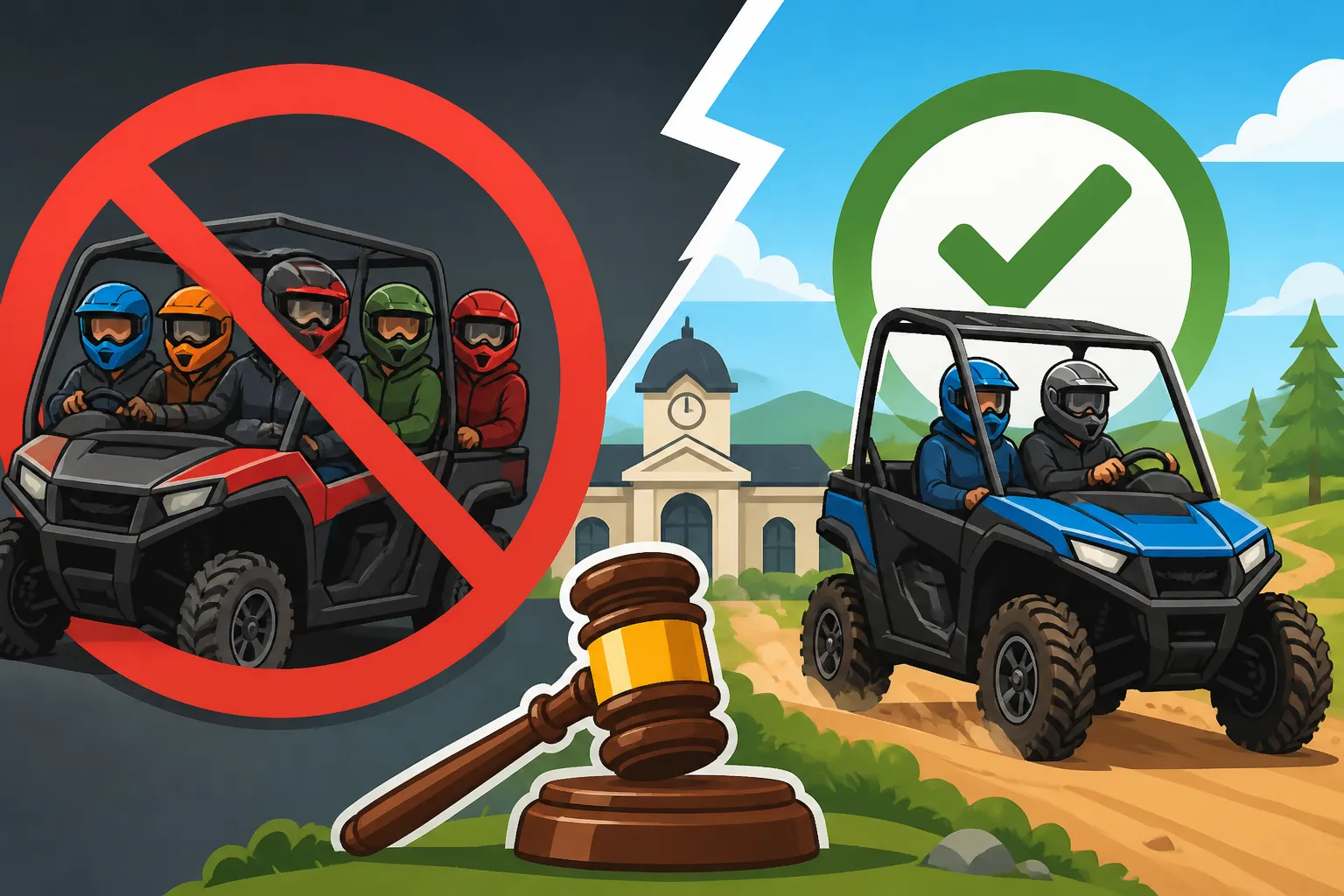
Some municipalities, particularly smaller towns or villages with limited road networks or those sensitive to recreational vehicle traffic, choose to implement bylaws that place an absolute cap on the number of passengers an OHV can carry. This can override the manufacturer's design for certain uses. For example, a bylaw might state: "No off-highway vehicle shall carry more than one person within town limits, regardless of its seating capacity."
Imagine you're driving your four-seat side-by-side, fully legal with your family of four on a designated trail just outside of town. You decide to pop into town for a quick ice cream. The moment your tires cross the municipal boundary, you could be in violation if that town has such a bylaw. This isn't about the safety features of your SuperATV equipped machine; it's a blanket rule designed to limit vehicle presence and impact. Such bylaws are typically aimed at reducing the overall footprint of OHVs, mitigating potential safety issues on shared roads, or simply maintaining a quieter atmosphere.
These rules often target the perceived nuisance of OHVs more broadly, rather than individual safety specifications. It’s not uncommon for towns to implement these types of restrictions alongside other rules, such as speed limits, noise restrictions, or specific routes OHVs are allowed to use, if any. The intent is often to manage the flow and presence of OHVs within the community, rather than to question the structural integrity or design of your particular machine.
When a Town Bylaw Limits How Many Ride
The core of the issue is that local bylaws can and do supersede certain aspects of provincial OHV regulations within their specific geographic areas. While the province dictates things like registration, helmet use, and general safe operation, municipalities retain the power to regulate "the use of highways and lands under their direction, supervision and control," which includes restricting the number of occupants on an OHV within their corporate limits.
This means a town might look at OHVs—even multi-passenger side-by-sides—and classify them as vehicles generally unsuited for their particular streets or shared pathways when carrying more than a single operator. Their reasoning might stem from narrower roads, pedestrian safety concerns, or simply a desire to keep the number of recreational vehicles on their roads to a minimum. The frustration here for riders is palpable: you've invested in a machine designed for family outings, only to find you can't use it as intended in certain areas. [Alberta Towns That Ban Quads] further illustrates the extent of municipal power in this regard.
It's crucial for riders to recognize that these bylaws are legally binding within the municipality's jurisdiction. An enforcement officer in that town will be operating under the local bylaw, not just the provincial Traffic Safety Act. Ignorance of the bylaw is generally not accepted as a defence, making it imperative for riders to do their homework before entering any new area.
How to Find and Understand Local OHV Bylaws
Given the variability of local rules, performing your due diligence before you ride into a new town or county is not just good practice—it's essential. Relying on what you think the rules are, or what you've observed others doing, can easily lead to a ticket. The responsibility to know and follow local bylaws rests squarely on the rider's shoulders.
The best place to start is always the municipal office or website of the specific town, village, or county you plan to visit or pass through. Most municipalities in Alberta have their bylaws available online, usually under sections related to "Bylaws," "Transportation," "Public Safety," or "Off-Highway Vehicles." A quick search for "[Town Name] OHV bylaw" can often yield the relevant documents. However, these documents can sometimes be written in legalistic language that's not always easy to decipher for the average rider.
Don't be afraid to make a phone call! A quick call to the municipal office or community peace officer's department can often get you a clear answer in plain language regarding OHV access and passenger limits. It's much better to spend five minutes on the phone beforehand than to spend an hour dealing with a ticket on the side of the road. Ask specific questions: "Can I ride my side-by-side with two passengers on your municipal roads?" or "Are there any restrictions on OHV passenger numbers within your town limits?"
Checking a Town's Official Website
When you visit a municipal website, look for a "Bylaws" section. Often, OHV regulations are grouped with traffic or public safety bylaws. You might find a specific "Off-Highway Vehicle Bylaw" or see OHV rules embedded within a broader "Traffic Bylaw." It's important to read the entire relevant section, not just skim for keywords. Sometimes, the restriction on passengers might not be in the most obvious place.
For instance, the County of Grande Prairie might have different rules than the Town of Wembley, even though they are geographically close. The County might allow multi-passenger OHVs on designated county roads, while Wembley, as a town, might have a stricter "one person per OHV" rule on its paved streets. Pay close attention to definitions within the bylaw as well. "Highway" in a bylaw context often includes not just paved roads but also ditches, shoulders, and even alleys, which might surprise some riders.
If you can't find clear information online, or the language is confusing, do not guess. That's when a phone call becomes absolutely critical.
Reaching Out to Local Enforcement or Town Office
Making a direct inquiry to the local authorities is a proactive and reliable way to get accurate information. Community Peace Officers, RCMP detachments (if they serve the area), or the local town or county office's administrative staff can usually provide the necessary details. When you call, be polite, state your intentions clearly (e.g., "I'm planning to ride my OHV in your area and want to understand your local bylaws regarding passengers"), and be ready to provide details about your machine if asked.
Here's a small table comparing how different municipalities might approach OHV passenger rules:
| Municipality Type | Typical Provincial Rule | Hypothetical Local Bylaw | Example Scenario |
|---|---|---|---|
| Provincial PLUZ | Manufacturer's capacity | N/A (provincial rules apply) | Riding a 4-seater side-by-side with 4 people. |
| Rural County | Manufacturer's capacity | May restrict to 2 on specific roads | County permits 2 passengers on gravel roads, but 4 on trails. |
| Small Town/Village | Manufacturer's capacity | Often restricts to 1 on all roads | Despite your 4-seat side-by-side, only 1 person allowed on town streets. |
| Residential Area | Manufacturer's capacity | May prohibit OHVs entirely | OHVs (even with one rider) may be banned from residential streets for noise/safety. |
This table illustrates the potential for significant variations. A call to the local office can clarify which row in this table applies to the specific location you're interested in, helping you avoid a ticket for simply not knowing the local nuances.
Penalties for Violating OHV Passenger Bylaws
Falling foul of a municipal OHV bylaw can be a costly and inconvenient experience. The penalties for violating these bylaws vary depending on the municipality and the specific nature of the infraction, but they generally involve fines. These aren't just minor slaps on the wrist; they can be substantial, often comparable to traffic tickets issued for vehicle violations on major roads.
Beyond the immediate financial hit, receiving a bylaw ticket can also lead to other complications. While most OHV bylaw infractions are not demerit-generating, they are still a legal matter that requires your attention. You might need to take time off work to appear in court if you choose to dispute the ticket, or you might find yourself explaining the incident to an insurance provider if an accident occurred while in violation. [Alberta Ticket Costs for a Riding Violation] and [Alberta Court Costs for an OHV Citation] can give you an idea of the potential financial burden.
The enforcement of these bylaws is often carried out by local Community Peace Officers, who are specifically empowered to enforce municipal regulations. They are well-versed in the local rules and are not likely to be swayed by arguments that "it's allowed everywhere else." Their job is to ensure compliance within their jurisdiction, and that means adhering to the local bylaw, even if it feels restrictive compared to broader provincial rules or manufacturer specifications.
Fines and Enforcement
The specific fine amount for carrying too many passengers on an OHV in violation of a local bylaw will be stipulated in that bylaw. These fines can range from a couple of hundred dollars to significantly more, depending on the municipality and the severity of the perceived infraction. For example, some bylaws might have a base fine, with additional penalties if other violations (like operating without a helmet, or on a prohibited road) are also observed.
Enforcement often occurs in areas where OHV use is either common or has generated complaints. This could be on designated access routes into a town, near residential areas, or even in popular staging areas if those areas fall within municipal boundaries with specific restrictions. Officers might be present during peak riding seasons or in response to specific community concerns about OHV traffic and safety. It's not uncommon for officers to conduct routine checks at known OHV access points, where they might review registration, insurance, and compliance with local bylaws, including passenger limits. [Alberta Officer Checks at a Staging Area] goes into more detail about what officers look for.
It's also worth noting that repeat offences or severe violations could potentially lead to more serious consequences, although this is less common for a simple passenger limit infraction. However, if the issue is combined with reckless driving or other dangerous behaviours, local authorities have a range of options at their disposal.
Vehicle Seizure Possibilities
While unlikely for a first-time, isolated passenger limit violation, it's crucial to understand that in certain extreme circumstances, an OHV can be seized by authorities. This usually occurs when there are much more severe infractions involved, such as operating an unregistered or uninsured machine, impaired driving, or persistent and dangerous disregard for safety regulations. [Alberta Vehicle Seizure for No Insurance] provides examples of when seizure is a real possibility.
However, if a passenger limit violation is part of a larger pattern of non-compliance, or if it contributes to an accident where serious injury or property damage occurs, authorities might have broader powers. For instance, if a machine is deemed unsafe for operation due to gross overloading that contributes to a dangerous incident, it's not outside the realm of possibility for enforcement to take more drastic measures. This underscores the importance of not just knowing the rules, but also prioritizing safety and responsible operation at all times.
At the end of the day, municipal bylaws are put in place for a reason, even if those reasons aren't always immediately clear or convenient to riders. Being informed, respectful, and proactive in understanding these local rules is the best way to ensure your ride in Alberta is enjoyable, safe, and free from unexpected penalties.
Disclaimer
This article is for general informational purposes only and does not constitute professional advice. Laws, prices and regulations vary by location and change over time. Consult a qualified professional for guidance on your specific situation.