Alberta Registration Before Your First Ride
It can be incredibly frustrating to get a new-to-you ATV or side-by-side, feel the excitement bubbling up to hit the trails, only to realize you're not entirely sure what paperwork you need to sort out first. Many riders mistakenly believe they can just take their machine out for a spin, especially if it's "just on public land." This guide will walk you through everything you absolutely must do to get your off-highway vehicle (OHV) legally registered and ready for its first ride in Alberta, ensuring you avoid fines and headaches.
The Basics: Why You Can't Just Hop On and Go
Alberta's vast landscapes are a dream for OHV enthusiasts, offering countless kilometres of trails, cutlines, and open spaces. But with that freedom comes responsibility, and a big part of that is ensuring your machine is properly registered and prepared. It’s not just a suggestion; it’s the law, and overlooking these initial steps can lead to significant inconvenience, financial penalties, or even having your machine seized.
Understanding Alberta's Off-Highway Vehicle Regulations
The foundation of safe and legal OHV operation in Alberta lies in the provincial regulations, specifically the Traffic Safety Act and the Off-Highway Vehicle Regulation 319/2002. These aren't obscure rules tucked away in some dusty government manual; they are active laws enforced by peace officers and RCMP on public land throughout the province. Many new riders, or even those coming from other provinces, are genuinely surprised by the strictness, especially when they just want to explore a local gravel pit or a forestry road. The key takeaway here is that most places you'd want to ride, including forestry roads, designated OHV areas like McLean Creek, and even highway ditches, are considered "public land" under these regulations. This means your machine needs to be street-legal in the sense of registration and insurance, even if it's never touching an actual paved road.
Without proper registration, you're not only breaking the law but also putting yourself at risk. Imagine being pulled over far out on a trail; the officer isn't just going to give you a warning. Ignorance of the law is rarely an excuse that holds up. Understanding these regulations from the outset saves you a lot of trouble down the line and ensures your first ride is memorable for all the right reasons.
What "Registration" Really Means in Alberta
When we talk about registering an OHV in Alberta, it's not just a casual formality or a simple sticker you put on your fender. It's a comprehensive process that results in a physical license plate for your machine and a registration certificate. Unlike some other jurisdictions that might use a sticker system, Alberta takes a more traditional approach. You'll receive an actual metal plate, which must be displayed properly on your OHV, along with a paper registration certificate that you need to carry with you when you ride. This certificate is your official proof that the machine is legally registered to you.
It's also important to understand that registration is tied to the machine itself, not just the rider. If you sell your ATV or side-by-side, the registration needs to be transferred to the new owner. If you acquire a used machine, you'll be responsible for registering it in your name. This system helps ensure accountability and traceability for every OHV operating on public land. For many years, Alberta had plate stickers, but that changed. If you’re wondering if you need one, remember: [Alberta Issues a Plate, Not a Sticker]. The plate is the primary identifier, and your paper certificate validates its active status.
Essential Steps Before You Hit the Trail
Getting your OHV registered is a fairly straightforward process, but it requires a bit of preparation. Walking into a registry office without all your ducks in a row can lead to wasted time and frustration. Let’s break down exactly what you’ll need and what to expect.
Gathering Your Paperwork and Information
Before you even think about heading to a registry agent, you need to collect all the necessary documents. This is where most people get tripped up, especially if they’ve bought a machine privately or are dealing with a unique situation. For a new machine purchased from a dealer, you’ll typically receive a New Vehicle Information Statement (NVIS) or a Manufacturer's Statement of Origin (MSO) directly from the dealership, along with your bill of sale. For a used machine, a properly filled-out bill of sale is absolutely crucial. This document needs to clearly state the buyer’s and seller’s names and addresses, the date of sale, the purchase price, and a full description of the OHV, including its make, model, year, and most importantly, the Vehicle Identification Number (VIN).
You’ll also need valid personal identification (like a driver’s license) that shows your full legal name and current address. If the address on your ID isn't current, you might need a secondary piece of mail with your name and current address to prove residency. Make sure the VIN on your bill of sale matches the VIN physically stamped on the machine itself. Discrepancies here will cause delays. If you’re buying a used machine privately and want to ensure you have a robust bill of sale, resources like LawDepot can help you generate a professional document. Having everything organized means a smooth transaction at the registry, so take the time to double-check everything before you leave your house. For those trickier situations, like a used machine with no formal bill of sale, there are specific procedures you can follow to still get registered; you might need to look into [Alberta Registration Without a Bill of Sale] for guidance.
The Registry Visit: What to Expect
Once your paperwork is meticulously organized, your next step is to visit an authorized Alberta Registry Agent. These are the folks who handle all vehicle registrations in the province, including OHVs. You can find them in most towns and cities across Alberta. When you arrive, you’ll present your identification and all your machine-related documents to a registry clerk. They will review everything, enter the information into the provincial system, and process the registration.
You’ll be asked to choose a registration term, typically one or two years. The clerk will then collect the applicable fees. It’s worth noting that beyond the base registration cost, there will be registry agent service fees, which can vary slightly from office to office. It’s a good idea to know [What Alberta OHV Registration Costs] and understand [Alberta Registry Counter Fees] beforehand, so you’re not caught off guard. After everything is processed, you'll be issued your new OHV license plate on the spot, along with your paper registration certificate. Remember to keep this certificate in a safe, accessible place, as you’ll need to carry it with you when you ride. Many riders keep a laminated copy in a waterproof pouch on their machine, and the original safely tucked away at home.
Beyond Registration: Insurance and Equipment Checks
Getting your OHV registered is a massive first step, but it’s not the only thing you need to consider before heading out. There are two other critical areas that often catch riders off guard: mandatory insurance and essential equipment requirements. Skipping these can be just as problematic as riding unregistered.
The Absolute Must-Have: Proof of Insurance
This is a non-negotiable for anyone planning to ride an OHV on public land in Alberta. The law is very clear: you must have valid third-party liability insurance for your off-highway vehicle if you intend to operate it anywhere that isn't entirely private property. This includes designated OHV trails, Crown land, and even those tempting road allowances and ditches. Many people mistakenly think that because it's "off-road," it doesn't need insurance, but that couldn't be further from the truth. The implications of riding uninsured can be severe. If you’re involved in an accident and cause damage or injury, you could be held personally liable for potentially massive costs.
Moreover, law enforcement officers can, and do, ask for proof of insurance on demand. If you cannot produce it, you face hefty fines, and in some cases, your machine could be immediately seized. This isn't just a theoretical threat; it happens. To learn more about this crucial requirement, you can check out [Alberta Requires Insurance on Public Land] and understand the dire consequences outlined in [Alberta Vehicle Seizure for No Insurance]. The best practice is to carry a physical or digital copy of your insurance pink card (or similar proof) with you every time you ride, just like your registration certificate. Before your first ride, call your insurance provider and ensure your OHV is properly covered.
Machine Readiness: Lights, Spark Arrestors, and More
Beyond the paperwork, your actual machine needs to meet certain operational and safety standards before it can legally be ridden on public land. These aren't just suggestions; they are part of the regulations designed to ensure safety and minimize environmental impact. First and foremost, your OHV must have working headlights and tail lights. This isn't just for night riding; in many situations, like dusty trails or changing weather, having functional lights is crucial for visibility and safety. Make sure they’re in good repair and actually turn on. You can read more about this requirement here: [Alberta Requires Working Head and Tail Lights].
Another critical component is a spark arrestor. This device, usually integrated into your muffler system, is designed to prevent hot carbon particles from escaping the exhaust and potentially starting a wildfire. Given Alberta's susceptibility to wildfires, this is taken very seriously. An officer checking your machine will often look for this. To ensure you're compliant, look for information on [Alberta Requires a Spark Arrestor]. Closely related to the exhaust system is the rule against modified exhausts. While some riders might be tempted to install aftermarket pipes for a "louder" sound, Alberta regulations are quite strict about noise levels and modifications that bypass emission controls. In fact, [Alberta Bans Modified Exhausts] on public land, and getting caught with one can lead to a ticket. Finally, while not part of machine readiness, rider readiness is paramount: remember that [Alberta Helmet Law on Public Land] means everyone needs a CSA-approved helmet on public land. Don't forget that crucial piece of safety gear!
Common Pitfalls and How to Avoid Them
Even with the best intentions, riders can sometimes fall into common traps or misunderstand certain aspects of Alberta’s OHV rules. Being aware of these pitfalls before your first ride can save you a lot of trouble and ensure your experience is positive and compliant.
The "Private Land Only" Misconception
One of the most widespread misunderstandings among OHV owners is the belief that if they're "just riding on private land," they don't need to register or insure their machine. While it's true that if your OHV never, ever leaves a clearly defined, fully private piece of property (like your own acreage or a friend's farm), then registration isn't required, the definition of "private land" is often much narrower than people assume. The moment your tire touches what is legally considered public land, even for a brief moment, you need to be compliant. This includes road allowances, undeveloped municipal land, Crown land, and most importantly, highway ditches. Yes, even a quick run down the ditch alongside a public road counts as riding on public land, which means your OHV needs to be registered and insured. Many fines are issued to riders who think they’re safely off-road, only to discover a ditch or un-fenced field is legally considered a public right-of-way. It's a critical distinction, and you can delve deeper into it by reading [Alberta Registration Before Riding a Ditch].
There are, of course, legitimate exemptions. For instance, farmers operating their OHVs exclusively for agricultural purposes on their own or leased farmland might have different rules. If this applies to you, it's worth understanding [Alberta Farmer-Owned Machines on Private Land] to confirm your specific situation. However, for the vast majority of recreational riders, the safest assumption is that if you're not within the boundaries of a securely fenced, privately owned property, you need to be fully legal.
Out-of-Province Visitors: The 30-Day Rule
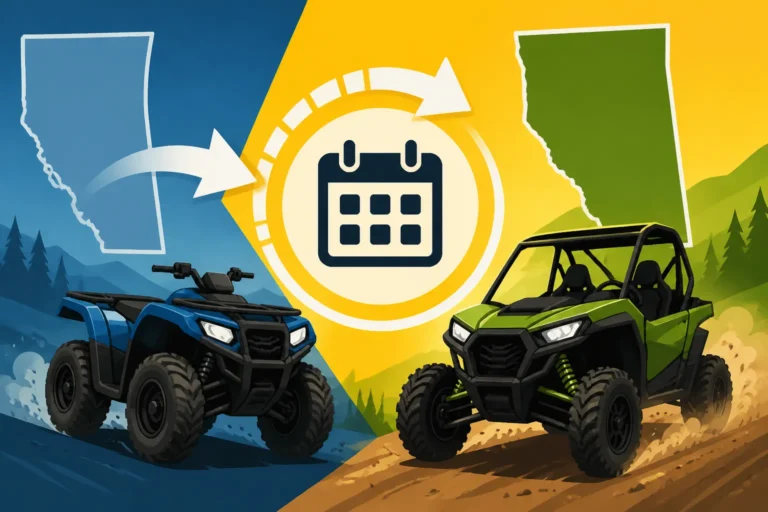
Alberta is a popular destination for OHV riders from other provinces and even the United States. If you're visiting Alberta with your OHV, you might assume your home province's or state's registration is sufficient, and for a short period, you'd be mostly right. However, there's a crucial time limit you need to be aware of: the 30-day rule. Generally, if you are visiting Alberta, your out-of-province OHV registration and insurance are recognized for up to 30 consecutive days. This allows tourists and temporary visitors to enjoy Alberta's trails without immediately having to re-register their machine in Alberta. You'll still need to comply with all other Alberta OHV laws, such as helmet use, equipment requirements, and operating rules.
However, if you plan to stay longer than 30 consecutive days, or if you're moving to Alberta permanently, then your machine must be registered in Alberta. This can sometimes be a surprise for those who relocate and bring their toys with them. For visiting riders, it's always wise to carry proof of residency from your home jurisdiction, in case you need to demonstrate your visitor status. If you're coming from a neighbouring province, understanding rules like [Alberta Registration for a Machine From BC] can be helpful. For a comprehensive look at what applies to non-residents, consult [Alberta Registration for Visiting Riders] and specifically, [Alberta's 30-Day Rule for Out-of-Province Machines]. Don't let a prolonged stay turn your exciting ride into a legal issue; plan ahead if you intend to be in the province for more than a month.
| Pre-Ride Checklist Item | Why It's Important | Where to Find Info |
|---|---|---|
| Valid ID | Required for registration at the registry agent. | At the registry office |
| Bill of Sale/NVIS/MSO | Proof of ownership, essential for transferring title and registration. Use LawDepot for private sales. | Dealer, seller, LawDepot |
| VIN | Unique identifier for your machine, needed for registration and checking for liens. | Stamped on machine frame |
| Registration Certificate | Official proof your machine is registered to you; must be carried when riding. | Issued by registry agent |
| Valid Insurance | Mandatory for public land riding; protects you from liability and avoids fines/seizure. | Your insurance provider |
| Working Head/Tail Lights | Required for visibility and safety, even in daylight. | Machine's electrical system, [Alberta Requires Working Head and Tail Lights] |
| Spark Arrestor | Prevents wildfires; legally required on public land. | Muffler, [Alberta Requires a Spark Arrestor] |
| Unmodified Exhaust | Ensures compliance with noise and emissions regulations. | Muffler, [Alberta Bans Modified Exhausts] |
| CSA-Approved Helmet | Mandatory for all riders on public land for safety. | Helmet itself, [Alberta Helmet Law on Public Land] |
| Awareness of OHV Bylaws | Knowing where you can and cannot ride, especially near urban/residential areas. | Local municipal websites |
Disclaimer
This article is for general informational purposes only and does not constitute professional advice. Laws, prices and regulations vary by location and change over time. Consult a qualified professional for guidance on your specific situation.