Why a Quad Does Not Need the Conservation Pass
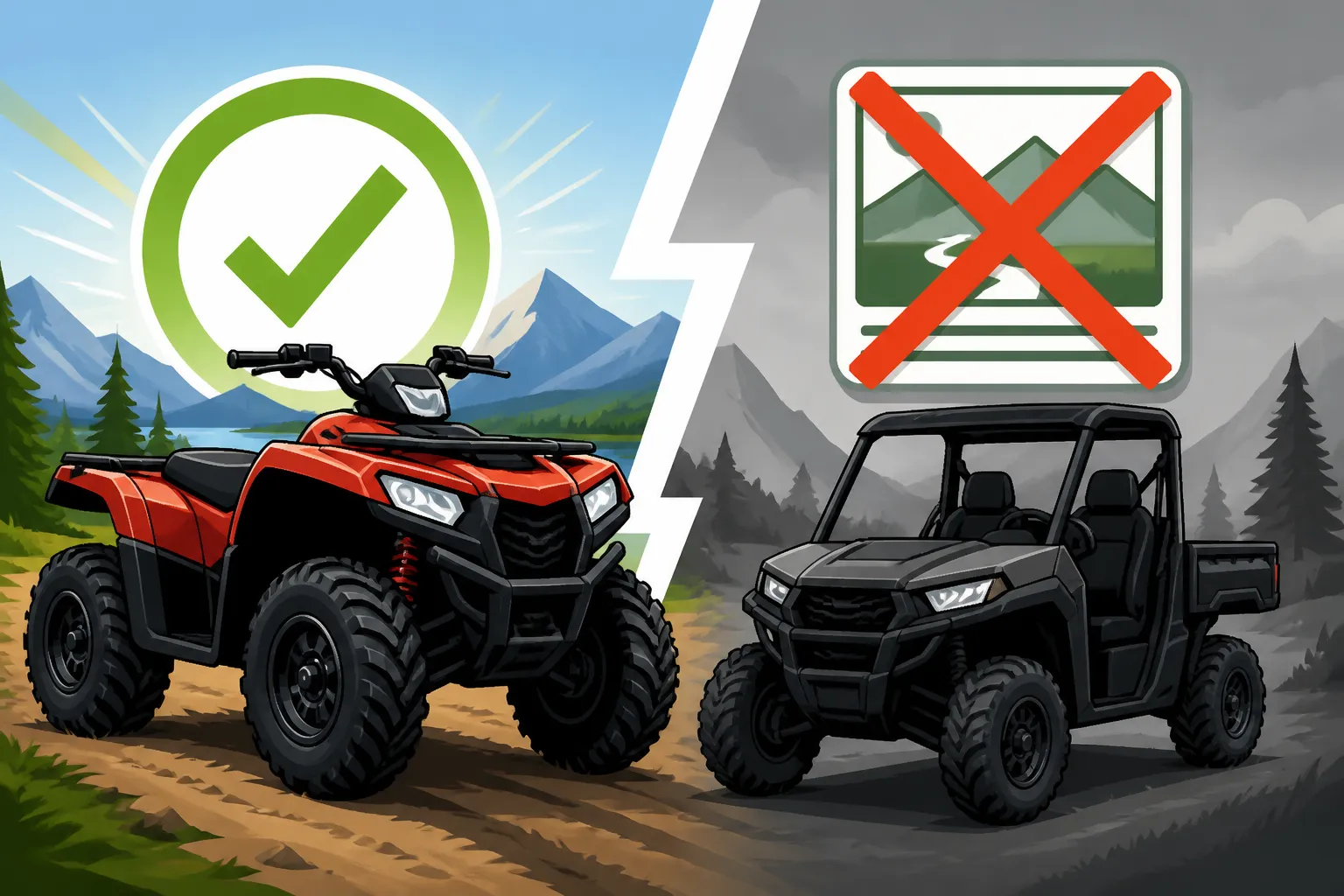
A common Alberta trailhead question is whether your quad needs a Kananaskis Conservation Pass before you ride. The short answer is generally no: that pass is for eligible motor vehicles parked in designated areas, not a permit for operating an ATV or side-by-side on a trail. The important catch is that your tow vehicle, camping plans, and riding area may each have separate requirements.
What the Kananaskis Conservation Pass Covers
It is a vehicle parking pass, not an OHV trail permit
The Kananaskis Conservation Pass is associated with eligible motor vehicles parked at designated locations in Kananaskis Country and the Bow Valley. It is not a general licence to ride an off-highway vehicle, and it does not replace your quad’s registration, insurance, or permission to use a particular trail.
That distinction can feel unnecessarily confusing when you arrive with a truck, trailer, and ATV all in the same trip. You may be using the truck to reach a staging area and the quad to ride the trails, but those are separate activities. The pass question is generally about the vehicle parked in a designated pass area—not whether the quad itself has a conservation pass attached to it.
For details on which vehicles and locations fall within the pass system, see [Alberta Kananaskis Conservation Pass Rules]. The practical takeaway is to check the requirement for the vehicle you are parking and the specific place you are visiting, rather than assuming every machine in your trailer needs the same pass.
The quad’s trail access is governed by other rules
A quad is an off-highway vehicle. Its use is controlled by the rules for the land and route you intend to ride, along with Alberta’s OHV requirements. Those rules can include registration, insurance, age and helmet requirements, equipment standards, and restrictions on where riding is allowed.
In other words, “no Kananaskis Conservation Pass needed for the quad” does not mean “no requirements apply to the quad.” A machine may be properly registered and insured and still be prohibited from a particular trail or area. Likewise, seeing a route on a map does not necessarily mean it is open to OHVs.
Alberta does not have a general province-wide OHV trail pass for every ride, but local land rules still matter. The guide [Alberta Has No OHV Trail Pass] explains that distinction. Before heading out, identify the land manager and check the rules for that specific area.
When Your Tow Vehicle May Need a Pass
Separate the drive to the staging area from the ride
Imagine you are hauling a quad from Calgary toward a Kananaskis riding area. The truck is driven on public roads and parked at a trailhead or other designated location. The quad is unloaded and ridden on a route where OHVs are allowed. The conservation-pass question usually concerns the parked road vehicle, not the ATV being ridden.
This is why a rider can correctly say, “My quad does not need the pass,” while still needing to check whether the truck needs one. If you arrive in a car or truck and leave it at a location where the pass applies, the fact that your quad is the main reason for the trip does not automatically exempt the parked vehicle.
The details can vary by location, so check the posted information and current pass guidance before you leave. [Where a Kananaskis Pass Actually Gets Checked] can help clarify why the place where you park matters. If you are unsure whether a particular staging area is covered, do not rely only on a trail name or a pin dropped into a navigation app.
A trailer does not turn the quad into a pass-covered vehicle
A trailer can make the situation look like one combined vehicle-and-machine package, but it helps to think in terms of what is being driven and parked. Your tow vehicle has its own plate and may be subject to the conservation-pass requirement at a designated location. Your quad remains an OHV and is subject to the rules for OHV use.
For example, a family might haul a side-by-side on a trailer, park the truck and trailer, and then unload the machine. They should check the parking and pass rules for the tow vehicle and the access rules for the side-by-side separately. The same approach applies if you are towing a quad behind a recreational vehicle or arriving with more than one machine.
Do not assume the pass is included with a camping reservation, an OHV registration, or a trail map. Those items serve different purposes. And do not assume that buying a pass for one vehicle automatically resolves every other access requirement for the group. Confirm what applies to the vehicle you are parking and the land you plan to use.
| What you are doing | Is the conservation pass the relevant requirement? | What to check instead or in addition |
|---|---|---|
| Riding a quad on an allowed OHV trail | Generally no, not for the quad as an OHV | Registration, insurance, equipment, and trail access rules |
| Parking a truck at a designated pass location | It may be required | Pass rules for that location and vehicle |
| Hauling a quad on a trailer | The tow vehicle may be subject to the pass rules | Parking requirements and trailer access arrangements |
| Camping on public land | The conservation pass may not be the camping requirement | Whether a public lands camping pass or other camping rule applies |
| Riding in a Public Land Use Zone | The conservation pass does not establish trail access | Zone rules, designated routes, closures, and OHV requirements |
What Quad Riders Should Check Instead
Confirm the land designation and route rules
Before a ride, find out whether your route is in a Public Land Use Zone, a provincial park, a designated OHV area, or another type of managed land. Each designation can come with different restrictions. A route that looks accessible on a general map might cross land where OHV use is limited, seasonal, or not allowed.
This matters around well-known riding areas such as McLean Creek and the Ghost Public Land Use Zone. Conditions and access rules can differ between areas, and closures or route designations may change. Start with the official information for the area, then use a map to help you understand where the route sits. [Alberta's Public Land Use Zones Explained] is a useful place to learn why the land designation matters.
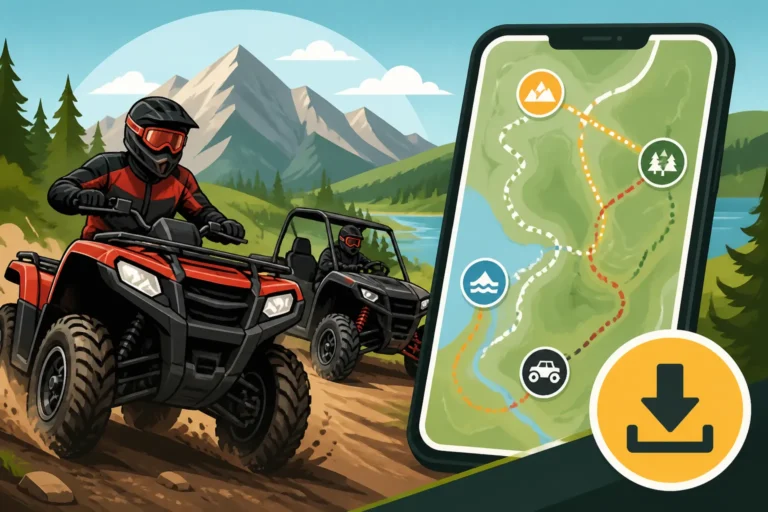
Mapping tools can help with trip planning, but they should not be treated as legal permission to ride. onX Offroad may help you orient yourself to trails and surrounding land, but compare what you see there with official land and trail information. This is especially important when a route approaches a boundary, a closure, private land, or an area where access is restricted.
Keep registration, insurance, and equipment in their own checklist
A conservation pass is not a substitute for the documents and equipment required for riding. Before you load the machine, check that its registration and insurance are in order for the kind of riding you plan to do. Riders heading onto public land should be ready to meet the applicable requirements and produce proof when asked.
Your equipment check should also match the ride. Depending on the rules that apply, you may need to confirm that required lights work, the exhaust system meets requirements, and the machine is suitable for the trail. Helmet rules, age requirements, and passenger limits are separate considerations; a pass does not waive them.
For a ride on Crown land, start with [Alberta Registration Before Riding Crown Land] and review the broader guidance in [Alberta OHV Trails: Riding Public Land]. If you are carrying a phone map, such as one prepared with onX Offroad, download or save the information you need before heading into an area with weak service. Use it as a navigation aid, not as a replacement for checking official rules and closures.
Check camping requirements separately
Some riders combine a trail day with an overnight stay, and that is where another pass can enter the conversation. Alberta’s public lands camping pass is separate from the Kananaskis Conservation Pass. It applies to certain public-land camping situations, not simply to riding a quad.
So if you are riding during the day and returning home, do not assume you need a camping pass just because you are on public land. If you plan to camp, check whether the location and type of camping require one and whether other limits apply. The rules can depend on where you camp, not just on what kind of machine you ride.
The distinction is worth checking before you pack. A rider may have no conservation-pass requirement for the quad, but still need to follow camping rules at an overnight stop. See [Alberta's Public Lands Camping Pass] for the separate camping question. If you are mapping a route with onX Offroad, verify that your planned overnight spot is actually an authorized camping location.
A Simple Pre-Ride Check
Work through the trip in order
It is easier to avoid a trailhead surprise when you check each part of the trip separately. Start with the riding area, then confirm the vehicle you are using to get there, and finally review any overnight plans. This keeps a conservation pass from being mistaken for a catch-all permit.
- Choose the riding area. Identify the land manager and the type of land, such as a Public Land Use Zone or designated OHV area.
- Confirm the route is open to your machine. Check official trail information, vehicle restrictions, seasonal closures, and any area-specific requirements.
- Check the quad’s documents and equipment. Make sure registration, insurance, and required safety equipment are in order for the ride.
- Check where you will park. If your truck or other road vehicle will be parked at a designated Kananaskis or Bow Valley location, confirm whether it needs a conservation pass.
- Check overnight plans separately. If you will camp on public land, find out whether a camping pass or other camping rules apply.
- Save reliable navigation information. Use a mapping tool such as onX Offroad for orientation if helpful, but compare the route with official maps and notices before relying on it.
This order also helps when plans change. If a trailhead is full and you park somewhere else, the parking location may have different requirements. If a ride turns into an overnight trip, camping rules become relevant even though the quad itself still does not need a Kananaskis Conservation Pass.
Ask a focused question if the location is unclear
When the rules are not obvious, ask about the exact place and activity rather than asking only, “Do I need a pass for my ATV?” A more useful question is: “I’m parking my truck and trailer at this named location, then riding this type of OHV on this route. Which requirements apply to the parking and which apply to the ride?”
That wording separates the pieces that are often blended together in casual conversations. It also makes it easier for a land office, campground, or pass information service to direct you to the right rule. Keep the location name, route, and vehicle type handy when checking.
The bottom line is straightforward: the quad generally does not need a Kananaskis Conservation Pass merely because you are riding it. The truck or other vehicle you park may have a separate pass requirement, while the ride itself remains subject to OHV, land-access, and trail rules. Treat those as separate checks, and you are much less likely to reach the staging area with the wrong paperwork—or the wrong assumption.
Disclaimer
This article is for general informational purposes only and does not constitute professional advice. Laws, prices and regulations vary by location and change over time. Consult a qualified professional for guidance on your specific situation.