Alberta Riding Areas With Wash Stations
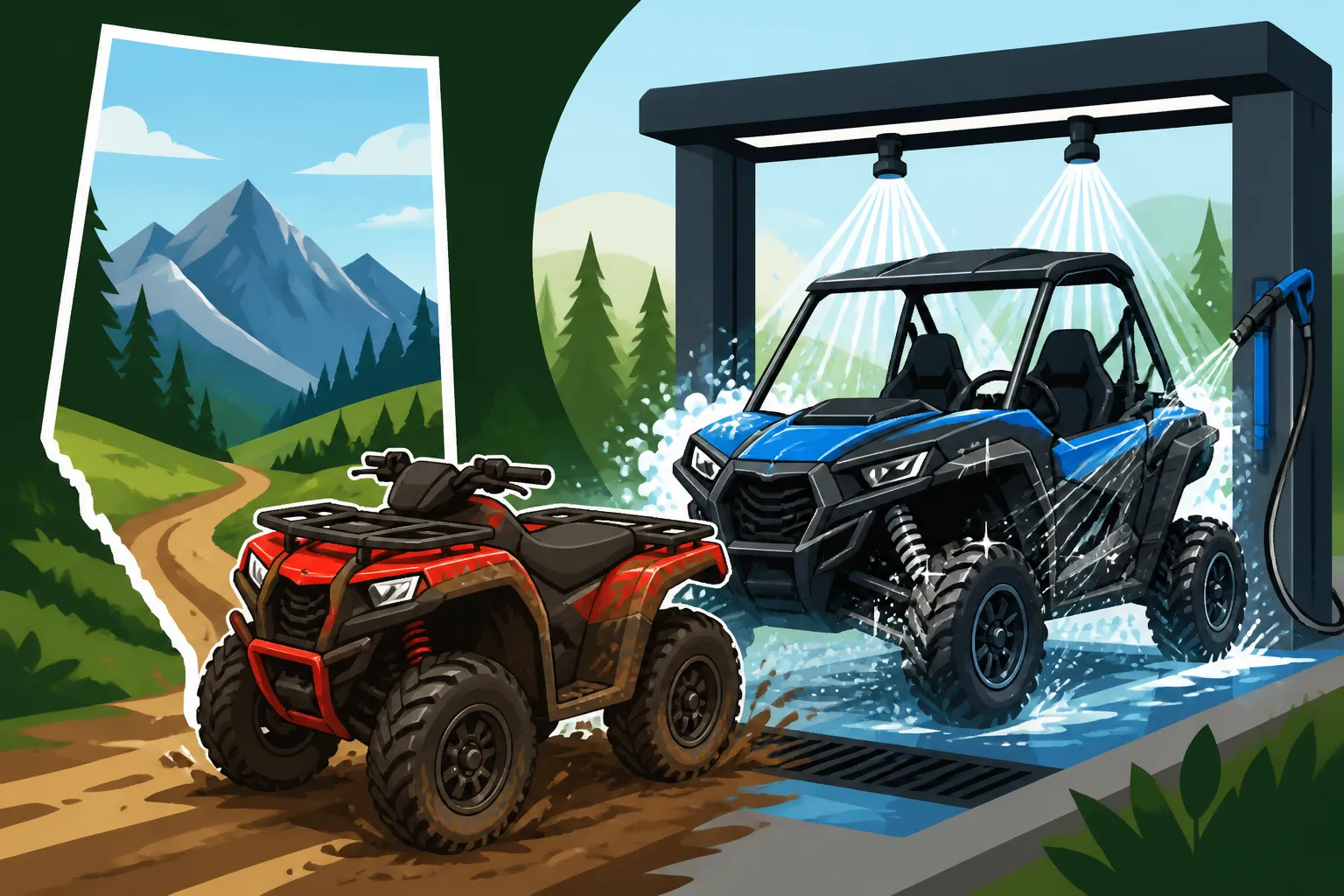
Finding a place to wash an ATV or UTV after a muddy Alberta ride can be harder than finding the trail itself. A staging area may have parking and toilets but no machine wash bay, and facilities can change or have restrictions. This guide explains how to locate a suitable wash station, what to check before riding, and how to clean your machine without spreading mud or debris.
What to expect from Alberta ATV wash stations
A staging area is not necessarily a wash area
A riding area’s staging lot is usually designed for unloading, parking, and gathering before a ride. Don’t assume it includes a hose, wash bay, or place to dispose of muddy water. Even when a facility has water, it may be intended for people or camp use—not washing vehicles.
This matters especially after a wet ride. Mud can collect around skid plates, footwells, suspension, and tires, and a quick rinse in the parking lot may send dirt into a ditch or nearby waterway. Some sites may prohibit washing machines on the premises, while others may have no water access at all. Check the specific facility’s rules before counting on it.
When researching a destination, look for wash facilities as a separate amenity from parking, toilets, or camping. The guide to [Alberta OHV Camping and Staging Areas] can help with planning the practical parts of a trip, but confirm the wash situation directly with the relevant site operator or land manager.
Treat named riding areas as places to verify, not guaranteed wash stops
Popular destinations such as McLean Creek, the Ghost Public Land Use Zone, and the Iron Horse Trail are useful starting points when planning an Alberta ride. They are not, by name alone, confirmation that a public machine wash station is available at the trailhead or staging area. Facilities may be nearby without being part of the riding site, and access or operating arrangements can change.
For example, someone riding near McLean Creek might plan to clean the machine after returning toward a community with suitable vehicle-washing facilities. A rider on the Iron Horse Trail may need to plan differently depending on the section ridden and where the trip ends. Build the wash stop into the route rather than assuming you will find one when the ride is over. The overview of [McLean Creek: Alberta's Best Known OHV Area] is a useful place to begin researching the riding destination itself.
Before leaving home, confirm three things: whether the wash station accepts off-highway vehicles, whether it is open when you expect to arrive, and whether its rules allow the type of cleaning you need. A facility that lets you rinse a car may not necessarily permit a heavily muddy quad or side-by-side.
Use maps to plan, then confirm the facility
Mapping tools can help you see the distance between a riding area, a community, and possible service stops. The [Alberta OHV Trail Map Downloads] page can help with trail planning, while onX Offroad can be useful for reviewing routes and locating nearby roads or points of interest. Neither a map pin nor a search result should be treated as proof that a wash bay is open, suitable for an ATV, or authorized for public use.
A reliable plan pairs the map with a direct check. Contact the facility or check its own posted information, and ask specifically about off-road machines, mud, water availability, and disposal rules. If you’re riding with a group, choose the wash stop before the day begins and share the address or meeting instructions with everyone.
| Planning question | Why it matters | What to confirm |
|---|---|---|
| Is there a wash station at the riding site? | A staging lot may not have vehicle-washing facilities | Ask the site operator or land manager |
| Does the facility accept OHVs? | Some vehicle washes may restrict muddy machines or particular vehicle types | Confirm directly with the business |
| Is water available and usable? | A tap may be for camp or public use only | Ask whether machine washing is permitted |
| Where does wash water go? | Mud and residue should not be rinsed into a trail, ditch, or waterway | Use only an approved wash area |
| Is the facility open after your ride? | A late return can make a planned stop impossible | Check operating details before setting out |
| Is there a backup option? | Weather, closures, or a full wash bay can disrupt plans | Identify another appropriate facility or clean at home |
How to find a suitable wash station before your ride
Search beyond the trailhead
Start with the exact riding area and the nearest communities, then search for vehicle washes or equipment-cleaning services that explicitly allow off-road vehicles. A general listing for a car wash does not tell you whether the business welcomes a quad covered in clay, whether its equipment can handle a side-by-side, or whether the site has a designated area for muddy vehicles.
Think through the whole outing. If you’re hauling from Calgary to a foothills riding area, for instance, a wash stop near your return route may be more practical than searching for one beside the trail. If you’re riding farther from town, plan for the possibility that the nearest appropriate service is a significant detour. That’s particularly important when the machine is caked in wet mud or you need to clean it before transporting it home.
Use onX Offroad or another mapping tool to understand the route and nearby communities, but call ahead to confirm the service. Ask whether you can arrive with a trailer, whether there is room to maneuver, and whether the facility expects riders to remove large clumps of mud before entering. These small questions can prevent an awkward arrival when the wash area is busy or unsuitable.
Ask questions that clarify the rules
A quick, specific phone call is often more useful than relying on a broad online listing. Explain that you’re bringing an ATV or UTV back from an off-highway trail and ask what the facility permits. Be clear if the machine is especially muddy, if you’re towing it, or if you’re travelling with multiple machines.
Questions worth asking include:
- Do you allow ATVs or side-by-sides in the wash area?
- Is there a designated bay or a preferred time for muddy machines?
- Can I use a pressure washer, or is only a lower-pressure rinse allowed?
- Are there restrictions on rinsing undercarriages or removing heavy mud?
- Is trailer parking available while the machine is being cleaned?
- Are there rules about detergents or other cleaning products?
Don’t assume that a wash station’s equipment is appropriate for every part of a machine. High-pressure water can force moisture into electrical connectors, bearings, seals, or other vulnerable areas. Follow your owner’s manual and use care around sensitive components, even if the facility allows pressure washing.
Make a backup plan for remote rides
In more remote riding areas, a public wash station may not be close to the trailhead—or available at all. Plan for that before departing rather than relying on an unmarked tap, a campground hose, or a roadside ditch. A campground’s water supply is not automatically permission to wash vehicles, and a nearby stream is never an appropriate substitute for a designated wash area.
Check the route and services around your destination using maps, then verify any likely stop with the operator. onX Offroad can help orient you to roads and riding areas, but facility permissions and services need separate confirmation. For a group ride, identify one primary wash stop and a practical fallback, and make sure both work with your trailer and return route.
If you cannot confirm a suitable wash station, consider whether you can transport the machine home and clean it there in an appropriate, contained area. Avoid leaving a trailhead or public staging area covered in mud, and don’t rinse debris into a ditch, culvert, wetland, or watercourse.
Clean your ATV or UTV responsibly after the ride
Remove mud where it can be contained
Start by knocking off large clumps of mud in a place where debris can be collected or managed appropriately. Don’t scrape mud into a storm drain, parking-lot catch basin, trail corridor, or natural drainage. Mud can carry plant material, seeds, and other debris, so where you remove it matters—not just how clean the machine looks afterward.
Pay attention to tires, wheel wells, underbody guards, racks, and the space around the footwells. If you have been riding through wet ground, inspect tucked-away areas before transporting the machine. A rinse that cleans the visible panels but leaves packed mud underneath may not solve the problem.
For guidance on minimizing your impact at the destination, [Leaving a Site Cleaner Than You Found It] is a helpful companion. The same basic courtesy applies at a wash facility: use only the areas intended for vehicle cleaning, manage debris as directed, and leave the bay ready for the next person.
Wash with care around water and sensitive components
Use only an authorized wash area and follow its posted instructions. If detergents are permitted, use them only as directed; if they are prohibited, skip them. Don’t let soapy runoff or muddy water flow toward a creek, storm drain, wetland, or roadside ditch.
A careful rinse is generally more useful than blasting every surface at close range. Keep water away from sensitive electrical connections, seals, bearings, and intake areas, and consult the machine’s manual for model-specific cleaning advice. After washing, check that the machine is safe to operate and transport, especially if you have removed or disturbed guards or other components while clearing mud.
If there is no approved wash facility nearby, don’t improvise by washing in a natural water source or on public land. Take the machine to a suitable location where the runoff can be handled appropriately. A little dried mud on the trailer ride home is preferable to creating a mess at a trailhead or contaminating a waterway.
Account for conditions and seasonal restrictions
Spring thaw and heavy rain can leave trails, staging areas, and access roads unusually muddy. A wash stop may become more important, but it is also worth reconsidering whether conditions are suitable for riding in the first place. Wet ground can be vulnerable to rutting, and a muddy machine is not a reason to continue on a trail that is soft or closed.
Check for closures and local guidance before heading out. [Alberta Trail Closures After a Storm] and [Alberta Riding in Spring Melt] offer useful context for understanding why conditions can affect both the ride and your cleanup plan. If you’re unsure whether a route is open or appropriate, verify with the responsible land manager rather than relying on an old trail description or a map alone.
Build wash planning into your ride checklist
Decide before you load the machine
A short pre-trip checklist saves time at the end of a long day. Confirm the riding area, check its access and facility information, identify a wash option that accepts OHVs, and plan the route from the staging area to that stop. If the wash facility is not confirmed, decide where you can clean the machine responsibly after returning home.
Also check whether the destination has other services you’ll need, such as toilets, fuel, or room to park a trailer. The pages on [Alberta Riding Areas With Toilets] and [Alberta Riding Areas With Fuel Nearby] can help you think through those practical details. Treat each amenity as something to verify for your specific trip rather than assuming everything is available at one location.
For a group, assign someone to confirm the wash stop and share the plan before the ride. It’s frustrating to discover after a muddy day that one trailer can’t fit at the wash bay or that the facility doesn’t accept off-road machines. A few minutes of checking ahead can make the return much smoother.
Keep a simple post-ride routine
After the ride, remove loose gear and inspect the machine before cleaning. Look for packed mud around the undercarriage and running gear, and make sure the wash method is appropriate for the machine. If you’re stopping at a public or commercial facility, follow its instructions, clean up any debris you’re responsible for, and avoid blocking access while you work.
Once the machine is clean, check it again before storing or transporting it. Look for damage that mud may have hidden, and let wet areas dry as recommended by the manufacturer. A wash is also a good moment to notice a loose guard, damaged tire, or debris caught near moving parts.
Most importantly, keep your expectations realistic: Alberta has many riding areas, but a trail system and a wash station are separate things. Verify the facility, confirm that OHVs are welcome, and have a backup plan. That simple habit helps protect the land, keeps the trip courteous for other users, and prevents the end of a great ride from turning into a frustrating search for a place to clean up.
Disclaimer
This article is for general informational purposes only and does not constitute professional advice. Laws, prices and regulations vary by location and change over time. Consult a qualified professional for guidance on your specific situation.