Alberta Riding Near Swan Hills
Swan Hills can look like an easy place to point the truck and head into the trees, but the hard part is knowing which routes are open, legal and suitable for your machine. This guide explains how to plan an ATV or UTV ride near Swan Hills, check access before leaving, choose practical equipment and avoid common northern Alberta riding mistakes.
What to expect when riding near Swan Hills
Understand the landscape before choosing a route
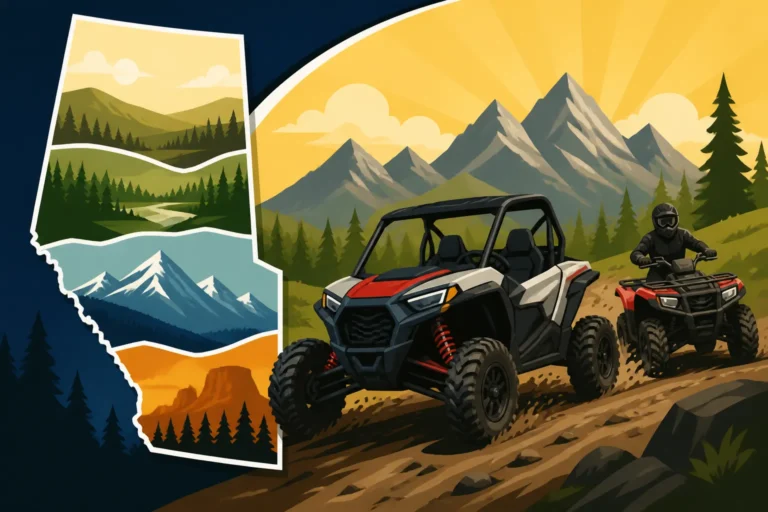
Swan Hills sits in Alberta’s north-central region, in a landscape of forest, rolling terrain and resource roads. A ride here may feel very different from a trip on a wide, clearly signed recreation trail: routes can pass through forested areas, connect with working roads or lead into places where landmarks are difficult to distinguish. The surface can change quickly with rain, seasonal thaw, logging activity or other land use.
That variety is part of the appeal, but it means a line on a digital map is not proof that you can ride it. A road, cutline or old track may be closed, may cross land with separate access rules, or may not be an authorized OHV route. Before you leave town, check the applicable public-land information and look for current notices about closures, restrictions and permitted trail use. [Checking a Zone Before You Go]
For a first outing, make the goal a manageable loop rather than a long-distance exploration. Pick a route you can identify on more than one map, set a turnaround point, and leave time to retrace your path if a gate, washout or closure blocks the route. This is especially helpful if your group includes new riders or machines with different ground clearance and fuel range.
Choose a ride that fits your machine and group
The word “trail” can mean very different things in practice. One group may be comfortable with a narrow, uneven track and frequent mud, while another may want a broad, lower-stress route with room to stop and regroup. Think about the least experienced rider and the least capable machine in your party, not just the person who knows the area best.
A larger side-by-side may offer comfort and storage, but its width can limit where it can travel. A quad may be easier to manoeuvre on a narrow route, but a smaller fuel tank or limited storage can affect how far the group can reasonably go. Check route rules for the vehicle class and size, and do not assume that a route shown for one type of OHV is suitable for every ATV or UTV.
Before committing to a route, agree on what “turn back” means. For example, the group might stop if the route becomes difficult to follow, if weather makes the surface unsafe, or if anyone is uncomfortable with a crossing. Clear expectations prevent the familiar pressure to keep going simply because the group has already ridden a long way. [Alberta Trail Difficulty Ratings]
Plan the route and confirm access
Use maps together, not one map alone
A digital trail app can be handy for planning and keeping track of your position. Some riders use onX Offroad to review routes and prepare maps for a ride, but an app should be one navigation tool, not the final authority on whether an area is open to OHVs. Map layers can differ, and a route visible on a screen may not reflect a recent closure, a seasonal restriction or a change in access.
Cross-check your intended ride against current Alberta public-land guidance and any relevant local information before you go. A useful planning routine is to identify the trail or road, confirm the land-use rules for that area, look for closure notices and then compare the route with a second map. If the information conflicts or you cannot establish whether a route is permitted, choose a different route rather than treating uncertainty as permission.
Download or save the information you need before leaving reliable service. In forested areas, mobile coverage may be limited or unavailable exactly when you need to check a junction. If you use onX Offroad or another mapping app, test the offline map at home and make sure your phone can display it without a connection. Carry a backup navigation option, such as a second device or a paper map, and make sure someone in the group knows how to use it. [Alberta OHV Trail Map Downloads]
Check for closures, work and seasonal conditions
A route that was rideable on your last visit may not be suitable today. Heavy rain can soften the surface or create deep ruts; thaw can leave low areas saturated; and active forestry or industrial work can affect road access. A route may also be temporarily closed for environmental, safety or land-management reasons. These changes are easy to miss if you rely on an old screenshot or a friend’s memory.
Look for information close to your departure date, and check again before entering an area if signs or barriers indicate a change. Respect gates and posted notices. Do not ride around a closure, cut a new bypass or assume a road is open because another vehicle has used it. A detour can damage wet ground, create conflict with other land users and put your group somewhere that is harder to leave safely.
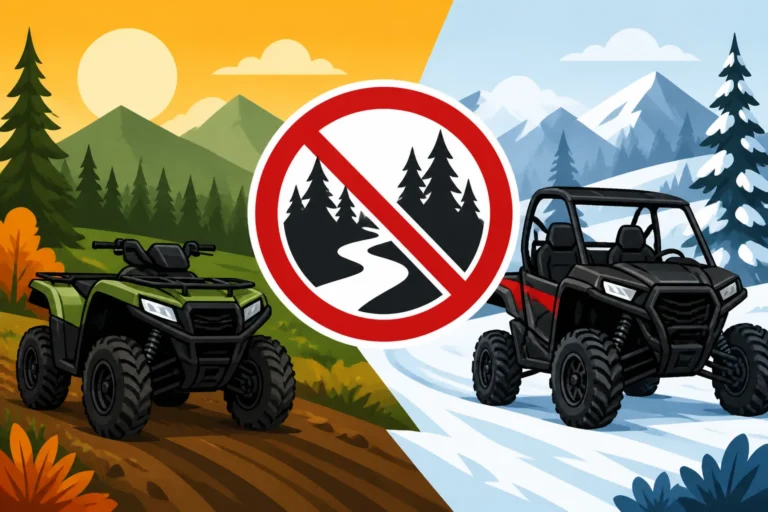
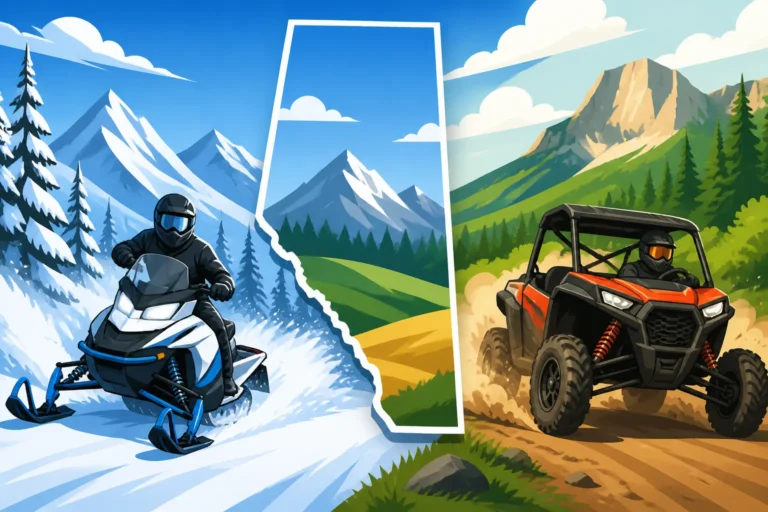
Season matters as much as the route itself. Spring melt can make apparently firm ground deceptive, while a dry summer ride can still bring dust, wildfire restrictions or sudden storms. In fall, hunting activity and shorter daylight hours can change how you plan your day. Build a route around the conditions you find, not the conditions you hoped for when you loaded the machines. [Alberta Trail Closures After a Storm] [Alberta Riding in Spring Melt]
| Planning question | What to check | A sensible response if the answer is unclear |
|---|---|---|
| Is OHV use allowed here? | Current land-use information and route rules | Choose a route with clearly established access |
| Is the route open today? | Closure notices, signs and barriers | Turn around rather than bypassing a closure |
| Can every machine use the route? | Vehicle class, width and route conditions | Pick a route that suits the largest machine |
| Can the group navigate offline? | Downloaded maps, battery and backup | Save another map or shorten the ride |
| Are conditions changing? | Rain, thaw, fire restrictions and daylight | Reduce the distance or postpone the trip |
Prepare your ATV or UTV and riding group
Set up for a remote-feeling day
Even a ride that begins near a community can leave you away from help. Give your machine a practical check before loading: inspect the tires, brakes, steering, throttle, lights and visible belts or chains. Confirm that your fuel is sufficient for the planned route with a reserve for delays or a necessary return trip. A route that looks short on a map can take much longer when it is muddy, rutted or unfamiliar.
Pack for the possibility of a minor repair and a longer stop. Useful items can include a basic tool kit, tire repair supplies, a pump, a tow strap, spare gloves, water, food and a first-aid kit. A winch can be helpful in some conditions, but it is not a substitute for choosing a suitable route or knowing how to use recovery equipment safely. If a machine becomes stuck, stop before repeatedly spinning the tires and making the situation worse.
Do not forget the items required for riding on public land. Check that the machine meets applicable equipment rules, including requirements for lights and a spark arrestor where they apply, and carry the registration and insurance documents you need. Rules and requirements can depend on where and how you ride, so review them before the trip rather than trying to sort them out at the staging area. [Alberta Equipment Required on Public Land] [Alberta Insurance Proof on Public Land]
Make a plan everyone can follow
Before unloading, identify the lead rider and the person bringing up the rear. Agree on simple regrouping points, hand signals or another way to communicate, and what to do if the group gets separated. A rider who stops at a junction should wait somewhere safe and visible rather than continuing on the assumption that everyone is following.
Ask each rider to carry basic essentials, even if the group has shared supplies. A phone with a downloaded map is useful, but it should not be the only communication plan in an area with weak service. Tell someone who is not riding where you plan to go and when you expect to be back. If your route changes substantially, update that person when you regain service.
Group size also affects pace and decisions. A large party may take longer to gather at junctions, and riders with different experience levels may need more breaks. Set a pace that allows everyone to stay together without feeling rushed. On a first visit, a shorter ride with frequent checks is usually more enjoyable than a long route that leaves the least experienced person anxious or exhausted. [Alberta Group Ride Planning]
Ride responsibly around other land users and wildlife
Treat roads, trails and cutlines as shared spaces
The area around Swan Hills may be used by more than recreational riders. You could encounter other OHVs, trucks, workers, hunters, land users or wildlife. Slow down when visibility is limited, keep to the permitted route and leave room for other vehicles to pass where it is safe. Dust, noise and speed can turn an otherwise ordinary encounter into a conflict, particularly near work areas or places where people are using the land for other purposes.
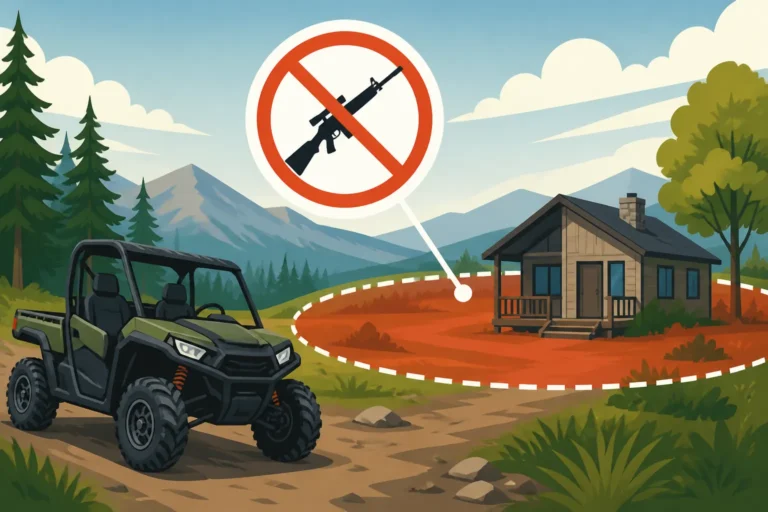
Do not assume that every road or track is open to recreational riding. Industrial roads, access roads and cutlines can look like convenient shortcuts, but appearance alone does not establish permission. Follow posted signs and the rules for the particular area. If access is unclear, pause and check rather than pushing ahead. The extra time spent confirming a route is far less frustrating than having to reverse course after a long ride.
Keep the group on established, authorized routes. Riding around a wet section or creating a fresh track may seem like a small shortcut, but repeated bypasses can widen the disturbed area and damage vegetation. If a route is too muddy or blocked, turn back or use an authorized alternative. Respecting closures and staying on the intended route helps preserve access for other riders as well as the landscape. [Alberta Grazing Lease Access Rules]
Give wildlife room and leave the area clean
Forested northern Alberta is wildlife habitat, so stay alert and give animals space. Do not chase, crowd or deliberately approach wildlife for a closer look. If an animal is on or beside the route, slow down, stop at a safe distance and wait for it to move away. Keep pets secured and under control, and avoid loud, prolonged stops near animals or nesting areas.
Carry out everything you bring in, including food packaging, broken straps and repair materials. If you stop for lunch, choose a durable spot and keep the group’s footprint small. Do not leave food or garbage behind, and do not treat a quiet clearing as a place to make a new campsite unless camping is permitted there. A clean staging area and trail are a practical courtesy to the next group, not just a matter of appearance.
Wildlife awareness also affects your route timing. Give yourself daylight for the return, especially when riding unfamiliar roads or trails. If weather, a mechanical issue or an unexpected closure slows the group, shorten the outing rather than pressing on toward a distant destination. [Alberta Wildlife on the Trail]
Make the day work from staging to the ride home
Prepare the trailer and staging routine
A smooth day begins before the machines reach the trail. Check that the towing vehicle and trailer are ready, that the machines are secured properly and that you have the gear you need without burying it under unnecessary cargo. If you are meeting other riders, choose a clear meeting point and share directions in advance. Do not assume a small pullout has enough room for several trucks, trailers and unloading activity.
At the staging area, park so other users can move through safely. Keep machines and equipment within the space you are using, and avoid blocking access roads, gates or signs. Before riding away, make a last check that helmets, documents, water and navigation gear are with the riders who need them. A missing item is easiest to fix while the trailer is still nearby.
When you return, inspect the machines before loading. Look for damage, loose equipment or problems that might become worse on the drive home. Secure the load, collect any waste and leave the site tidy. Staging areas are shared, and considerate parking makes the experience better for people arriving after you. If you are unsure where to park or unload, look for posted instructions or choose a designated area rather than improvising beside a road. [Alberta Staging Areas With Trailer Parking]
Use a simple go-or-no-go checklist
A quick decision before departure can save a long, uncomfortable day. Confirm that the route is permitted and open, weather and surface conditions are reasonable, every machine is ready, and the group has enough fuel, water, navigation and safety equipment. Make sure riders know the planned route and turnaround time. If one important piece is missing, scale back the plan or choose a different day.
| Before leaving | Confirm |
|---|---|
| Route | Access rules, closures and a realistic turnaround point |
| Machines | Fuel, tires, brakes, steering, lights and required equipment |
| Riders | Suitable clothing, helmet, water and agreed group plan |
| Navigation | Offline map, charged device and a backup |
| Conditions | Weather, trail surface, daylight and any restrictions |
| Return plan | Someone knows where you are going and when you expect back |
A first ride near Swan Hills does not need to cover a huge distance to be worthwhile. Choose a route the whole group can handle, stay flexible when conditions change and save the longer exploration for a day when you have better local knowledge. If the map, signs and conditions do not line up, treat that as a reason to stop and reassess—not a challenge to find a way through.
Disclaimer
This article is for general informational purposes only and does not constitute professional advice. Laws, prices and regulations vary by location and change over time. Consult a qualified professional for guidance on your specific situation.