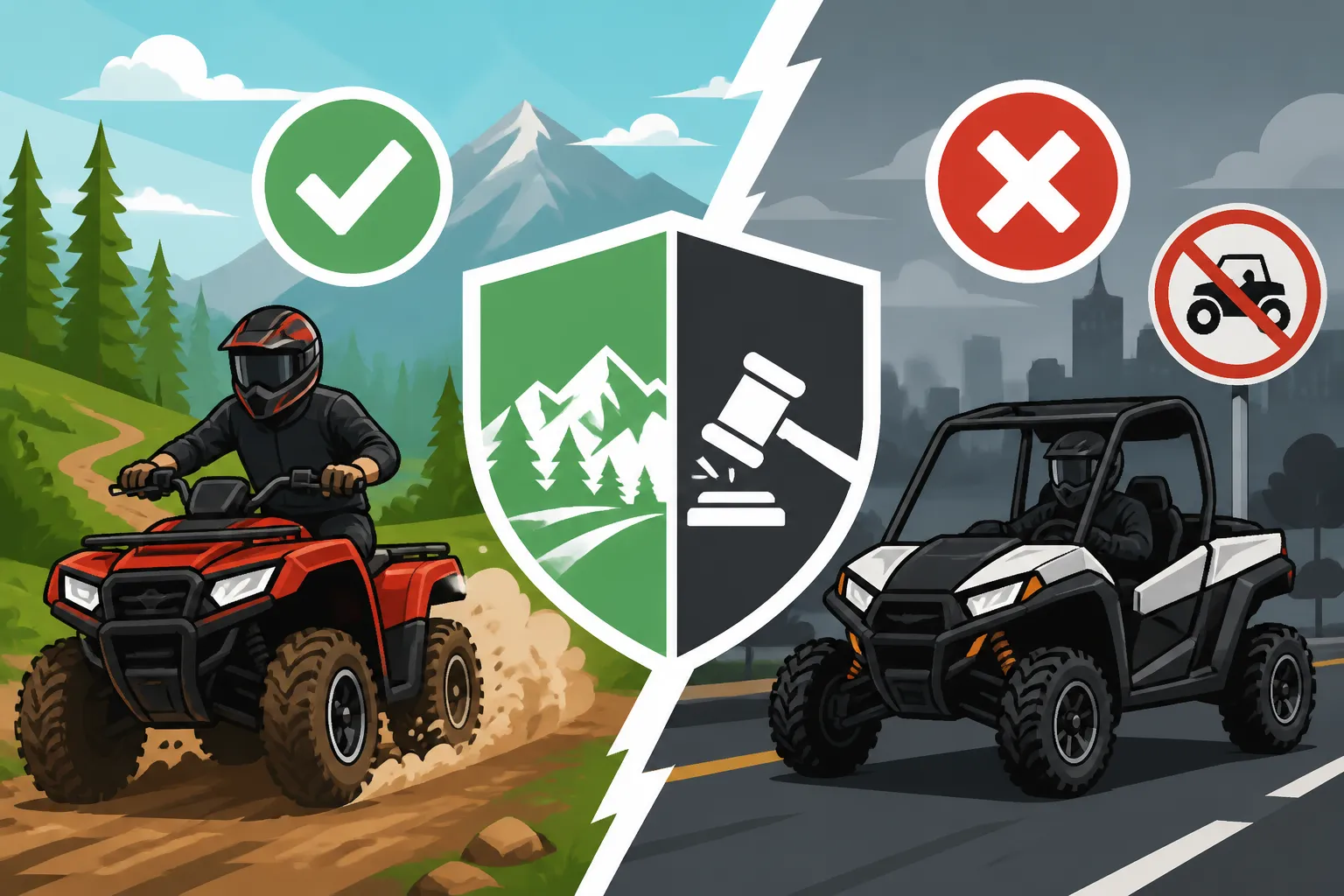
Alberta ATV Road Rules: Bylaws Decide
There’s a lot of confusion out there among ATV and UTV riders in Alberta when it comes to riding on roads. It's not as simple as "yes" or "no," and that grey area can be incredibly frustrating, leaving many riders unsure of where they can legally take their machines. This comprehensive guide will clear up that confusion by explaining how road rules for off-highway vehicles (OHVs) in Alberta are primarily decided by local municipal bylaws, giving you the knowledge to ride responsibly and legally.
The Fundamental Ban: Why Your OHV Isn't Automatically Road Legal in Alberta
Let's start with the baseline, because it's the foundation of everything else. In Alberta, the default position of the law is that off-highway vehicles – that's your ATV, UTV, dirt bike, or snowmobile – are generally not allowed on public roads, streets, highways, or even their associated ditches. This isn't just a suggestion; it's enshrined in provincial legislation. Many riders assume that if they're just going a short distance, or if there's no visible traffic, it's probably fine. Unfortunately, that assumption can lead to costly tickets and potential headaches.
The Traffic Safety Act and OHV Restrictions
The primary piece of legislation governing vehicles in Alberta is the Traffic Safety Act. This act defines what a "highway" is (and we'll dive deeper into that in a moment, because it's far more expansive than most people think), and it sets out the rules for who can operate what, where. Under this act, OHVs are categorized separately from regular passenger vehicles, and they don't automatically come with the same privileges to operate on these "highways." The provincial government's intention is generally to keep off-highway vehicles off of roads where they might mix with faster-moving traffic or where their unique characteristics could pose a safety risk. This means your quad, designed for rugged terrain and trails, isn't inherently welcome on the paved or gravel roads meant for cars and trucks.
You might be thinking, "But I see people doing it all the time!" And you're not wrong. However, what you're likely seeing are specific exceptions created at a local level, not a blanket provincial permission. The provincial framework starts with a "no," and then allows local authorities to carve out very specific "yesses" under certain conditions. So, if you're ever in doubt, the safest bet is to assume the provincial rule applies until you can confirm a local exception. You can learn more about the provincial framework in [What the Traffic Safety Act Requires of Alberta OHVs].
Provincial Law Versus Municipal Discretion
Here's where the nuance comes in, and why that "it depends" answer is so common. While the Traffic Safety Act sets the overall framework, it also empowers municipalities – that's your counties, towns, and villages – to create their own bylaws that can modify or exempt certain OHV uses within their specific geographical boundaries. This legislative dance means that what's perfectly legal in Brazeau County might get you a hefty fine just a few kilometres away in the County of Wetaskiwin. It's not a unified system, which is a major pain point for riders who travel between different regions.
This discretion allows local governments to tailor rules to their specific community needs. A rural county with vast agricultural lands might have very different needs and concerns than a densely populated urban centre or a municipality bordering a popular OHV trail system. They consider factors like road safety, dust control, noise complaints, and the economic impact of allowing or restricting OHV access. Because of this patchwork approach, relying on what you "heard" or what your friend does in a different county is a recipe for trouble. You absolutely have to do your homework for the specific area you plan to ride in.
Why OHVs Aren't Designed for Pavement
Beyond the legal framework, there's a practical safety reason why OHVs aren't generally allowed on paved roads. These machines are built for off-road environments – for mud, rocks, dirt, and uneven terrain. Their tires are often knobby, designed for traction in soft conditions, not for grip on smooth, hard asphalt at higher speeds. Their suspension is typically softer, with more travel, which can make them feel unstable on pavement, especially when cornering or braking suddenly.
Furthermore, OHVs often lack standard safety features common in road vehicles, like turn signals, proper mirrors, or even fully enclosed cabins for some ATV models. Even a side-by-side, which might seem more car-like, still has different handling characteristics and crash protection compared to a passenger car. The braking distances, stability, and visibility of an ATV or UTV are simply not optimized for highway speeds and conditions, putting both the rider and other road users at increased risk. While some aftermarket accessories from companies like SuperATV can add things like mirrors or turn signals, these modifications don't automatically make your machine street legal in the absence of a specific municipal bylaw.
Unpacking the "Highway" Definition: It's More Than Just Pavement
When the Traffic Safety Act talks about "highways," it's not just referring to major freeways or paved arterial roads. This definition is incredibly broad and catches many riders by surprise, leading them to inadvertently break the law even when they think they're safely off the main road. Understanding this expansive definition is critical for any OHV rider in Alberta.
Ditches, Shoulders, and Alleys: All Part of the Highway
This is perhaps the biggest surprise for many. In Alberta, a "highway" legally includes the main travelled portion of a road, as well as the shoulders, ditches, and even alleys in urban areas. Yes, that's right – riding in the ditch alongside a county road without explicit permission from a bylaw is generally considered riding on a highway, and thus, illegal for most OHVs. The same goes for the gravel shoulder or cutting through an alleyway in a town or village.
The rationale is that these areas are part of the public right-of-way, maintained by the municipality or province, and are considered extensions of the road itself for traffic safety and infrastructure purposes. So, when you pull off the pavement and think you're "off the road," you might still be legally on a "highway." This is why a simple short cut across a ditch to get to a trail can land you a ticket if there isn't a specific bylaw allowing it. For a deeper dive into this, check out [Alberta Highways Include Ditches and Alleys].
Crossing Roads Versus Riding Along Them
There's a critical distinction to be made between crossing a highway and riding along a highway. Many municipalities, even those with generally restrictive OHV bylaws, will often permit OHVs to cross a public road at a right angle, typically at a low speed, to get from one section of private land to another, or to access a permitted trail. This is usually allowed under specific conditions: the crossing must be done safely, yield to all other traffic, and be the most direct route. It's often permitted only where a bylaw explicitly states it, or under the general provision of the Traffic Safety Act if no specific bylaw prohibits it.
However, riding along a road, even for a short distance to connect trails or access a staging area, is a much different scenario and almost always requires a specific municipal bylaw. This is because riding along a road involves continuous exposure to traffic, prolonged interaction with other vehicles, and a greater potential for accidents. Without a bylaw opening up that specific stretch of road, even a short jaunt down the shoulder is likely an infraction. You'll find more details about permitted crossings in [Alberta Rules for Crossing a Highway].
Designated OHV Zones and Their Boundaries
Some areas in Alberta have established "designated OHV zones" on public land, like McLean Creek or parts of the Ghost Public Land Use Zone. These zones are specifically managed for off-highway vehicle recreation and often have a network of trails. Within these zones, riding is generally permitted on marked trails. However, the roads leading to and within these zones can still be subject to municipal bylaws, especially if they are public access roads rather than strictly internal trail system roads.
It's crucial to understand the boundaries. Just because you're near a designated OHV area doesn't mean you can ride your quad on the public road leading into it. You're typically expected to transport your machine to a designated staging area (often via truck and trailer) and only then unload and begin riding on the approved trails. The municipal bylaws often govern these access points, sometimes permitting limited road use to get from a staging area to a trailhead, but these are exceptions, not the rule. Always check the specific land use regulations and local bylaws for any public land use zone or provincial park you plan to visit.
How Municipalities Create Exceptions: The Power of Bylaws
This is the key to understanding legal OHV road access in Alberta. As we've discussed, the provincial Traffic Safety Act generally says "no" to OHVs on highways. However, it gives the power to local municipalities – counties, cities, towns, and villages – to pass their own bylaws that can create specific exceptions within their jurisdiction. These bylaws are the only way an OHV can legally operate on a public road in Alberta, outside of a very few rare, province-wide exemptions (like emergency services or certain utility work).
Specific Bylaws for Farm, Industrial, or Recreational Use
Municipal bylaws are typically drafted to address specific needs within a community. For OHV use on roads, these often fall into a few categories:
- Farm Use: In many rural counties, bylaws allow farmers and agricultural workers to operate OHVs on certain roads for agricultural purposes. This recognizes the practical necessity of using a quad or side-by-side to move between fields, check fences, or transport tools on roads that might border their land. These bylaws often stipulate that the machine must be used directly for agricultural work, not for recreational joyrides, and may specify certain roads or times of day. They might also require specific equipment like a safety flag or flashing lights.
- Industrial Use: Similar to farm use, some bylaws permit OHVs for industrial operations, such as oilfield workers moving between sites or forestry workers accessing remote areas. Again, the purpose is usually tied directly to the work, not recreation.
- Recreational Use: This is the category most riders are interested in. A growing number of municipalities, especially those with strong tourism or outdoor recreation sectors, have begun passing bylaws that open up specific roads or road allowances for recreational OHV use. This might be to connect segments of a trail system, allow access from campgrounds to trailheads, or provide limited access within a town or village to services like fuel or food. These bylaws are often the most restrictive, specifying exact routes, times, speed limits, and mandatory equipment.
It's important to remember that these bylaws are highly localized. Just because one county has a "recreational use" bylaw doesn't mean the neighbouring county does. Always consult the specific municipality's bylaws. Many counties publish these bylaws on their official websites, or you can contact their municipal offices directly for clarification. Checking with the county office is often the best first step, as mentioned in [Asking a County Office What Applies].
Which Roads and Times Are Permitted
When a municipality does pass a bylaw allowing OHV access on roads, it's rarely a blanket permission for all roads at all times. These bylaws are typically very specific, outlining:
- Designated Roads: The bylaw will explicitly list the names or numbers of the roads, road allowances, or sections of road where OHVs are permitted. This might include secondary roads, undeveloped road allowances, or even specific residential streets in a rural subdivision. They will usually create maps to show these routes.
- Times of Operation: Some bylaws might restrict OHV use to certain hours (e.g., daylight hours only), or prohibit it during specific times of year (e.g., during spring thaw to prevent road damage).
- Speed Limits: Often, OHVs are required to operate at a reduced speed limit on roads, significantly slower than the posted limit for other vehicles, to enhance safety.
- Purpose of Travel: As noted above, bylaws often specify why you can be on the road – for farming, industry, or to access a trail, not just for general cruising.
If a road isn't explicitly listed in the bylaw as permitted for OHV use, then the general provincial prohibition applies. There's no "implied" permission. You must stick to the letter of the bylaw.
Conditions and Requirements Set by Bylaws
Beyond designating roads and times, municipal bylaws will almost always impose conditions and requirements on OHV operators. These are put in place to ensure safety for both the OHV rider and other road users, and to mitigate potential nuisances like noise or dust. Common conditions include:
- Mandatory Equipment: While your machine might not come from the factory with road-ready features, a bylaw permitting road use will often require them. This can include working headlights and taillights, brake lights, mirrors (often one on each side), turn signals, and a visible safety flag. For many side-by-sides, SuperATV offers great aftermarket mirrors and signal kits that can help meet these bylaw requirements, ensuring you're visible and can signal your intentions clearly to other traffic.
- Helmets: Even if the provincial helmet law allows exemptions for certain situations (like enclosed side-by-sides with ROPS and seatbelts), a municipal bylaw for road use might still require a CSA-approved helmet for all riders, regardless of the machine type. Always wear a helmet, and be sure it's up to standard as discussed in [Buying a CSA-Approved Helmet Before an Alberta Ride].
- Insurance and Registration: You will absolutely need valid registration for your OHV and proof of insurance, especially if you're operating it on any public land or road where a bylaw permits it. These are provincial requirements that apply whether you're on a trail or a bylaw-permitted road. [Alberta Requires Insurance on Public Land] is a good resource for this.
- Licensing and Age: The bylaw might specify minimum age requirements for drivers, and often requires the operator to hold a valid driver's license (e.g., a Class 5 for cars) even if it's not strictly required for off-road operation in certain contexts.
- Noise Restrictions: Many bylaws will have clauses about excessive noise, reiterating the provincial ban on modified exhausts to prevent disturbance to residents.
Failure to comply with any of these conditions can still result in a ticket, even if you're on a road that is technically open to OHVs by bylaw. It's not enough to just be on the right road; you have to be following all the rules associated with that permission.
Common Scenarios: Where Riders Often Get It Wrong (or Right!)
The complexity of Alberta's OHV road rules really shines when you look at real-world riding situations. Riders frequently find themselves in grey areas, trying to navigate local topography and access points. Let's break down some common scenarios and how bylaws typically apply.
Riding to the Staging Area
This is a classic dilemma. You've got your ATV or side-by-side, you're all geared up, and the designated staging area for your favourite trail system is just a couple of kilometres down the gravel road from your cabin or campsite. Can you just hop on and drive there? More often than not, the answer is no, unless there's a specific municipal bylaw that explicitly permits it.
Many staging areas are located directly off public roads, and these roads themselves are still part of the "highway" system, as defined by the Traffic Safety Act. Without a bylaw from the local county, riding your OHV on that short stretch of road is illegal. This means you'll typically need to transport your machine on a trailer, even for short distances, until you reach the actual staging area. The frustration is understandable, but the law prioritizes the safety of all road users. Some forward-thinking municipalities, particularly those that want to promote OHV tourism, have started to implement bylaws that allow this specific type of "staging access" on certain roads, but these are exceptions you must confirm.
Connecting Trails Between Public Lands
Imagine a fantastic trail system that spans two different sections of Crown Land, but there's a short stretch of municipal road in between. It's a natural desire to want to connect these trails by riding your OHV across that road, perhaps for a kilometre or two, rather than loading up and driving around. Again, this situation requires a specific municipal bylaw.
If a county has a recreational OHV bylaw, it might designate specific roads as "connector routes" between trail systems. These routes are usually clearly marked and come with specific conditions (e.g., speed limits, helmet requirements, daytime only). Without such a bylaw, that connecting road remains off-limits, and riding your OHV on it would be illegal. This is a prime example of where local knowledge and prior research are absolutely essential. Many municipalities have mapping resources, or you might find information through local OHV clubs, which are often involved in advocating for such connector routes.
Farm and Ranch Operations Crossing Roads
For farmers and ranchers, using an OHV to get around their property, especially if their land is divided by a public road, is a practical necessity. Most rural municipalities recognize this and have bylaws in place that allow OHVs to be operated on roads for specific agricultural purposes. These bylaws often come with caveats:
- Purpose: The OHV must be used for a legitimate farm purpose (e.g., checking cattle, transporting tools, accessing fields). It's not for personal recreation.
- Equipment: The machine might need to be equipped with certain safety features like a slow-moving vehicle sign, flashing lights, or a safety flag, making it more visible to other traffic.
- Road Type: Often, these permissions apply only to specific types of roads, such as local county roads or gravel roads, and typically exclude higher-speed provincial highways.
These provisions are designed to support agricultural operations while still ensuring a degree of safety on public thoroughfares. If you're using an OHV for farm work, it's still your responsibility to know the specific bylaw in your municipality and ensure your machine and operation comply with its terms. An example might be [Alberta Farmer-Owned Machines on Private Land] for general farm exemptions, but specifically crossing roads relies on local bylaws.
Utility Work and Special Exemptions
Beyond farming, there are other specific scenarios where OHVs might be legally operated on roads, often under special permits or provincial exemptions. This primarily applies to utility companies (e.g., power, gas, telecommunications) or government agencies (e.g., forestry, wildlife officers) who use OHVs as part of their official duties to access remote infrastructure or patrol public lands.
These exemptions are usually tied to the nature of their work and are not available to the general public. They often involve extensive safety protocols, specialized training, and a clear operational need for the OHV to be on the road. For the average recreational rider, these types of exemptions are largely irrelevant, as they don't provide a pathway for personal road use.
Understanding Your Machine's Role: Equipment and Safety Considerations
If a municipal bylaw does grant permission for OHVs on specific roads, it will almost certainly come with a list of mandatory equipment and safety requirements. This isn't just bureaucratic red tape; it's about making your off-highway vehicle as visible and predictable as possible when sharing space with cars and trucks. Neglecting these requirements can lead to fines, even if you're on a legally permitted road.
Lights, Turn Signals, and Mirrors for Road Use
When you're on a public road, you need to communicate your presence and intentions clearly to other drivers. While many ATVs and UTVs come with basic headlights and taillights, these might not be sufficient for road use as stipulated by a bylaw.
- Headlights and Taillights: These are a must. They must be working and switched on, especially during dusk, dawn, nighttime, or in low visibility conditions. Some bylaws might even require them to be on at all times when operating on a road. You can find more information about general lighting requirements in [Alberta Requires Working Head and Tail Lights].
- Brake Lights: Essential for indicating when you're slowing down or stopping. Most modern OHVs have them, but confirm they are functional.
- Turn Signals: Very few stock ATVs or UTVs come with turn signals. If a bylaw permits road use, it will almost certainly require them. This is where aftermarket kits come in handy. Companies like SuperATV offer universal or model-specific turn signal kits that include lights, a switch, and all the wiring needed to make your machine road-ready in areas where bylaws permit.
- Mirrors: Another common requirement is mirrors, typically at least one, but often two (one on each side) to give you a clear view of traffic behind you. Again, SuperATV has a range of UTV mirrors that are easy to install and provide much-needed rear visibility. Without these, you're not just violating the bylaw; you're significantly increasing your risk of an accident by not being aware of your surroundings.
Before heading out on a bylaw-permitted road, conduct a thorough pre-ride check to ensure all your lights are working, your mirrors are properly adjusted, and your signals (if installed) are functional.
Helmet Laws and Passenger Restrictions on Bylaw Roads
Alberta has a mandatory helmet law for OHV riders on public land, which includes most trails and public access areas. When it comes to operating on roads under a bylaw, these helmet rules often become even stricter, or at least remain fully in force.
- Helmets for All: Even if you're in an enclosed side-by-side with seatbelts and a rollover protection system (ROPS), which might offer a provincial exemption from helmets in some off-road scenarios, a municipal bylaw permitting road use could still mandate a CSA-approved helmet for all occupants. The reasoning is simple: the increased speed and interaction with other vehicles on a road amplify the risk of head injury in a collision. You can learn more about provincial helmet requirements in [Alberta Helmet Law on Public Land].
- Passenger Limits: Most ATVs are designed for a single rider. Carrying a passenger on a single-rider ATV is inherently dangerous and illegal in most circumstances, especially on a road. Side-by-sides have designated seating, and you must adhere strictly to the manufacturer's intended passenger capacity. Overloading a machine or carrying passengers not in designated seats is a serious safety violation and will almost certainly be prohibited by any bylaw allowing road access. Remember, [Alberta Passenger Rules on an OHV] gives more details on this.
Always prioritize safety. Even if a bylaw doesn't explicitly state a helmet requirement (which would be rare), wearing one is always the smart choice when operating an OHV, particularly on a road.
Insurance Requirements and Proof of Ownership
Operating any registered OHV on public land in Alberta – and that includes roads where bylaws permit OHV access – requires you to have valid third-party liability insurance. This is a provincial requirement, not just a bylaw stipulation, and it's non-negotiable.
- Proof of Insurance: You must carry proof of your current insurance policy whenever you're operating your OHV. An officer can demand to see it, and not having it can lead to fines or even vehicle seizure. This is covered in [Producing Insurance on Demand].
- Registration: Your OHV must also be registered with Alberta registries. This involves getting a registration plate and a certificate. The registration certificate also serves as proof of ownership. Make sure your registration is current and carry your certificate with you. [What Alberta OHV Registration Costs] and [Alberta Issues a Plate, Not a Sticker] offer more insight into the registration process.
- Adequate Coverage: While the provincial minimum for third-party liability is important, consider higher coverage. Accidents on roads, especially involving other vehicles, can be incredibly costly. The minimal required coverage might not be enough to protect you from significant financial liability.
Ensuring your machine is properly insured and registered isn't just about avoiding a ticket; it's about protecting yourself financially in the event of an accident. Operating an unregistered or uninsured OHV on any public land or road in Alberta is a serious offense with severe penalties, including potential vehicle seizure, as explained in [Alberta Vehicle Seizure for No Insurance].
The Fines and Consequences of Ignoring Road Rules
Thinking you can just chance it and hope for the best when it comes to riding your OHV on unpermitted roads in Alberta is a risky gamble. The penalties for violating the Traffic Safety Act and municipal bylaws are significant and can go far beyond a simple warning. Law enforcement officers, including RCMP and local bylaw officers, are empowered to enforce these rules, and they do.
Tickets and Penalties for Illegal Road Riding
If you're caught operating your OHV on a road where it's not permitted by municipal bylaw, or if you fail to comply with the conditions of a bylaw that does allow road use, you'll likely face a ticket.
- Provincial Offenses: Violations of the Traffic Safety Act (e.g., riding an unregistered OHV, no insurance, improper equipment if no bylaw exists) carry set fines that can easily run into the hundreds of dollars. These tickets are issued by RCMP officers or other authorized peace officers. [Alberta Ticket Costs for a Riding Violation] outlines some of these.
- Municipal Bylaw Infractions: If you're violating a specific municipal bylaw (e.g., riding on a prohibited road, exceeding a bylaw-imposed speed limit, not having required mirrors when a bylaw demands them), you'll be ticketed under that local bylaw. These fines also vary but can be substantial.
- Multiple Charges: It's common for riders to receive multiple tickets for a single incident. For example, if you're riding an uninsured, unregistered OHV on a prohibited road and aren't wearing a helmet, you could be looking at several separate fines adding up to well over a thousand dollars. This is why [Alberta Penalties for Illegal Road Riding] is such an important read.
These fines are not just an inconvenience; they can put a serious dent in your wallet and potentially affect your insurance rates for your other vehicles.
Vehicle Seizure for Serious Violations
This is one of the most severe consequences and a very real possibility for certain infractions. Law enforcement has the authority to seize your OHV if you are found operating it in violation of serious provincial laws.
- No Insurance: Operating an OHV without valid third-party liability insurance on public land (which includes roads) is a critical offense that can lead to immediate vehicle seizure. The machine will be towed and impounded, and you'll be responsible for all towing and storage fees, in addition to significant fines. Retrieving your machine can be a costly and time-consuming nightmare.
- Unregistered OHV: While not always an immediate seizure, riding an unregistered OHV on public land is also a serious offense.
- Impaired Operation: Operating an OHV while impaired by alcohol or drugs on any public land or road can lead to criminal charges, immediate vehicle seizure, and the same severe penalties as impaired driving in a car, including license suspension.
Vehicle seizure is a strong deterrent, and it's a clear message from authorities that they take these violations seriously. Don't risk losing your machine and facing exorbitant recovery costs for a moment of convenience or carelessness.
Impact on Insurance and Future Riding Privileges
Beyond the immediate fines and potential seizure, illegal road riding can have long-term repercussions.
- Insurance Rates: A ticket for an OHV infraction, especially for something like no insurance or reckless operation, could be recorded on your driving abstract or a separate OHV-specific record. This could lead to increased insurance premiums for all your vehicles, as insurance companies may view you as a higher-risk client. In some cases, it could even make it difficult to get insurance in the future.
- Future Riding Opportunities: While not common, repeated serious violations could potentially impact your ability to acquire future permits or participate in organized OHV events if your riding history is considered.
- Criminal Record: For very serious infractions like impaired operation or dangerous driving, you could end up with a criminal record, which has far-reaching consequences for employment, travel, and your general reputation.
It's clear that understanding and adhering to the rules isn't just about avoiding a fine today; it's about protecting your financial well-being, your machine, and your ability to enjoy OHV recreation responsibly in the long run.
Finding Local Bylaws: Your Essential Research Steps
Given that municipal bylaws are the gatekeepers to legal OHV road access in Alberta, knowing how to find and understand them is paramount. This isn't always as straightforward as it sounds, but a little proactive research can save you a world of trouble.
Contacting County and Municipal Offices
The most direct and often most reliable way to get information about OHV bylaws in a specific area is to contact the local municipal office directly. This includes:
- County Offices: If you plan to ride in a rural area, contact the county administration office. Many popular riding areas fall within various counties like Brazeau County, Yellowhead County, or the MD of Foothills.
- Town or Village Offices: If your route involves a smaller town or village, even just passing through, contact their municipal office. They will have their own bylaws.
- Bylaw Officers or Planning Departments: Sometimes, the best department to talk to is the bylaw enforcement office or the planning and development department, as they are often more familiar with the specifics of land use and vehicle regulations.
When you call, be specific about your intentions: "I plan to ride my ATV from my cabin on Range Road 123 to the XYZ staging area, which involves riding on a section of Township Road 456. Are ATVs permitted on that specific road according to your bylaws?" Ask for the bylaw number if one exists, so you can reference it yourself. Remember, [Asking a County Office What Applies] is your best bet for clarity.
Online Resources and Official Websites
Most municipalities in Alberta maintain official websites, and many of them publish their bylaws online. This can be an excellent resource for your research.
- Municipal Websites: Navigate to the "Bylaws" or "Services" section of the relevant county, town, or village website. Look for bylaws related to "Off-Highway Vehicles," "Traffic," "Vehicles," or "Road Use."
- Search Function: Use the website's search bar with terms like "ATV bylaw," "OHV access," or "off-highway vehicle."
- Maps: Some municipalities might even publish maps illustrating which roads are open to OHVs. These are incredibly helpful as they provide a visual representation of permitted routes. For example, some counties might have specific maps that show [Finding a County Map of Roads Open to OHVs].
Keep in mind that bylaws can be updated, so always try to find the most current version. If you can't find specific OHV bylaws online, that usually means the general provincial prohibition applies, and no exceptions have been made.
Interpreting Bylaw Language: What to Look For
Bylaws can sometimes be written in legalistic language, which can be a bit daunting to interpret. Here are a few things to look for and questions to ask yourself when reviewing a bylaw:
- Clear Permissions: Does the bylaw explicitly state that OHVs are permitted on certain roads? Look for phrases like "Off-highway vehicles may be operated on…" or "The following roads are designated for OHV use…"
- Specific Road Designations: Are the roads clearly identified by name, number, or geographic description? If it's vague, it's problematic.
- Conditions and Restrictions: Pay close attention to any clauses outlining:
- Times of operation: (e.g., "daylight hours only," "not between 11 p.m. and 7 a.m.")
- Speed limits: (e.g., "speed not to exceed 20 km/h")
- Equipment requirements: (e.g., "must be equipped with mirrors and turn signals")
- Operator requirements: (e.g., "operator must possess a valid Class 5 driver's license")
- Purpose of use: (e.g., "for agricultural purposes only," "to access designated trailheads")
- Definitions: Ensure you understand how the bylaw defines terms like "off-highway vehicle" or "highway" within its own context, as definitions can sometimes vary slightly from the provincial act.
If you find a bylaw that permits OHV road use, copy it, print it, or save it to your phone. Having proof of the bylaw, especially if it includes a map, can be invaluable if you're ever stopped by law enforcement. Remember, ignorance of the law is never an excuse. Taking the time to properly research and understand the rules for your specific riding area is the mark of a responsible OHV enthusiast. Many towns, for example, have [Alberta Towns That Ban Quads] in their core areas, regardless of what the surrounding county might allow.
Looking Ahead: The Evolving Landscape of OHV Road Access
The conversation around off-highway vehicle access, particularly on public roads, is an ongoing one in Alberta. As the popularity of ATVs and UTVs grows, and as trail networks expand, the pressure on municipalities to re-evaluate their bylaws and consider more flexible solutions is increasing. This landscape is not static; it's constantly evolving through advocacy, policy discussions, and rider education.
Advocacy for More Consistent Rules
Many OHV associations and clubs in Alberta are actively engaged in advocating for more consistent and sensible rules regarding road access. They understand the frustration of riders facing a patchwork of differing bylaws and are working with municipalities and the provincial government to:
- Standardize Bylaws: Push for model bylaws that counties can adopt, reducing the complexity and inconsistency riders currently face.
- Create Connector Routes: Advocate for specific roads or sections of roads to be designated as OHV connector routes, allowing riders to link trail systems without having to trailer their machines for short distances.
- Educate Decision-Makers: Help local councils understand the economic benefits of responsible OHV tourism and the desire of riders for practical access solutions.
These advocacy efforts are crucial because they highlight the rider's perspective and needs. While it's a slow process, the trend in some regions suggests a growing willingness from municipalities to consider well-thought-out proposals for limited road access. Supporting your local OHV club or provincial association can be a way to contribute to these efforts.
The Role of Rider Education and Responsibility
Ultimately, the future of OHV road access hinges significantly on rider behaviour and a commitment to responsibility. When bylaws allow OHVs on roads, it's a privilege, not an inherent right, and that privilege can be revoked if riders abuse it.
- Respecting Rules: Adhering strictly to speed limits, equipment requirements, and designated routes is non-negotiable. One irresponsible rider can jeopardize access for everyone.
- Safety First: Operating your OHV safely, being courteous to other road users, and practicing defensive riding are critical. Your actions reflect on the entire OHV community.
- Environmental Stewardship: When accessing trails via roads, riders must also be mindful of environmental impacts, staying on marked trails, packing out what they pack in, and respecting private property.
Municipalities are far more likely to open up road access or maintain existing permissions if they see a strong track record of responsible riding from the OHV community. Conversely, complaints about noise, dust, speeding, or environmental damage can quickly lead to stricter rules or even outright bans, as some areas have experienced with [Alberta Bylaws That Ban Quads].
Future Trends in OHV Management
Looking ahead, we might see a few key trends influencing OHV road access in Alberta:
- Increased Trail Connectivity: As trail networks mature, the demand for legal ways to connect them will likely grow, potentially leading to more municipalities adopting specific connector bylaws.
- Technology Integration: The rise of GPS mapping and apps like Avenza is making it easier for riders to know exactly where they are and which routes are permitted. Municipalities might leverage these technologies to publish interactive maps of legal OHV routes.
- Balancing Act: Local governments will continue to face the challenge of balancing recreational access with concerns from residents about noise, safety, and environmental impact. This means that any new road access bylaws will likely be carefully crafted with numerous restrictions and conditions.
For now, the mantra remains: "Know before you go." Rely on official bylaws and direct communication with municipal offices. The more informed and responsible we are as riders, the better the chances of expanding safe and legal OHV access on Alberta's roads in the future.
| Scenario | General Provincial Rule | Potential Municipal Bylaw Exception |
|---|---|---|
| Riding in a Ditch | Generally prohibited; ditches are part of the "highway." | Some bylaws allow specific ditches for agricultural access or trail connection. |
| Crossing a Paved Road | Generally permitted at a right angle, safely, to access land. | Bylaws may specify additional conditions (e.g., designated crossing points, speed). |
| Riding Along a Gravel Road | Generally prohibited; gravel roads are "highways." | Specific bylaws may designate certain gravel roads for recreational or agricultural use. |
| Accessing a Staging Area | Generally requires trailering; roads to staging areas are "highways." | Some bylaws permit limited OHV travel on specific access roads to staging areas. |
| Connecting Trails | Prohibited if it involves riding on an undesignated "highway." | Bylaws may designate specific roads as OHV connector routes between trails. |
| Farm Work on Roads | Generally prohibited for general OHV use. | Many rural bylaws permit OHVs on local roads for specific farm purposes. |
| Required Equipment | Basic lights, spark arrestor. | Bylaws often require mirrors, turn signals, brake lights, safety flags for road use. |
| Helmets | Mandatory on public land; some exemptions for enclosed UTVs. | Bylaws allowing road use often mandate CSA helmets for all riders, no exemptions. |
| Insurance/Registration | Mandatory for public land/road use (provincial law). | Always required, regardless of bylaw. |
Disclaimer
This article is for general informational purposes only and does not constitute professional advice. Laws, prices and regulations vary by location and change over time. Consult a qualified professional for guidance on your specific situation.