Buying From a Private Seller in Alberta
Buying an ATV or UTV from a private seller in Alberta can feel like navigating a minefield. You're trying to find a good deal, but you're also worried about hidden problems, legal headaches, or even buying a stolen machine. This guide will walk you through everything you need to know to make a confident, secure private purchase, from initial checks to final paperwork.
Why Private Sales Can Be Tricky (But Worth It)
Let's be real, the idea of buying a used quad or side-by-side from a stranger off Kijiji or Facebook Marketplace can be a bit daunting. You don't get the comforting hum of a dealership's finance department or a shiny warranty. It's often "as-is, where-is," and if you miss something, that problem becomes yours. But here's the flip side: private sales often offer better prices and a wider selection of machines that might not be available on a dealer's lot. You're cutting out the middleman, which means more of your hard-earned cash can go towards the machine itself, or maybe that new helmet you've been eyeing. The trick is to empower yourself with knowledge and a systematic approach to mitigate those risks. It's about being smart, not scared.
Understanding the "As-Is" Reality
When you buy privately, the machine is typically sold "as-is." This means that once the money changes hands and you take possession, any issues that arise are generally your responsibility. There's no Lemon Law protection like with new vehicles, and unless the seller actively misrepresented something or committed fraud, you usually have very little recourse if a major repair pops up a week later. This isn't meant to scare you off, but rather to emphasize why your due diligence is so incredibly important. Every rattle, every leak, every flicker of a dashboard light needs to be considered before you hand over payment.
The Advantage of Direct Negotiation
One of the biggest upsides to a private sale is the opportunity for direct negotiation. Dealers have overhead, sales targets, and fixed pricing structures that leave little room for major haggling. With a private seller, you're dealing directly with the owner, who might be more motivated to sell quickly, especially if they've already got their eye on an upgrade or need cash for something else. This personal touch allows for a more flexible negotiation process. You can discuss the machine's history, their reasons for selling, and perhaps even build a rapport that leads to a mutually agreeable price, rather than just accepting a sticker price.
Your Pre-Purchase Detective Work
Before you even think about laying eyes on a machine, a significant portion of your detective work can be done from the comfort of your couch. This involves gathering as much information as possible about the machine and its history. This step is crucial for weeding out potential headaches before you waste time driving to see something that's not worth your effort. Think of it as your first line of defense against a bad deal.
Initial Inquiries and Red Flags
When you first contact a seller, whether it's via text, email, or phone, be prepared with a list of questions. Ask about the year, make, model, and crucially, the VIN (Vehicle Identification Number). Request photos from all angles, including close-ups of the tires, engine, and any visible damage. Ask about maintenance history – when was the last oil change? What parts have been replaced? Has it ever been involved in an accident or submerged in water? Pay attention to how quickly and thoroughly the seller answers your questions. Evasiveness or a refusal to provide the VIN is a major red flag that should prompt you to walk away immediately. A legitimate seller will be transparent and understand your need for information.
Checking for Liens and Stolen Status
This is arguably the most critical step in your pre-purchase research. An innocent-looking ATV could still be legally owned by a bank or a previous owner if there's an outstanding loan or debt attached to it – a lien. If you buy a machine with a lien, you could become responsible for that debt. In Alberta, you can perform a Personal Property Registry (PPR) search online or through an Alberta Registry Agent to check for liens against the VIN. This search will tell you if any financial institution has a claim on the machine. Similarly, always run the VIN through the Canadian Police Information Centre (CPIC) database. While individuals can't directly access CPIC, you can ask a police officer or a registry agent if they can assist, or use a third-party service that has access. If a machine is stolen, you'll lose both the machine and your money, so this step cannot be skipped. Ensure the VIN on the machine matches the VIN on any paperwork provided and the VIN you used for your searches. You'd be surprised how often folks forget this simple but vital check. For more on this, you might find [Checking a Serial Number for Theft Before You Pay] helpful.
Researching Market Value
Knowing the fair market value for the specific make and model you're interested in is your secret weapon during price negotiations. Don't just rely on the seller's asking price. Check online marketplaces, dealer websites, and classifieds for similar machines in your area. Consider factors like age, mileage/hours, condition, and any aftermarket accessories. Is the machine accessorized with a winch, snowplow, or upgraded suspension? These can add value. Conversely, obvious wear and tear, missing parts, or a history of neglect should lower the price. Having this market data empowers you to make a reasonable offer and recognize an overpriced machine versus a genuine bargain. This research also helps validate if the seller's asking price is in the right ballpark.
The In-Person Inspection: Getting Your Hands Dirty
Once your pre-purchase detective work gives you the green light, it's time to arrange an in-person viewing. This is where you become the mechanic, the detective, and the test driver. Remember, you're not just buying a machine; you're buying its past. Every scratch, every sound, every loose bolt tells a story. And you want to know that story before you commit.
What to Look For Under the Hood (and Everywhere Else)
When you meet the seller, take your time. Don't feel rushed. Start with a thorough visual inspection.
- Frame and Suspension: Check for cracks, bends, or welds on the frame, especially around suspension mounting points. Look for bent A-arms, tie rods, or shocks. Heavy impacts can cause frame damage that's expensive to repair and compromises safety.
- Tires and Wheels: Examine tire tread depth and look for uneven wear, which could indicate alignment issues or worn suspension components. Check rims for dents, cracks, or excessive runout.
- Engine and Drivetrain: Look for oil leaks around the engine, transmission, and differential. Pull the dipstick to check the oil level and colour – milky oil can indicate water contamination, a huge red flag. Check the air filter for cleanliness. Listen for unusual noises during startup and idle.
- Fluids: Check coolant levels and colour. Brake fluid should be clear, not murky.
- Electrical: Test all lights (headlights, taillights, brake lights), horn, and starter. A flickering or weak battery could be a simple fix or indicate a charging system problem. Ensure all switches and gauges are working correctly. Keep in mind [Alberta Requires Working Head and Tail Lights] for public land use.
- Brakes: Check brake pad thickness and rotor condition. Ensure brakes engage firmly without excessive lever/pedal travel.
- Steering: With the machine off, grab the handlebars/steering wheel and try to move them side-to-side without moving the wheels. Excessive play could mean worn steering components.
- Accessories: If there's a winch, test it. Check the condition of racks, seat, and plastics.
- VIN Check: Physically verify the VIN on the machine matches the paperwork and the VIN you checked for liens. Look for signs of tampering around the VIN plate or stamping.
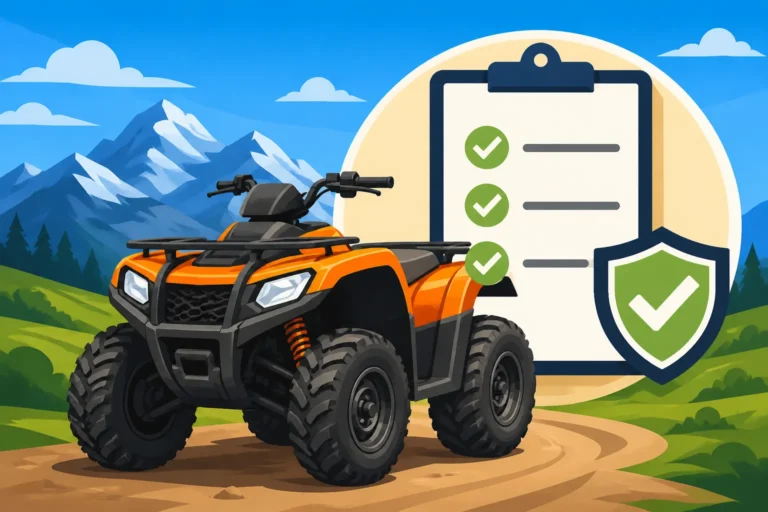
Here's a quick checklist to help you stay organized:
| Area to Inspect | Specifics to Look For | Red Flags |
|---|---|---|
| Frame | Bends, cracks, welds | Significant damage, rust |
| Suspension | Bent A-arms, leaking shocks, play | Worn bushings, poor alignment |
| Tires/Wheels | Tread depth, cracks, dents | Uneven wear, severely bent rims |
| Engine | Leaks, oil condition, air filter | Milky oil, excessive smoke, strange noises |
| Brakes | Pad wear, rotor condition, fluid | Spongy feel, grinding, low fluid |
| Electrical | All lights, gauges, switches | Non-functional components, corroded terminals |
| Drivetrain | CV boots, U-joints, diff leaks | Torn boots, excessive play, grinding |
| VIN | Match paperwork, tampering signs | Mismatched numbers, grind marks |
| Exhaust | Modifications, damage | Loud, aftermarket exhausts (can be illegal in Alberta, see [Why a Modified Muffler Can Cost You a Ticket]) |
The Test Ride: Feeling Out the Machine
If the visual inspection passes muster, it's time for a test ride. This is non-negotiable. Don't buy a machine you haven't ridden, or at least seen ridden by the seller.
- Engine Performance: How does it start? Does it idle smoothly? Does it accelerate without hesitation or unusual noises?
- Transmission: If it's manual, does it shift smoothly through all gears? If automatic, does it engage promptly?
- Braking: Test both front and rear brakes (if applicable). Do they stop the machine effectively and without pulling to one side?
- Steering and Handling: Does it steer straight? Does it feel stable at speed? Are there any wobbles or vibrations?
- Suspension: Does the suspension absorb bumps without bottoming out excessively? Listen for squeaks or clunks.
- Four-Wheel Drive (if applicable): Test engagement of 4WD. Does it work without grinding or binding?
- Reverse: Ensure reverse engages and works properly.
If you're not mechanically inclined, seriously consider taking a knowledgeable friend or even paying a reputable powersports mechanic to accompany you for the inspection. An independent expert eye can spot things you might miss and save you from a costly mistake.
Paperwork and Payment: Sealing the Deal Legally
Congratulations, you've found a machine you love, it passed all your inspections, and you've negotiated a fair price. Now comes the nitty-gritty: making the deal legally binding and ensuring you become the rightful owner. This isn't just a formality; it's your protection.
Crafting a Solid Bill of Sale
A bill of sale is the cornerstone of any private transaction. It's a legal document proving the transfer of ownership from the seller to you. Do NOT rely on a casual handshake or a simple receipt. A good bill of sale should include:
- The full names and addresses of both the buyer and the seller.
- The date of the sale.
- A detailed description of the ATV/UTV, including year, make, model, colour, and most importantly, the VIN.
- The agreed-upon purchase price.
- A statement confirming the machine is being sold "as-is, where-is" (this protects the seller).
- A declaration by the seller that they are the legal owner and have the right to sell the machine, and that it is free of all liens and encumbrances (this protects you).
- Signatures of both buyer and seller, preferably with a witness for each.
You can find templates for a bill of sale online. Resources like LawDepot offer customizable templates specifically for vehicle sales, which can be a real lifesaver for ensuring all the necessary legal language is included. It’s a small investment in peace of mind.
Understanding the Transfer of Ownership Process
Once you have a signed bill of sale, you'll need to register the ATV/UTV in your name. In Alberta, this happens at an Alberta Registry Agent office. You'll need:
- The Bill of Sale: The original, signed document.
- Proof of Identity: Your driver's license or other government-issued ID.
- Proof of Insurance: You'll need to arrange insurance for your OHV before you can register it. Even if you're only riding on private land, if you plan to ever ride on public land, you'll need at least third-party liability coverage. Many people find [Alberta Requires Insurance on Public Land] is a good primer on this.
- The Manufacturer's Statement of Origin (MSO) or previous registration: If it's a brand new machine being sold, the MSO is key. For a used machine, the previous owner's registration certificate might be helpful, but the bill of sale is paramount.
The registry agent will process the transfer, issue you a new registration certificate, and provide you with an OHV license plate if the machine doesn't already have one, or transfer the existing plate into your name. Remember, [Alberta Issues a Plate, Not a Sticker] for OHVs. There will be a fee for the registration. Sometimes, when buying a used machine, the previous owner might not have all the original paperwork. In situations where you're asking [Alberta ATV Registration Without a Bill of Sale], you might need to fill out a statutory declaration or take other steps, which can complicate things, so always aim for a complete bill of sale.
Payment Methods and Security
How you pay the seller is another critical consideration for both your safety and financial security.
- Cash: While convenient, carrying a large sum of cash is risky. If you pay in cash, meet at a bank during business hours where you can withdraw the money and complete the transaction. Get a detailed receipt.
- Bank Draft/Certified Cheque: These are secure forms of payment, guaranteed by the bank. However, always verify the draft/cheque with the issuing bank before releasing the machine or signing over documents. Fraudulent drafts are a real concern. Go to the seller's bank together to complete the transaction if possible.
- Electronic Funds Transfer (EFT) / Interac e-Transfer: For smaller amounts, an e-transfer can work. Just be aware of daily limits. For larger sums, an EFT through your bank offers more security but typically takes longer to process. Ensure the funds have fully cleared your account before you finalize the sale.
Never pay with a personal cheque for a large amount, and avoid payment apps that don't offer buyer protection for high-value items. Always prioritize your safety; if a seller insists on meeting in a secluded location or demands an unusual payment method, consider it a red flag. A secure transaction often happens at a public place, ideally a bank or registry agent's office, during daylight hours. LawDepot can also help you structure the payment terms in your bill of sale, adding an extra layer of clarity.
Post-Purchase Essentials for Alberta Riders
You've got your new-to-you ATV or UTV, the paperwork is signed, and it's officially yours. Congratulations! But your journey isn't quite over. There are a few crucial steps to take before you hit the trails, ensuring you're legal, safe, and ready for adventure.
Registering Your Machine
This is a non-negotiable step if you plan to ride anywhere off your own private property. As discussed earlier, you'll head to an Alberta Registry Agent with your bill of sale, ID, and proof of insurance. They will issue your new registration certificate and plate. Remember, this registration needs to be renewed. You can learn more about renewal options by looking up [Alberta ATV Registration Renewal Online]. It's always a good idea to keep a printed copy of your registration certificate with you when you ride, as [Printing a Certificate Before You Ride] is essential, even if you have a digital version.
Securing Proper Insurance
Even if you're the most careful rider, accidents happen. In Alberta, you are legally required to have at least third-party liability insurance if you operate your OHV on public land. This protects you financially if you cause damage or injury to others. Beyond the legal minimum, comprehensive and collision coverage can protect your investment in the machine itself, covering theft, damage from fire, or an accident. Speak to an insurance broker specializing in powersports vehicles to ensure you have adequate coverage for your specific machine and how you plan to use it. Don't assume your home or auto insurance will cover your OHV – it typically doesn't. Insurance costs can vary greatly depending on the machine, your riding history, and where you live. For more details, explore [Alberta Insurance Requirements on Public Land].
Planning Your First Legal Ride
Now that your machine is registered and insured, you're almost ready to explore Alberta's incredible landscapes. But before you just point and go, take a moment to understand where you can legally ride. Alberta has specific regulations regarding off-highway vehicles, including age restrictions, helmet laws, and designated riding areas. For example, [Alberta Helmet Law on Public Land] requires all riders and passengers to wear a CSA-approved helmet on public land. Many areas are part of Public Land Use Zones (PLUZs), which have their own specific rules and designated trails. Research your intended riding area thoroughly. Services like LawDepot might not directly help with trail maps, but knowing your legal standing as an owner is the first step before you can enjoy the trails. Make sure your machine meets basic equipment requirements too, like having a spark arrestor (see [Does Your Quad Need a Spark Arrestor in Alberta?]).
Taking the time to do your homework and follow these steps will significantly reduce the risks associated with buying from a private seller, allowing you to focus on the joy of riding your new ATV or UTV safely and legally across Alberta.
Disclaimer
This article is for general informational purposes only and does not constitute professional advice. Laws, prices and regulations vary by location and change over time. Consult a qualified professional for guidance on your specific situation.